Tuesday, February 25, 2020

Post #175 - February photo essay

I can't believe I haven't updated the blog for nearly a month, but a mid-month trip to Southern California interrupted my usual every-other week rhythm! I hope everyone weathered the drought, and I'll keep this post short to aid reacquaintance. With January cloud recently - and thankfully - yielding to February sun, I've managed some decent frames these last few weeks. I'll use this post to present four with a bit of commentary accompanying each.

That reminds me - if you're in the Bay Area - I'm presenting for the Bay Area Bird Photographers next Wednesday, March 4 in the Embarcadero Room of the Rinconada Library in Palo Alto from 7:30 - 9:00pm. I'll be showing photos from New Zealand, Colombia, Thailand, and around the US.

Let's start with a departure from my front-lit wheelhouse, a Belted Kingfisher silhouette captured in the Pillar Point Harbor from my inflatable kayak. The rising sun had just overcome the coastal mountains to the east, and an intervening fog bank scattered the horizontal rays to create this luminous backdrop. In the past, I've entirely blacked-out my silhouettes via underexposure - either in-camera or during editing - but I decided to leave a faint suggestion of the bird's white collar in this instance. It's a really small creative decision but lends the subtlest hint of plumage characteristic to the already unmistakable subject. The human eye possesses greater dynamic range than any camera sensor, so we rarely see silhouettes as entirely black anyway.

***Click images for larger, better views***

Belted Kingfisher - Megaceryle alcyon
Canon 600mm f/4 IS II on Canon EOS 1DX Mark II 
1/4000 at f/5, ISO 400

Next is this juvenile Black-crowned Night-Heron which I encountered an hour after the above kingfisher. I'm a sucker for close-cropped and highly-detailed headshots, so I couldn't resist snapping this frame when I floated within twenty feet of this confiding subject. The golden background results from earthen cliffs well-behind the roosting bird, and I knew the greenish lores and orange eye would demand attention against the surrounding brown tones.

Black-crowned Night-Heron (juvenile) - Nycticorax nycticorax
Canon 600mm f/4 IS II + 1.4x TC III on Canon 1DX Mark II 
1/5000 at f/5.6, ISO 800

Some might ask why I shot the above static subject with a lightning-fast 1/5000 shutter. Well, I was primarily set-up to capture flying waterfowl, manual circumstances which facilitated the capture of this Bufflehead shortly after the above encounter. I'd long-wanted a decent flight frame of this skittish species, and this effort represents my best from a dozen individual forays to Pillar Point Harbor over the last two winters. Getting my kayak into position ahead of the inevitable escape is really challenging, but I met with success by driving the birds towards a shoreline and forcing them to flee my craft at a perpendicular angle. Without something to restrict their escape, they fly directly away and make appealing captures impossible. The golden water results from cliff reflections.

Bufflehead (male) - Bucephala albeola
Canon 600mm f/4 IS II + 1.4x TC III on Canon 1DX Mark II 
1/4000 at f/5.6, ISO 640

Last is this little Eared Grebe. I had some time to kill ahead of the last month's Bay Area Bird Photographers meeting, so I swung into the Palo Alto Baylands ahead of that event. I love depicting common and/or drab birds, so I was stoked this individual swam into range and gave me the opportunity to show his winter garb in perfect end-of-day light. This sort of low-angle work is about my favorite sort.

Eared Grebe (winter plumage) - Podiceps nigricollis
Canon 600mm f/4 IS II + 1.4x III TC on Canon EOS 5D Mark IV
1/2500 at f/5.6, ISO 800

OK, that's it for now. I have another crop of photos from my time in Southern California, and I'll be sure to share those in the near future!

Wednesday, January 29, 2020

Post #174 - An epic day of bike-birding in my home San Mateo County!

When Alvaro 'Gull Whisperer' Jaramillo found an adult Slaty-backed Gull - an Asian species which wanders to the lower 48 states in small number each year - in Half Moon Bay on January 14th, he immediately texted me in case I wanted to put my bike into motion to pursue it. I received his alert at 1:15pm, promptly stood from my desk chair, did a bit of stretching and a few unweighed squats, and realized I didn't have the juice to ride for the bird that afternoon. It was a tough concession, but I slated a better-rested chase the following morning.


Slaty-backed Gull range

I left my San Mateo apartment at 7:15am, covered the 15 miles and 1,000 vertical feet over Highway 92, and rolled onto the Venice bluffs at 8:25am where several birders were already assembled. Initial scans of several hundred gulls revealed no Slaty suggestions, but Chris Hayward and Malia DeFelice arrived on bikes and redirected efforts to a lower beach vantage from which they'd observed the bird the previous afternoon. Sifting through a greater number of gulls we couldn't see from the bluff, Chris picked the sought Slaty-backed from the flock. Marginally darker than nearby Western Gulls (none in photo), the streaked head, comparatively smaller beak, and pot-bellied profile helped make the ID.


Slaty-backed Gull - Bay Area bike bird #301 (Digiscope)

The gull handled, I mulled the possibility of continuing south to Pescadero to look for would-be-Bay-Area-bike-birds Red-naped Sapsucker and Prairie Warbler, an ambitious extension which would swell my morning jaunt (30 miles) into a full-day undertaking (68 miles). My legs felt good during my outgoing ascent of Highway 92, and I knew I'd have to survive a return/second climb whether I went directly home or extended south. The decision therefore hung on wind, a quick check of the weather revealing a weak southern flow building through the afternoon. That would be perfect as I'd get an unusual afternoon push as I returned north later in the day. All the variables aligning, I was off to Pescadero.


Perfect riding conditions

Chris and Malia joined me in Pescadero after swapping bikes for a car, and the three of us absorbed Aaron Maizlish as we scoured the roadside thicket the Prairie Warbler had frequented since its discovery ten days earlier. Unable to find that bird and suffering a depressing lack of activity, Chris and I ditched the other two while we explored the creek for the Red-breasted Sapsucker. That bird showed with the minimal effort Chris promised, our Picidae quarry revealing itself after an easy fifteen-minute search.


Red-naped Sapsucker - Bay Area bike bird #302 (Digi-binoc'd)
The red back is a phone artifact.

Activity had increased while Chris and I were dealing the with Sapsucker, and our reunited foursome persevered to achieve distant but diagnostic views of the sought Prairie Warbler (Bay Area bike bird #303). When a closer encounter wasn't afforded after an additional 20 minutes, we ducked into town to try for a continuing Orchard Oriole. Unlike the wary warbler, the obliging oriole materialized for great views just after we arrived.


Orchard Oriole (Digi-binoc'd)

When a final try for better views and photos of the warbler failed, I began the two-and-a-half-hour ride home. The wind didn't aid me as much as I'd hoped, but high clouds kept the sun off me and held temperatures in the mid-50s. My afternoon ascent of Highway 92 was rough, but the day's efforts didn't seem outrageous against some really nice birds!


Map with elevation profile at top right

To summarize

Slaty-backed Gull: Bay Area bike bird #301, San Mateo bike bird #265

Red-naped Sapsucker: Bay Area bike bird #302, San Mateo bike bird #266

Prairie Warbler: Bay Area bike bird #303, San Mateo bike bird #267

Orchard Oriole: San Mateo bike bird #268 (I'd seen one in SF previously)

The kicker? The gull and warbler were new for my CA list, sorry as it is. So yeah, January 14th will go down as an amazing day of bike birding! 

Saturday, January 18, 2020

Post #173 - My Bay Area bike list reaches 300 species!

Happy 2020! Glad you've returned for another year of The Speckled Hatchback, the blog's fifth! I'm sorry for the month since my last post, but I should be back on track after returning from Thailand, a wonderful country and fantastic birding destination which I will feature in future posts. For now, I'll stick to the Bay Area, but only after I mention three quick asides.

1) I have put together a gallery of my favorite photos from 2019 to match those from previous years. This years's collection features shots from CA, NY, AL, New Zealand, Colombia, and Thailand. Here's a preview....


Blue Pitta from Thailand
Canon 600mm f/4 IS II on EOS 1DX Mark II
1/100 at f/5, ISO 3200, tripod

2) I would like to shine attention on John Patten Moss, the entertaining Georgia twenty-something who has recently embarked upon his unicycle Big Year from Washington State. His plan is super ambitious, and I encourage you to have a look his blog, updated weekly. I will post more about his CA route as he approaches The Golden State, and I am sure John would appreciate housing offers from those who can manage it. I'm hoping to intersect him at some point, and I'll be sure to offer a write-up of that anticipated rendezvous when it happens.

Photo from this article

3) If you're mapping out your birding year, be advised there is still space on the Colombia birding extravaganza I'm running for Alvaro's Adventures. It will run June 20 to July 2, and - with two additional days this year - we should exceed the 375 species we found last year.


Colombia has tanagers, antpittas, and hummingbirds galore!

OK, on with the bike-birding show! As I finished 2019 with 299 species on my Bay Area bike list, I was curious to see what yet-unobserved species would surface as 2020 arrived. I missed some potentials while I was in Thailand - notably Scarlet Tanager at the SF Zoo - but Ken Moy's discovery of a usually-more-eastern Rose-breasted Grosbeak at the Botanical Gardens in Golden Gate Park on January 6th lent intrigue just as I returned. Exhaustion and responsibility prevented me from pursuing the bird immediately, but it stuck around until the 11th when I observed it in the same fruiting tree it had frequented for the previous six days. Though unable to obtain a photo during my brief encounter, I was hella stoked to achieve 300 species after pedaling nearly 5,000 bird-motivated miles since moving to the Bay Area in May of 2017. Granted, an amassed list of 300 birds isn't good for much, but it's been a ton of healthy fun exploring the Bay Area as I inched towards that plateau. I'm encouraged to explore more and farther afield, and I'm excited to discover what additional species will surface along the way!


My grosbeak pursuit. I also added Wrentit
 in the Presidio for SF bike bird #191.

This seems the perfect occasion to remind everyone of the achievements of some other notable California bike-birders. Most impressive are Mark Kudrav and Jim Royer who've each observed 300+ bike-based species in California a single year, Jim with 318 in 2010 and Mark with 326 in 2013. Their's was remarkable dedication, and I am in awe of the efforts they put forth during their respective campaigns. They and folks like Josiah Clark, Rob Furrow, and Chris O'Connell are California bike-birding pioneers, and we are fortunate their examples have inspired so many, me included. I am particularly excited by the number of Bay Area birders who have more recently taken up the bicycle. I regularly intersect burgeoning bike-birder Joshua Stacey, and Chris Hayward and Malia DeFelice increasingly patrol the Half Moon Bay beachfront from rolling perches. Most exciting is seeing the younger generation of Oscar Moss and Jonah Benningfield wheeling around!


Jonah and Oscar exploring SF

All of this is to say that California - and specifically the Bay Area - feels the nation's bike-birding capital at this moment. Climate, topography, bicycle infrastructure, and species diversity certainly encourage the pursuit, but it's ultimately up to adventurous individuals to seize on those facilitating circumstances. Bike-birders are still a small group, but I hope our ranks will continue to swell through 2020. It'll be great when John Patten Moss wheels through our state, so hopefully we can give him the welcome he deserves when he arrives! I'll try to keep everyone posted as that day approaches. Cheers!

Wednesday, December 18, 2019

Post #172 - 2019 Santa Clara Evening Grosbeak and 2019 bike-birding summary

I'm off for 16 days in Thailand tomorrow, but here's a quick and final post to close out 2019. I didn't do much bike-birding in the first third of the year, but a renewed commitment through the remainder yielded lots of birds and adventures, most of which I've chronicled in previous entries. I'd hoped to run my cumulative Bay Area Bike List to 300 species this year, but I fell just one short, the long-staying Evening Grosbeaks at Stanford checking-in at #299 on, December 12th. This winter is a mini-invasion for Evening Grosbeak, the usually more-alpine/coniferous finch making sporadic appearances around the Bay Area through November and December after after a several-year absence.

Evening Grosbeak Range (L) and Bay Area sightings 2015-2019 (R)
More info on Evening Grosbeak here.

Stanford Evening Grosbeak

Evening Grosbeak pursuit

With all the twists and turns, I churned out 2,086 miles of bike-birding in 2019, a total exceeding the 2,002 I logged last year. I spent comparatively less time in my home San Mateo County and correspondingly more exploring neighboring counties. Most notable were my first three trips over the Golden Gate to Marin (one in successful pursuit of Yellow-crowned Night-Heron and two failed in pursuit of Tricolored Heron) and a long, roundabout foray into Alameda to tick Bar-tailed Godwit. Incidentally, I chased only one bird by car in 2019 - Yellow-browed Warbler in the Sierras - and missed. At least I reconnected with loads of old friends in the bird's absence..... 

Bird added to my Bay Area Bike List in 2019

As I am now fully entrenched in the county listing game, here's a glance of where I stand to begin 2020. The 25-mile radius doesn't mean much - because riding distances aren't linear - but does give some sense of scale. Going north, it's 16 riding miles from home to the southern end of San Francisco and 28 to reach Marin via the Golden Gate. Going South/east, it's 16 riding miles to reach Santa Clara at the Palo Alto Baylands (and 30 to Alviso) and ~22 to across the Dumbarton Bridge to reach Alameda at Coyote Hills. 


Looking forward to 2020, I have several more ambitious overnight rides I'd like to execute.

1) A 3-day, 2-night loop going north into Marin (Feb 6), over the newly-opened bike lane on the Richmond-San Rafael Bridge into Contra Costa County (Feb 7), and continuing to Arrowhead Marsh (Feb 8) for Nelson's Sparrow on the 11am high tide. That will leave me the afternoon of the 8th to continue south over the Dumbarton and back up the western shore of SF Bay to San Mateo. With ticks accumulated across Marin, Contra Costa (where everything will be new), and Alameda Counties, I should approach 1,000 county total.


2) A 4-day, 3-night out-and-back featuring Mines Road (Santa Clara) and Del Puerto Canyon Road (Stanislaus) for inland species including Swainson's Hawk, Greater Roadrunner, Costa's Hummingbird, Canyon Wren, Bell's Sparrow, Phainopepla, Lawrence's Goldfinch, Blue Grosbeak, and perhaps Common Poorwill. I'd go ~50 miles to Livermore on Day 1 and ~60 to Patterson on Day 2. That would let me do Mines Road in the AM and Del Puerto in the PM. I'd retrace those track on Day 3 and 4 to clean up whatever species I missed. I'd probably do this in early-May once all the birds are on territory. 


3) A two-day run down the San Mateo Coast to Año Nuevo to get Black Swift. I could also nibble on the northwestern edge of Santa Cruz County before returning to the Pigeon Point Hostel for the night. 


4) I'd also love to do a bigger loop around the North Bay to get into Sonoma, Napa, Solano, Sacramento, and San Joaquin Counties, but I can only dedicate so many days to this nonsense, right?

OK, enough. I will have a full photo recap coming, but that will have to wait until I return from Thailand. I thank readers for slogging through another year of what is mostly an on-line diary; I hope it provides at least a short refuge from the daily noise we are forced to endure at this least-inspired moment in American history. 

Monday, December 9, 2019

Post #171 - Bay Area bike birding - Tricolored Heron and Plumbeous Vireo

With my Bay Area bike list sitting 3 species shy of 300, I was stoked to learn about William Legge's discovery of a Tricolored Heron at Rodeo Lagoon in Marin County on November 10. There are only 3-4 eBird records from Northern California, the most recent from Point Reyes in 1996, so the regionally-rare bird would be a fantastic addition to my self-powered collection. There was, however, a major barrier to any pursuit.

(L) Tricolored Heron range adapted from this Cornell website
(R) California sightings adapted from eBird 

Knowing I'd be at the Rio Grande Valley Birding Festival from November 5-10 and visiting my family in Philadelphia from November 14-19, I'd surrendered my painfully-neglected bicycle for major repairs before I left for Texas (on the 4th) on the understanding the overhaul would be complete by the time I returned from Philly (on the 19th). Though conceding the three usable days between the trips (11th, 12th, 13th) seemed a pittance against the guarantee of losing the bike for two solid weeks at a later time, the vagrant heron gave me the big fat middle finger by staying at Rodeo through those days. Adding insult to injury was the continued presence of Kevin Gin's coincidently-discovered Plumbeous Vireo in Santa Clara County. Like the Tricolored, the would-be-new-Bay-Area-bike-Plumbeous would need to stay until the 20th for me to have a crack at it. Needless to say, I was not optimistic about my chances to add either bird as I boarded my flight to Philly on the 14th.


(L) Tricolored Heron range adapted from this Cornell website
(R) California sightings adapted from eBird 

I monitored online reports of both vagrants from Philadelphia. Sightings of the Plumbeous ceased after the 17th, but those of the Tricolored continued through my travel day on the 19th, circumstances suggesting I prioritize that bird at my first chase opportunity on the 20th. Because I am a total dork, I also kept tabs on the San Francisco Red-footed Booby (November 8th, Peter Winch). That bird was also present through the 19th, so I swung through the city to tick it before continuing over the Golden Gate and into Marin for the heron. Red-footed Booby was not a Bay Area bike bird because I saw the Half Moon Bay individual in November 2017, but it was an SF County bike bird (#188).

Great day for a ride

Digiscoped Red-Footed Booby on Coast Guard Pier, SF

Once at over the bridge, I descended to Rodeo Lagoon where the heron materialized right on schedule!


Sadly, we all know people who've tried to pass photos of one individual bird as another, but I'm not gonna play you like that. This photo was taken on November 9th in Texas, my time at Rodeo on the 20th yielding no whiff of the Tricolored despite its presence for the previous ten days. It was a painful miss, but I was due for disappointment after a very lucky fall. At least I found a use for this otherwise random photo. The low angle in the above shot should be a dead giveaway its not from the Bay Area; its virtually impossible to get into the water/habitat around here to take good pictures of waders. 

BUT WAIT! THERE'S MORE! Though the Tricolored wasn't reported on the 20th, 21st, or 22nd, two independent reports on the 23rd prompted a second attempt on the 24th. And you know what? I missed it on that day too. I'd like to say I wouldn't bother chasing this bird again if it resurfaced, but I know I'd have a hard time ignoring it. I don't rarely chronicle misses - fortunately there haven't been that many - but I thought this instance absurd enough to mention. All this bike-birding nonsense keeps me in shape if nothing else. 

(L) Route on November 20th
(R) Route on November 24th

OK, but what about the Plumbeous? Well, that bird kinda fell of my radar in the wake of the time and energy I'd invested into the missed Tricolored, but a renewed spate of sightings between November 28 and December 4th prompted a much-delayed attempt at the long-staying bird on December 5th. I intersected the singing bird after an hour search, it offering great views foraged at eye-level in the parking lot adjacent to the area it had frequented for the previous 3 weeks.


Plumbeous Vireo - Bay Area bike bird #298

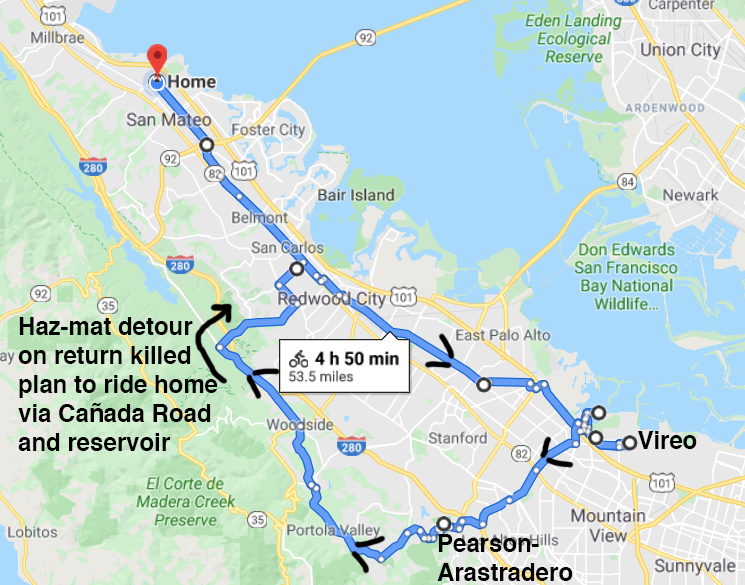
And because I'm now full-blown county lister - albeit with very limited self-powered reach - I detoured into the foothills and Pearson-Arastradero on my return to add a few more Santa Clara species, Ring-necked Duck, Hooded Merganser, and Purple Finch among them. Santa Clara bike list now at 184.


That's it for now. I'm hoping to crank out one more post before I leave for Thailand on the 18th, so please stay tuned for that. Enjoy the start of CBC season in the meantime!

Wednesday, November 27, 2019

Post #170 - Photos of the San Francisco Rock Sandpiper. What is 'Image Design?'

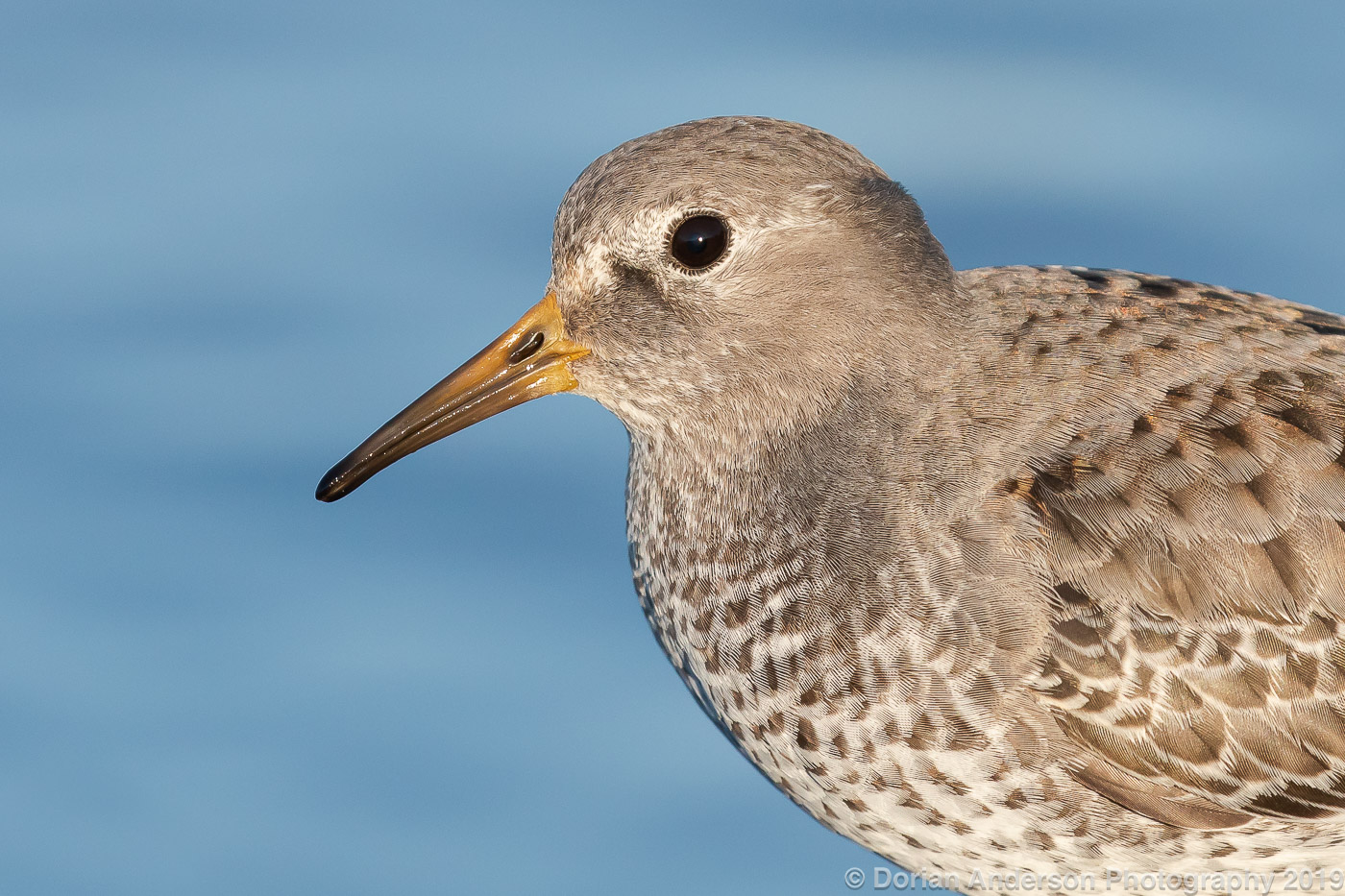
I've always held shorebirds in high photographic regard (my collection here), but Rock Sandpiper, a North Pacific example, eluded my lens until this past week. A long-staying representative at Heron's Head in San Francisco glued to the terminus of the park's rocky peninsula for the past three weeks - the same individual I observed by bike on November 3rd and wrote about in my last entry - I decided a second, photographically-motivated visit in order. The bird was very tolerant of birding hoards earlier in the month, so I was optimistic I'd be able to capture some nice shots of the lingering rarity.

I had the end of the peninsula to myself when I arrived at 3pm on November 23rd, a brief search revealing the bird five feet from where I observed it during my first visit. I busted out my 600mm lens and began a leisurely game of cat-and-mouse with the subject sandpiper. It was as approachable as I'd hoped, and my lens quickly proved too much for a bird willing to wander with five feet of me. I swapped in my 100-400mm, that closer-focusing and more-maneuverable option proving a much better choice.

***click images for larger, more detailed views***

Rock Sandpiper - Calidris ptilocnemis
Canon 100-400mm f/4.5-5.6 IS II on EOS 5D Mark IV
1/1000 at f/7.1, ISO 1000

Obtaining a clean composition between rocks and shadows was challenging, but my patient, hour-long interaction yielded a couple choice opportunities. I avoided shooting the bird on the intermingled chunks of concrete because I don't want man-made objects contaminating my frames, and I thought the above example afforded and an accurate and attractive picture of the bird in its natural habitat. Importantly, I can see the bird's legs and feet amidst the seaweed, a critical consideration for my shorebird frames. I chose to use f/7.1 (versus wide-open and fastest f/5.6) to achieve a bit more depth-of-field across the seaweed. I didn't want to close down more - to f/8 or f/9 - because that would have compromised my ability to generate a smooth background, the water only a few feet behind the subject.

Rock Sandpiper - Calidris ptilocnemis
Canon 100-400mm f/4.5-5.6 IS II on EOS 5D Mark IV
1/1600 at f/7.1, ISO 1000

For this headshot, I crouched lower to shoot against more distant water; hence the more blurred background. I selected f/7.1 for this shot as well, but for different reasons than the first. In the full-body example, I wanted more depth-of-focus across the seaweed while in this I wanted more depth-of-focus across the bird, the focal plane compressing at this comparatively closer range. It would have been difficult/impossible to achieve critical feather detail on both the face and flank had I used a wider/faster aperture with less DoF.

With the two frames taken just moments apart and under identical lighting conditions, why did I use different shutter speeds at the same f/-stop and ISO? The exposure on the bird should be the same, right? Yes, but I selected the slower shutter (1/1000 versus 1/1600) in the first to get more detail on the comparatively darker seaweed. I could have raised the shadow/darks in the first in post-production had I used 1/1600, but that would have added noise to the lower half of the frame. Adding the extra light to get more detail on the seaweed meant I had to turn down the highlights on the comparatively lighter bird instead, but that is very easy to do in Lightroom and generally comes with little penalty in image quality (assuming the lights aren't completely saturated to start).

OK, enough. The point of all this is to take you through my thought process and highlight the importance of 'image design'. Good photographs don't just happen; they almost always result from creative conception, proper planning, and excellent execution. Having decent gear helps, but no camera is going yield a beautiful, high-contrast, color-saturated images in overhead sunlight, right? For this shoot, rubber boots and crappy pants were probably my most important gear! Proper photography, like hardcore birding, is a commitment!

OK, that's it for now. Hopefully it wasn't technical overload. Happy Thanksgiving either way.....

Wednesday, November 13, 2019

Post #169 - An incredible 24 hours of bike-birding!

The weekend of November 2nd and 3rd was epic bike-birding, my wheels put into eventual motion by the discovery of a Yellow-crowned Night-Heron (YCNH) on the Sausalito waterfront in Marin County on Monday, October 28. As the species hadn't been reported in the Bay Area during my two-and-a-half-year San Mateo tenure, I immediately consulted eBird for context, my investigation revealing only four records from the extended Bay Area and none since 2005. To put that into paucity into perspective, there are multiple Bay Area records of White Wagtail and Dusky Warbler since the last YCNH sighting.

(L) YCNH range map adapted from this Cornell Lab page
(R) Bay Area YCNH sightings extracted from eBird

I didn't have time for the 65-mile round-trip YCNH chase during the week, but I watched eBird reports roll-in through the next few days, one noting, "residents say the bird has been here for years." That remark floating my hopes until Saturday, I set off at 1pm after leading a morning bird walk at Coyote Point. Lodging secured in Mill Valley, I'd have Saturday afternoon and most of Sunday to find the bird. The ride would be my first bike trip across the Golden Gate, so I'd enjoy initiating the Marin arm of my Bay Area bike list with or without inclusion of the sought YCNH. I'm going to place quick pause on YCNH for a second........

While my YCNH plans were crystalizing through the week, Richard Bradus found a Black-and-white Warbler (BAWW) in Alta Plaza in downtown San Francisco on Thursday, October 31. A follow-up  report on Friday suggested I swing through the park en route to Marin and the YCNH on Saturday, a decision rewarded when the high-contrast passerine revealed itself without ten minutes of delay. Like Chestnut-sided Warbler from the last post, BAWW is a common stray from the Eastern US, one I hadn't chased previously but knew I'd intersect eventually.

(L) BAWW range map adapted from this Cornell Lab page
(R) Bay Area BAWW sightings extracted from eBird

Digi-binoc'd Black-and-white Warbler - Bay Area bike Bird #295

The bonus BAWW ticked, I rolled through the Presidio and across the Golden Gate Bridge. This was only my second time biking across the famous span, the first occurring on the San Francisco leg of my 2014 bicycle Big Year. Like that first crossing, my second was graced with blue skies and killer views!


Touching down in Marin, I descended through Fort Baker, dodged tourists through Sausalito, and rolled into the waterfront community the YCNH had frequented since its discovery - and possibly longer if the quoted resident is correct. I hadn't dismounted my bike before spotting the heron standing on porch railing, the bird basking in the afternoon sun for the next half hour. I was joined by some other folks, and we enjoyed point blank views after the bird flew over the shoreline we occupied. After watching a ~10 year old girl walk with six feet of the bird, I totally buy the claim the bird has been around for a while. It literally couldn't care less about people. It's crazy to think this amazing bird lurked unreported (though not entirely undetected) for so long. It will be interesting to see how long it sticks around. Departing the heron, I spent the remaining 1.5 daylight hours exploring the Sausalito Shoreline, Bothin Marsh, and Bayfront Park before retiring to Mill Valley for the evening.

Yellow-crowned Night-Heron - Bay Area bike bird #296
Very obliging for digi-scoping....

My plan for Sunday was to explore Tennessee Valley, Rodeo Lagoon, and the Marin Headlands before re-crossing the Golden Gate in the early afternoon, but a late-Saturday report of Rock Sandpiper (ROSA, found by Teresa Ely and Ben Dudek, 1st SF record) from Heron's Head Park in San Francisco demanded attention. A mostly-Alaskan species, ROSA reaches down the coasts of British Colombia, Washington, Oregon, and California in winter. The Bay Area represents the extreme southern end of that non-breeding range, and the species had not been recorded in the area since I moved here in May of 2017 (there was one Farallon bird in that time - and another last week).

(L) ROSA range map adapted from this Cornell Lab page
(R) Bay Area sightings (all) extracted from eBird

I decided I'd bird in Marin Sunday morning while I awaited news of the ROSA - I didn't want to quit Marin without knowing the sandpiper was present - but an early 6:30am confirmation sent me scampering towards the Golden Gate right at sunrise. Reaching the bridge at 7:10, I was informed both Golden Gate foot/bike paths would be closed until 10am because of a running race. As I was unwilling to utilize the courtesy bike shuttle to cross the bridge - gotta keep it 100% self-powered - I suddenly found myself with three hours to kill on the Marin side. Dropping to Rodeo Lagoon, I enjoyed beautiful and productive coastal birding while I awaited the 10am opening, all the while hoping the ROSA stayed put.

Rodeo Lagoon

Rodeo Beach

With my time at Rodeo, I was able to run my virgin Marin County bike list to 81 species. (I saw ~140 on a Marin County bike Big Day with Josiah Clark and others in April, but I had to drive from San Mateo for that event, a circumstance rendering those birds excluded from my fully-green Bay Area biking project.)

The bridge finally opened, I fought through traffic lights and fended-off weekend drivers to reach Heron's Head at 11am. There wasn't much drama, the ROSA sleeping at peninsula's terminus as half-a-dozen birders gazed onto it. This was only my second encounter with the species, my first on the Humboldt Jetty in January 2011, and it was fun to observe this individual at such close range. The bird spend most of its time resting, but I had a few quick full body views as waves occasionally forced the bird to reposition itself. The close views were a great cap on an awesome weekend on the bicycle.

The end of Heron's Head Park. Bird was on
shoreline directly over my handlebars.

Rock Sandpiper - Bay Area bike bird #297

So, a ride conceived around (a potentially very long-staying) Yellow-crowned Night Heron additionally yielded Black-and-white Warbler and Rock Sandpiper. A pretty solid hat trick.....

~80 miles with doubling back and screwing around

Those birds leave me three species shy of 300. Upcoming travel will probably delay reaching that plateau into the New Year, but it will be a great feeling when it does finally happen. I'm amazed I've been able to find (and by find I mean 'chase') enough new birds to generate blog content through the summer and fall. I'll have to get more creative as new birds become fewer and farther between. Cheers!