Monday, October 19, 2020

Post #184 - Solano County Photography

With international travel shut down and domestic travel dissuaded in the COVID age, I've explored more of the Bay Area in 2020 than in previous years. Much of my wandering has been on my bike, but I have ventured farther afield in the car. I'd not, for example, birded in Solano County prior to March, and I've had fun exploring that southern end of that area in the intervening months. Lagoon Valley outside Vacaville has proven particularly productive (eBird hotspot), and I'm going to use this post to share a few photos I recently captured at the park. It's worth noting Lagoon Valley barely escaped the gigantic LNU Fire which roared through nearby Vacaville in August; the fire approached the park on two sides but ultimately spared it. 


When I visited Lagoon Valley for the first time, on April 26th, the central lake was full of water and hosted a nice variety of waterfowl. It offered excellent birding but didn't strike me that it would be particularly good for photography (or at least no better than spots closer to home). Fast forward to September 8th; I returned to the park to find the lake almost empty, a giant mud puddle all that remained. A variety of shorebirds patrolled the shoreline, and I kicked myself for bringing the dog and leaving the camera. Birding with him isn't an issue, but I cannot do proper photography with him in tow. 

The evaporated lake at Lagoon Valley.
The backing hillsides were incinerated by the LNU fire.

I thought the evaporated lakebed had so much photographic potential that I returned the following day, with camera and without Beagle. I always try to arrive at a shoot before sunrise because it allows me to ready my gear, survey the situation, and get into position ahead of the best light. Among Killdeer, Black-necked Stilts, Greater Yellowlegs, Long-billed Dowitchers, and Least Sandpipers, I decided to focus on a group of five Pectoral Sandpipers. It took a bit of cat and mouse, but my crawling earned the quintet's trust through the next 90 minutes. 

I was shooting straight west -- as is best in the early morning -- and some thin forest fire smoke filtered the sun behind me to the east. Besides evening out the exposure and helping to preserved detail in the lightest parts of the subject, the smoke imparted the surroundings with some really unique colors.

Pectoral Sandpiper - Calidris melanotos
Canon 600mm f/4 IS II + 1.4x III on EOS 1DX2
1/2000 at f/5.6, ISO 1600

Without much action/behavior to motivate this next shot, I went with a wide crop to emphasize the pastel surroundings. I think the composition imparts the frame with a pensive feel, the bird pausing to contemplate his next move as I captured him. I love these small-in-frame-type images where I can use the camera to 'paint' the surroundings.

Pectoral Sandpiper - Calidris melanotos
Canon 600mm f/4 IS II + 1.4x III on EOS 1DX2
1/1600 at f/5.6, ISO 1600

I wish I could see at least one foot in the next shot. The problem was that the birds wouldn't give me eye contact while they were feeding, so I had to settle for a static frame where the feet were obscured by mud. Without eye contact, the frame goes in the trash!

Pectoral Sandpiper - Calidris melanotos
Canon 600mm f/4 IS II + 1.4x III on EOS 1DX2
1/1600 at f/7.1, ISO 1600

While I was pursuing the Pecs, this guy cruised through in the background. Thankfully, I was able to reposition for a clear shot! These lighting conditions were unlike anything I'd previously experienced.

Great Egret - Ardea alba
Canon 600mm f/4 IS II + 1.4x III on EOS 1DX2
1/2500 at f/5.6, ISO 800

The adult Black-necked Stilts were very wary of me, but this juvenile was willing to come pretty close to me. I didn't notice the flies until I returned home and put the images into the computer - bonus!

Black-necked Stilt - Himantopus mexicanus
Canon 600mm f/4 IS II + 1.4x III on EOS 1DX2
1/2000 at f/5.6, ISO 1000

I did notice the flies in this last shot and did everything I could to get maximize their presence in the frame. I had to crawl into some hella nasty stuff, but I think I came out with a really unique shot.

Black-necked Stilt - Himantopus mexicanus
Canon 600mm f/4 IS II + 1.4x III on EOS 1DX2
1/2000 at f/5.6, ISO 800

So yeah, this was a really productive morning of photography. I'm usually hoping to get one keeper frame per outing, so I was stoked to get these five and a few others. I'm hoping to make it back to Lagoon Valley sometime this fall. I'd particularly like to capture some Long-billed Dowitchers as that species is a weak spot in my shorebird collection at the moment.

The best part of Lagoon Valley?  There's a hose in the parking lot! I got some funny looks as I stripped down to my boxers and cleaned up, but it was totally worth it given these frames. Thanks to the kind soul who snapped this 'before' pic.....

Mud didn't smell as bad as it 
looked. Nice and cool though....

Saturday, October 10, 2020

Post #183 - Fall Bay Area Bike-birding Update

Damn, my recent blogging has been shameful! I apologize for the lack of content, and I hope at least a few readers can forgive my extended neglect. I'm going to try to rekindle the blog as shorter days approach, so hopefully some will find refuge in my silly posts these next few months. They're going to be interesting, to say the least..... 

I wrote in June that I'd established a torrid bike-birding pace through the first half of this year, and I've continued that momentum through to fall. To date, I've amassed 2,251 miles, the equivalent to driving from San Francisco to Indianapolis. I biked 2,086 miles in 2019 and 2,001 in 2018, so this year represents a significant increase. Stoked cuz though miles allow me more pizza, donuts, and ice cream.

2,251 miles from San Francisco to Indianapolis

My cumulative Bay Area Bike List is an ongoing project (obsession?), so I'll use this eBird snap to show the last five birds I've added. I'll say about a few words about the circumstances of each below.


#317 Northern Parula, Fort Mason, San Francisco County, June 30th
Northern Parula (NOPA) was not the bird I set out to find on this day. I was initially pursuing Sooty Shearwater (SOSH) and American White Pelican (AWPE) for the San Francisco County subset of my bike list, but this bird was reported at Fort Mason while I was birding at Chrissy Field, just two miles away. Folding my failed pelican search, I powered towards the parula and found it without much effort. Sadly, the bird was too fast for my lackluster digi-binoc skills.

Incidentally, I had Sooty Shearwater on my regular (i.e. petroleum powered) SF list from Alvaro's Adventures pelagic trips, so I was trying redeem that "dirty" bird. I failed on JUne 30th but succeeded a few weeks later, on August 13. I finally got the pelican on September 24, after 3 misses.

My ride Northern Parula (NOPA) on June 30th
Red = missed, Green = Found

#318 Sabine's Gull, Sunnyvale Water Treatment Plant, Santa Clara County, September 9
This bird was present for two days before I had the time to pursue it on the third. There were 4 other would-be Santa Clara bike birds in the same area, so this outing had tons of potential. My ride unfolded under apocalyptic conditions, forest fires smoke blanketing the Bay Area, but I wasn't affected because most of the soot and ash stayed in the upper atmosphere. Despite the conditions, I found all 5 of my targets: Sabine's Gull, Brandt's Cormorant, Yellow-headed Blackbird, Vaux's Swift, and Bank Swallow. The kicker? I also found a Purple Martin on the ride home to give me 6 county Santa Clara bike birds on one 54-mile swing. Talk about efficiency!

Sabine's Gull (left) and 2 Brandt's Cormorants (right, together)

Birding the apocalypse

My ride for Sabine's Gull (and Santa Clara others) on September 9th

#319 Lark Bunting, Pier 94, San Francisco County, September 14
This bird was found in the morning, but I couldn't chase it until later in the afternoon. It was a quick sprint once I departed, and the bird showed within 10 minutes of my arrival. I swung through Yosemite Slough to look for Pectoral Sandpiper (PESA, map) on the way home, but that was not to be. 70 minutes up, 80 minutes home with the extra stop - easy! Interestingly, another LABU showed at my Coyote Point patch two days later, so that was a nice San Mateo addition in the wake of the SF individual. I wasn't able to get a photo of the SF bird, so here's a digi-binoc of the Coyote Point bird.

Lark Bunting

My September 14 ride for Lark Bunting

#320 Sage Thrasher (Sept 30) and #321 Brewer's Sparrow (Oct 5), Coyote Point Park, San Mateo County
Both of these birds were found in the course of general birding at my Coyote Point Patch. The thrasher was a particular surprise because the bird wasn't remotely on my radar given how infrequently it visits the Bay Area. I was just scanning bushes when the bird appeared in my view, and I nearly fell off my bike when I realized what it was. One other birder who I didn't recognize arrived 30 mins after I posted, but the bird didn't stick overnight. Crushed it with the digi-scope on the first day though!

Sage Thrasher from Coyote Point

A week later, the Brewer's Sparrow materialized from a flock which included its White-crowned, Golden-crowned, Lincoln's, Song, and Clay-colored relatives. The bird wouldn't allow close approach, but I was able to grab a couple of crappy digi-bin shots from a distance. Others had been reporting the Brewer's to eBird before I observed it - albeit without my knowledge - so I can't claim to have found this bird. Regardless, it was pretty exciting in the moment. This was a bird I knew I'd get at some point, so it was nice to intersect it so close to home.

Digi-binoc record of Brewer's Sparrow at Coyote Point

Coyote Point convenience. This is my usual route. Takes 60-90 mins most days.

That's it for this installment! I notched an additional bird (#322) in the two days it took me to put this together, but I'll hang onto that story for another post. 

Stay safe out there.....

Monday, August 3, 2020

Post #182 - Early Summer Photography - Landbirds for a change!

Damn, this blog is on life-support right now! It's been five weeks since my last entry, and I'll confess I've had a really hard time blogging in 2020. Some of my block can be blamed on COVID-related distraction, but I'm also burned out on writing. I'm still grinding away on my book about my 2014 bicycle Big Year, and the project has consumed more than twice years I'd imagined. Without giving too much away, the book is not the traditional Big Year account of the places I visited and the birds I saw; I'm more using my bird-motivated bicycle journey - itself totally unique in the Big Year landscape - to examine my decisions, insecurities, and mistakes ahead of my adventure. So, while most Big Year authors chronicle one year, I'm treating 35! The process has been an incredible emotional drain, but I'm confident my examination will yield an engaging, inspirational, and entertaining story when it's finally done. 

With that as a preface, I'll offer a few photos with some words about each. That's about all the additional writing I can handle at this moment!

Let's start with this Grasshopper Sparrow. Most shots of this species feature brown and tan backgrounds because the bird prefers arid grasslands, so I was really happy to capture something different here, the darker background resulting from a distant coniferous hillside as I shot over the crest of a ridge.

Grasshopper Sparrow - Ammodramus savannarum
Canon 600mm f/4 IS II + 1.4x TC III on EOS 5D Mark IV
1/3200 at f/5.6, ISO 640

Here is another shot of the same bird with a more traditional background. This is a super heavy crop - it represents less than 10% of the original frame - but I think the detail held up well. It's sometimes difficult to appreciate subtle plumage characteristics in the field, like the thin rufous streaks on the nape, so it's really satisfying to capture a photo which reveals otherwise overlooked details. Doubtful I'll ever encounter such a cooperative individual again! 

Grasshopper Sparrow - Ammodramus savannarum
Canon 600mm f/4 IS II + 1.4x TC III on EOS 5D Mark IV
1/2500 at f/7.1, ISO 1000

OK, let's switch gears to this Wrentit. This shy bird likes tangled underbrush, so I was shocked when this representative assumed this exposed perched when tempted with a few cycles of playback. I see/hear this bird on many of my birding outings, but this represents my first keeper frame of the species. The sun was a bit higher than ideal, but shooting down the hillside helped minimize late-morning shadows on the subject's chest.

Wrentit - Chamaea fasciata
Canon 600mm f/4 IS II + 1.4x III on EOS 5D Mark IV
1/1600 at f/5.6, ISO 800

This next shot is an Ash-throated Flycatcher I captured just before the Wrentit. This bird was standing on a metal post, so I decided to go with a tight headshot to keep the man-made object out of the frame. This represented another new species for my photo collection. I see these all the time, just not in photogenic proximity like this one!

Ash-throated Flycatcher - Myiarchus cinerascens
Canon 600mm f/4 IS + 1.4x III on EOS 5D Mark IV
1/1000 at f/8, ISO 800

Ok, just two more. I like to shoot birds at eye level because it maximizes eye contact, but I raised my lens a bit to capture this Spotted Towhee. He would have ideally been 18 inches lower, but I couldn't pass on the full song and beautiful view of the rufous flanks. No wonder this birds used to be lumped with Eastern Towhee as Rufous-sided Towhee. Closing down to f/9 enabled me to keep the entire bird in focus.

Spotted Towhee - Pipilo maculatus
Canon 600mm f/4 IS II on EOS 5D Mark IV
1/2000 at f/9, ISO 1000

Lastly, here is the male Anna's Hummingbird which lives in the bayshore park behind my house. He's present almost every time I visit, usually on the same perch, but it took me forever to make the effort to photograph him because I can't carry binoculars, scope, and camera on my bike when I visit. Leaving the scope and binoculars at home on this day, I was able to get super close to him for this shot. The smooth background was generated by standing on a high rock and shooting across SF Bay. Like the towhee, closing down to f/10 at close range helped keep the whole bird in focus.

Anna's Hummingbird - Calypte anna
Canon 400mm f/4 IS DO II + 2x TC III on EOS 1DX Mark II
1/1250 at f/10, ISO 1600

OK, that's it for now. I'll try to crank out more content this month to make up for the recent lack. Cheers!

Tuesday, June 30, 2020

Post #181 - Bay Area bike-birding in the age of COVID - 1,000 county ticks achieved!

Though we've been in the firm grip of COVID for nearly 4 months, I've been doing a ton of bike-birding across that span. How much is a ton? Well, in 2019, I biked 2,086 miles. To the midpoint of this year, I've already covered 1,661 miles, an increase which is counterintuitively attributable to COVID for two reasons.

First, COVID has forced parking areas closures at many reserves to prevent overcrowding. While I don't usually drive to bird in the Bay Area, I always drive to photograph because I'm not going to lug my 600mm f/4 lens and multiple camera bodies on my bike. I also like to arrive hella early for photography, so I'm not going to start biking at 3am to be at Hayward Regional Shoreline for a 6am sunrise. With access restricted, I've been doing less photography and more biking. 

1,661 miles is equal to driving Tucson > SD > Seattle

Second, I've cancelled several out-of-state trips and tours which has freed up time for bike-birding, most notably a 5-day loop which took me east through Alameda to explore Stanislaus, San Joaquin, and Contra Costa Counties for the first time (at least by bike). By the time I added some unmapped miles to the rough route below, I cranked out 290 miles across those days and added 5 birds to my Bay Area bike list: Ring-necked Pheasant, Phainopepla, Lawrence's Goldfinch, Bell's Sparrow, and Swainson's Hawk. With the additions of Hooded Warbler (SF), Yellow-throated Warbler (SF), Purple Martin (SM), and Black-chinned Sparrow (SM) closer to home, I've run that list to 316 species.

My 5-day, 290-mile inland loop

Mines Road in Alameda County

(L) Lawrence's Goldfinch on Mines Road in Santa Clara County
(R) Hooded Warbler at San Pedro Valley Park in San Mateo

When I moved to the Bay Area in May of 2017, I set three bike-birding goals for myself. The first was to ride 50 miles per week, an aim I've achieved when my out-of-area time is forgiven. Second, I wanted to find 300 species under my own power, a plateau I reached with the addition of Rose-breasted Grosbeak in San Francisco on January 11th. Lastly, I wanted to amass 1,000 total ticks because it would motivate me to explore different areas/habitats within each county. I stood at 996 ticks before my 5-day loop, but low-hanging fruit in previously-unexplored counties helped me shatter the 1K ceiling; my total is now 1,212 with a few additions since that trip. I'd be stoked to do an extended loop around the North Bay to visit Sonoma, Napa, and Solano Counties for the first time, but I suspect COVID is going to put the kibosh on that plan, at least for the foreseeable future.


And check this out - county birding beast Jim Lomax has started birding by bike! Well, sort of. He drove his two-wheeled transport across the bay to aid his San Mateo Black-chinned Sparrow pursuit and was about to fold the search when I ran into him. Fortunately, I heard the bird singing high on the hillside above us and was able to get him onto it. We'll need to upgrade him to racks and panniers before his next adventure. Gears would help too....


That's what I've been up to on the bike-birding front these last few months. With so many activities restricted under the the current circumstances, it's been nice to have a passion which hasn't been impacted. Bike-birding is even more isolating than car-based birding (no gas station stops!), and I'm hoping conditions will allow me to continue the torrid pace I've established through the first half of this year. I'll post updates as my adventures unfold, so stay tuned for those. Cheers....

Saturday, May 30, 2020

Post #180 - Red-necked Phalarope showcase, part 2 of 2

In my last post, I chronicled two recent and emotionally-charged encounters with Red-necked Phalaropes. However, those represented only two-thirds of the story, and I'll use this post to fill in the remaining chapter.

As a reminder, I ran into an amazingly-cooperative octet of Red-necked Phalaropes at Hayward Regional Shoreline on May 25th. I was on my bicycle on that day, and I captured a few nice images of the birds with the Canon 7D2 and 400mm f/5.6 lens I was carrying. The pictures were good (again, last post), but I deeply regretted I hadn't intersected the birds with my preferred photographic equipment, my Canon 1DX2 and 600mm f/4 IS II lens, because the results would have been even better. Returning home that afternoon, I decided I'd return to Hayward Regional Shoreline the following morning, a sunny forecast suggesting ideal shooting conditions if the birds stayed through the night. The sun scheduled to rise at 5:55am, I departed the house at 5:30 to be in position by 6:15.


As the following shots will attest, the birds did stay through the night. They proved as cooperative as the previous day, and I spent 90 minutes interacting with them as they paddled about the surface of the small pond I show above (I was laying in the mud just to the left of my bag). I started with my 1.4x III teleconverter mounted on my 600mm lens, and by the end of the session I'd removed it and added a 25mm extension tube to facilitate closer focus than the naked lens would allow. Rather than drone on, I'll just shut up and show you the results. I hope you enjoy them! You will want to click on the images to see them larger!

Red-necked Phalarope pair - female in front, male behind
Canon 600mm f/4 IS II + 1.4x III on EOS 1D Mark II
1/2500 at f/5.6, ISO 640

Male Red-necked Phalarope 
Canon 600mm f/4 IS II on EOS 1DX Mark II
1/2500 at f/7.1, ISO 800

Female Red-necked Phalarope 
Canon 600mm f/4 IS II + 1.4x III on EOS 1DX Mark II
1/3200 at f/5.6, ISO 800

Female Red-necked Phalarope 
Canon 600mm f/4 IS II + 1.4x III on EOS 1DX Mark II
1/3200 at f/5.6, ISO 800

Female Red-necked Phalarope 
Canon 600mm f/4 IS II + 1.4x III on EOS 1DX Mark II
1/3200 at f/5.6, ISO 800

Male Red-necked Phalarope 
Canon 600mm f/4 IS II +1.4x III on EOS 1DX Mark II
1/3200 at f/5.6, ISO 800

Female Red-necked Phalarope 
Canon 600mm f/4 IS II + 25mm extension tube on EOS 1DX Mark II
1/2500 at f/7.1, ISO 800

It was a truly amazing morning, one of those rare instances when photographer and subjects connected perfectly. I never thought I'd be able to obtain such close-range breeding plumage captures of this species outside of Alaska, so I was thrilled to walk out of my local encounter with so many keeper frames. These are the mornings which make wildlife photography - the pure, in-field sort where subjects are stalked/approached under natural and unbaited conditions - such a wonderful and rewarding pursuit.

Tuesday, May 26, 2020

Post #179 - The life and death of the Red-necked Phalarope, part 1 of 2

Every once in a while, the timing of two events imbues them with otherwise unrealized significance. Such was the case these last few days, and I'd like to share the following story with you.

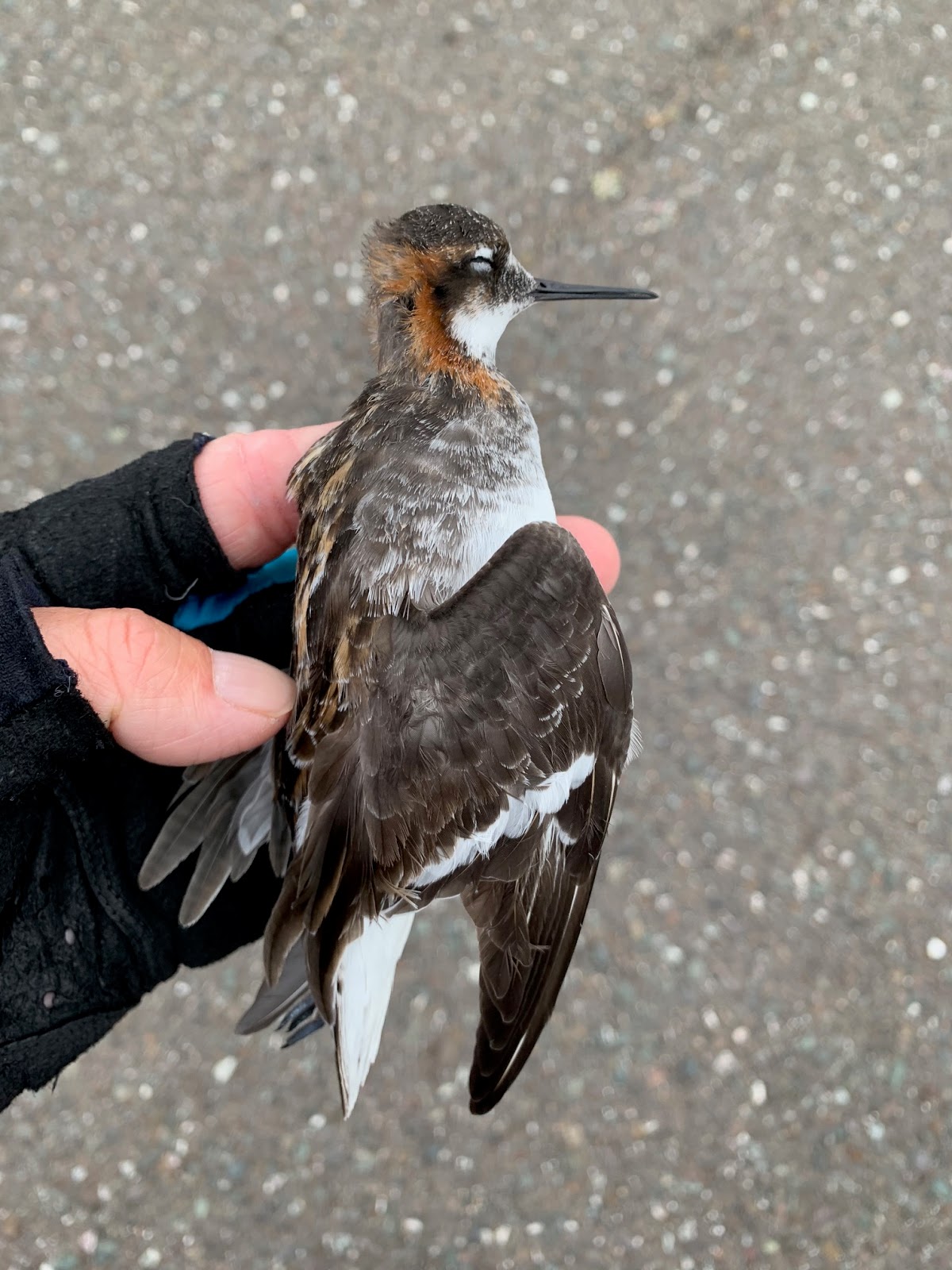
This past week - and with covid restrictions loosening - I took an extended ride to the Central Valley to explore some new bike-birding territory in Stanislaus, San Joaquin, and Contra Costa Counties (more on this in a future post). Incongruously still missing Red-necked Phalarope for my Alameda County bike list, I decided to make an in-transit stop at Don Edwards National Wildlife Refuge after crossing the Dumbarton Bridge on the first morning of my five-day loop. Unfortunately, enthusiasm waned when I found this in the middle of the road just outside the refuge entrance.


Male Red-necked Phalarope - The number and array of 
car-killed birds I find while cycling is astounding. 

I've seen tens of thousands of Red-necked Phalaropes over the years, notably on pelagic trips and at the Great Salt Lake in Utah, but I hadn't appreciated how dainty the species was until I held this lifeless example in my hand. With the bird migrating from its Arctic breeding grounds to its tropical wintering grounds and back each year, it was depressing to know the long-distant migrant  succumbed to unnatural causes - probably a vehicular strike or power line collision - given the herculean challenges it likely overcame during its sadly-truncated life. The encounter was really depressing, particularly as my subsequent half-hour search failed to reveal any living phalaropes, and the episode weighed heavily on me through the remainder of my ride to Livermore.


Red-necked Phalarope range map 

Fast-forward four days, and I'm back on the Alameda Bayshore after looping inland (map below). Birding Hayward Regional Shoreline, I noticed a small area which looked surprisingly suitable for photography. The elevated bayshore dikes are useless for proper shorebird photography, and access considerations and pollution make it impossible to get into the habitat in all but a few places. Seeing Black-necked Stilts and American Avocets in a clean and accessible patch of marsh, I put birding on hold and flipped into photo mode, the warm morning light painting those resident shorebirds with photogenic colors. Approaching the birds, I noticed eight Red-necked Phalaropes foraging on a small and adjacent patch of water. Beyond representing my sought county bike-bird, they proved very receptive to approach once I busted out my 7D2 and 400/5.6. Laying down in the packed mud abutting their preferred puddle, I captured a few frames, these representing the two best. After finding the dead phalarope on the outgoing leg, it was wonderful to experience the living versions for an extended time and at close range. 


A very rough outline of my route. With additional 
and unmapped exploration, the total was ~290 miles.


Male Red-necked Phalarope

Female Red-necked Phalarope

So, two phalarope intersections - one depressing, one inspiring - separated by 250 miles of pedaling. I thought it was a fun story. Hopefully you do as well. I'll have part two of this feature sometime in the next week, so please check back for that. Cheers!

Thursday, April 30, 2020

Post #178 - A Quick Three: Breeding Plumage Western Sandpipers in the age of Covid-19

Damn! I've totally neglected the blog in the last five weeks with the continuing coronavirus distraction. It's pretty depressing, but people in the Bay Area are thankfully committed to shelter-in-place, bending the curve, and so on. Sonia has been working from home for the last seven weeks, but my routine has hardly changed, the life of a childless writer hardly subject to disruption. Unfortunately, my two-week Colombia tour in June and my three-week Brazil vacation in August are probably kaput, but I'm look forward to exploring more of California once restrictions ease in upcoming weeks.  

I have ventured out for a few local photography sessions during the quarantine, late-April the only time of year I can capture shorebirds in breeding plumage, and I'll offer three shots of Western Sandpipers taken under various lighting conditions. The bayshore mud is treacherous, but I think these were worth getting dirty.

Let's start with this high-key frame. I usually don't bother to shoot on cloudy days because I'm a huge fan of color saturation, but the tides were perfect on this afternoon. My strategy was to stake out a piece of semi-firm mud, lay down, and let the rising tide push the birds towards me. The flats flood very quickly, and birds initially 50 yards away were soon right in front of me, this individual particularly confiding. Understanding tides is critically important for shorebird photography because their movements and behaviors are entirely tide-dependent.


Western Sandpiper - Calidris mauri
Canon 600mm f/4 IS II + 1.4x III TC on EOS 1DX2
1/3200 at f/5.6, ISO 1250

OK, this second image was taken a few days later at a different site, one I've learned only productive only on the falling tide. It was a perfectly sunny afternoon, but the receding waters took the birds out of photographic range before the light got really good. I'm really happy with the muddy beak and foot and soft blue surrounds, but I wanted another crack a generating even more color and contrast.


Western Sandpiper - Calidris mauri
Canon 600mm f/4 IS II + 1.4x III TC on EOS 1DX2
1/3200 at f/5.6, ISO 800

Returning to the exact same place the following evening, I was able to utilize even later-day light, the out-going tide delivering the birds to me an hour after than the above shot. This is the kind of warm-light color saturation for which I'm looking (though I'm hella stoked with the above two frames as well).


Western Sandpiper - Calidris mauri
Canon 600mm f/4 IS II + 1.4x III TC on EOS 1DX2
1/4000 at f/5.6, ISO 800

And, just for fun, I thought I'd show what it takes to get these types of low-angle shots. These were taken by my supportive wife who was walking the dog on the adjacent path while I shot. Thankfully, I didn't have to worry about getting pulled over in my underwear and towel since she drove home!

Falling tide on the San Francisco Bay

I'm was a lot happier than this photo indicates.......