Tuesday, May 26, 2020

Post #179 - The life and death of the Red-necked Phalarope, part 1 of 2

Every once in a while, the timing of two events imbues them with otherwise unrealized significance. Such was the case these last few days, and I'd like to share the following story with you.

This past week - and with covid restrictions loosening - I took an extended ride to the Central Valley to explore some new bike-birding territory in Stanislaus, San Joaquin, and Contra Costa Counties (more on this in a future post). Incongruously still missing Red-necked Phalarope for my Alameda County bike list, I decided to make an in-transit stop at Don Edwards National Wildlife Refuge after crossing the Dumbarton Bridge on the first morning of my five-day loop. Unfortunately, enthusiasm waned when I found this in the middle of the road just outside the refuge entrance.


Male Red-necked Phalarope - The number and array of 
car-killed birds I find while cycling is astounding. 
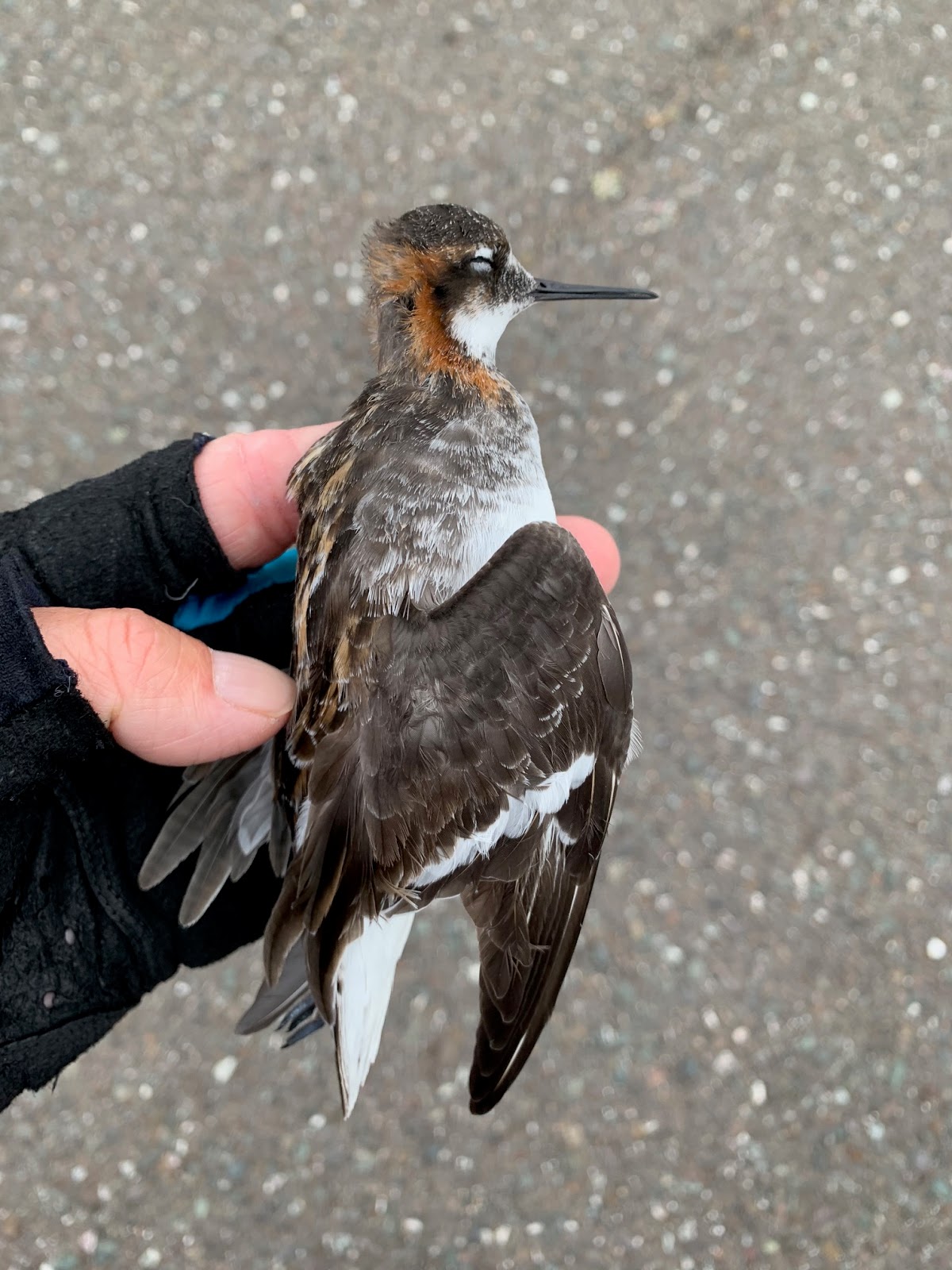
I've seen tens of thousands of Red-necked Phalaropes over the years, notably on pelagic trips and at the Great Salt Lake in Utah, but I hadn't appreciated how dainty the species was until I held this lifeless example in my hand. With the bird migrating from its Arctic breeding grounds to its tropical wintering grounds and back each year, it was depressing to know the long-distant migrant  succumbed to unnatural causes - probably a vehicular strike or power line collision - given the herculean challenges it likely overcame during its sadly-truncated life. The encounter was really depressing, particularly as my subsequent half-hour search failed to reveal any living phalaropes, and the episode weighed heavily on me through the remainder of my ride to Livermore.


Red-necked Phalarope range map 

Fast-forward four days, and I'm back on the Alameda Bayshore after looping inland (map below). Birding Hayward Regional Shoreline, I noticed a small area which looked surprisingly suitable for photography. The elevated bayshore dikes are useless for proper shorebird photography, and access considerations and pollution make it impossible to get into the habitat in all but a few places. Seeing Black-necked Stilts and American Avocets in a clean and accessible patch of marsh, I put birding on hold and flipped into photo mode, the warm morning light painting those resident shorebirds with photogenic colors. Approaching the birds, I noticed eight Red-necked Phalaropes foraging on a small and adjacent patch of water. Beyond representing my sought county bike-bird, they proved very receptive to approach once I busted out my 7D2 and 400/5.6. Laying down in the packed mud abutting their preferred puddle, I captured a few frames, these representing the two best. After finding the dead phalarope on the outgoing leg, it was wonderful to experience the living versions for an extended time and at close range. 


A very rough outline of my route. With additional 
and unmapped exploration, the total was ~290 miles.


Male Red-necked Phalarope

Female Red-necked Phalarope

So, two phalarope intersections - one depressing, one inspiring - separated by 250 miles of pedaling. I thought it was a fun story. Hopefully you do as well. I'll have part two of this feature sometime in the next week, so please check back for that. Cheers!

Thursday, April 30, 2020

Post #178 - A Quick Three: Breeding Plumage Western Sandpipers in the age of Covid-19

Damn! I've totally neglected the blog in the last five weeks with the continuing coronavirus distraction. It's pretty depressing, but people in the Bay Area are thankfully committed to shelter-in-place, bending the curve, and so on. Sonia has been working from home for the last seven weeks, but my routine has hardly changed, the life of a childless writer hardly subject to disruption. Unfortunately, my two-week Colombia tour in June and my three-week Brazil vacation in August are probably kaput, but I'm look forward to exploring more of California once restrictions ease in upcoming weeks.  

I have ventured out for a few local photography sessions during the quarantine, late-April the only time of year I can capture shorebirds in breeding plumage, and I'll offer three shots of Western Sandpipers taken under various lighting conditions. The bayshore mud is treacherous, but I think these were worth getting dirty.

Let's start with this high-key frame. I usually don't bother to shoot on cloudy days because I'm a huge fan of color saturation, but the tides were perfect on this afternoon. My strategy was to stake out a piece of semi-firm mud, lay down, and let the rising tide push the birds towards me. The flats flood very quickly, and birds initially 50 yards away were soon right in front of me, this individual particularly confiding. Understanding tides is critically important for shorebird photography because their movements and behaviors are entirely tide-dependent.


Western Sandpiper - Calidris mauri
Canon 600mm f/4 IS II + 1.4x III TC on EOS 1DX2
1/3200 at f/5.6, ISO 1250

OK, this second image was taken a few days later at a different site, one I've learned only productive only on the falling tide. It was a perfectly sunny afternoon, but the receding waters took the birds out of photographic range before the light got really good. I'm really happy with the muddy beak and foot and soft blue surrounds, but I wanted another crack a generating even more color and contrast.


Western Sandpiper - Calidris mauri
Canon 600mm f/4 IS II + 1.4x III TC on EOS 1DX2
1/3200 at f/5.6, ISO 800

Returning to the exact same place the following evening, I was able to utilize even later-day light, the out-going tide delivering the birds to me an hour after than the above shot. This is the kind of warm-light color saturation for which I'm looking (though I'm hella stoked with the above two frames as well).


Western Sandpiper - Calidris mauri
Canon 600mm f/4 IS II + 1.4x III TC on EOS 1DX2
1/4000 at f/5.6, ISO 800

And, just for fun, I thought I'd show what it takes to get these types of low-angle shots. These were taken by my supportive wife who was walking the dog on the adjacent path while I shot. Thankfully, I didn't have to worry about getting pulled over in my underwear and towel since she drove home!

Falling tide on the San Francisco Bay

I'm was a lot happier than this photo indicates.......

Sunday, March 22, 2020

Post #177 - EPIC Bay Area bike-birding update including San Mateo Laysan Albatross

I wish I was reaching you under different circumstances, but I hope this post offers diversion against coronavirus/COVID-19-prescribed inactivity. I've been on the bike a lot this year - 716 miles on a date when I'd logged < 300 last year - and I'll use this post to highlight my recent county-birding exploits, the game of maximizing species totals in each individual municipality (below table). The San Mateo section is a bit involved, but the Santa Cruz, Santa Clara, San Francisco, and Alameda are comparative snippets. If nothing else, check out the maps to see where I've explored.


San Mateo County
I'll start in my home San Mateo County where I had 264 species of of January 1st. Minus quick late-afternoon spins around Coyote Point park behind my apartment, I don't do much bike-birding in my home county because I'm focused on exploring farther afield. That said, I've had two epic days of San Mateo bike-birding this calendar year, those yielding a combined 7 new birds. I chronicled the first of these, January 14th, in a previous post, but I'll offer the following map as a reminder.

My January 14th ride down the San Mateo Coast

More recently, on March 13, I rode a very similar but slightly-longer route in pursuit of a continuing dark phase Rough-legged Hawk at Pigeon Point. Reaching Pigeon is rarely a problem, but returning home is usually a royal pain-in-the-ass because the prevailing northwest winds build through the afternoon and impede my return. Rather than ride into headwinds when I am tired, I only ride to Pigeon on south winds; there's little impediment early in the day but I get a nice push going home (see below graphic). The one caveat is south winds imply rain, so I have to know I can get down-and-back before it starts pouring. We had no rain - and hence no south wind - in February, so that's why I waited so long to pursue the long-staying hawk.
It took 2 hours and 40 mins to overcome the coastal mountains and cover the 35 miles to Pigeon, the wind gathering through the 9am hour, and a quick scan of nearby power poles revealed the hawk as I arrived. Can't beat a short search after a long ride!

Rough-legged Hawk (dark phase)
Bay Area bike bird #304 / San Mateo bike bird #269  

The hawk handled, I set to seawatching for Black-legged Kittiwake, a species I've missed despite making several late-February- and early-March-trips to Half Moon Bay for it over the last three years. Malia Defelice and Chris Hayward joined my vigil, and we chatted while scanning a relatively quiet ocean against gathering winds. Scanning the horizon, I nearly soiled myself when I spotted an albatross, the bird banking to reveal the light underwings with wide, smudgy wing margins indicative of Laysan. Chris and Malia got onto the bird, and we enjoyed distant but diagnostic views as the bird soared out of view. I've seen loads of Black-footed and quite a few Laysans on pelagics, but this was my first albatross from shore. It was Bay Area bike bird #305 and San Mateo bike bird #270. Though kittiwake didn't show at Pigeon, there was one resting in Pescadero Marsh on my return ride - kismet!

Black-legged Kittiwake
Bay Area bike bird #306, San Mateo bike Bird #271

My recent March 13 ride to Pigeon Point

Santa Cruz County
Santa Cruz County has been on my radar for a while but presents significant access challenges; it's ~43 riding miles to the nearest point of coastal access or ~32 miles (plus a huge climb) to the nearest point of interior access (right map). Either round-trip ride doesn't leave much time or energy for birding, so I back-burnered Santa Cruz plans until some recent Santa Clara bike-birding business brought me within striking distance on January 19th. The way the county lines fall (black lines, left map), I needed to go very far south for Santa Clara access to Varied Thrush and Red-breasted Nuthatch at Monte Bello OSP (VATH, RBNU on left map). Given the northern reaches of Santa Cruz County are only 8 miles beyond Monte Bello, I decided to extend my Santa Clara efforts to include Santa Cruz. I could only allow 90 minutes in relatively specialized ridge/redwood habitat, but I tallied 26 species, Red Crossbill and Ring-necked Duck among them. I'm hoping to reach the coastal side of the county as days lengthen, so stay tuned for that. 

January 19th ride to Santa Clara + Santa Cruz

Santa Clara County
As referenced in the Santa Cruz section above, Monte Bello OSP yielded Varied Thrush and Red-breasted Nuthatch for Santa Clara bike-birds #187 and #188. It was a haul to reach that elevated point, so I'm not sure when I'll be attempting that ride again. More easily accessed is Pearson-Arastradero Preserve, a great oak-savannah habitat and possibly my favorite Santa Clara birding spot. Pearson is an easy 20-mile ride from my apartment, loaded with birds, and usually devoid of people. My February 7th visit yielded Common Merganser and Ferruginous Hawk, Santa Clara bike-birds #189 and #190. Both were too far for decent photos, even with the scope.


San Francisco County
I've made several trips to SF so far in 2020. Two of those were explicitly motivated by the Golden Gate Park Red-naped Sapsucker - a tricky bird which didn't show on either day I visited - but I still found a nice collection of stuff for my SF bike list on each trip. Rather than offer lengthy recounts of each of those rides, I'll offer maps for context. Currently at 199 SF bike-birds, I hope to reach 200 sometime soon, lockdown permitting. Species in red are those for which I looked but ultimately missed.

January 11th - the grosbeak was 
also Bay Area bike-bird #300.

January 31st, my first miss on the sapsucker

February 21st, my second miss on the sapsucker

Alameda County
I'd only biked to Alameda four times before visiting for the fifth time earlier this month, so there was a lot of low-hanging county-bird fruit on that visit. Exploring Dry Creek Regional Park for the first time, a two-and-a-half hour walk yielded 11 Alameda birds including Sharp-shinned Hawk, Hairy Woodpecker, Warbling Vireo, Oak Titmouse, and Pine Siskin. Coupled with Blue-winged Teal, Canvasback, Northern Rough-winged Swallow, and Lincoln's Sparrow added at Coyote Hills on my ride home, my 60-mile ride netted me 15 county birds to raise my cumulative total to 151. I'm hoping to return during spring migration, so that will be another nice bump if that happens. Again, lockdown permitting.

Dry Creek Regional Park

March 19th ride to Alameda

So yeah, lots of maps representing lots of miles! I'm not sure what the virus is going to dictate in the next few weeks, but I'll be out for one long ride each week as long as conditions and rules allow. Stay healthy these next few weeks.

Thursday, March 12, 2020

Post #176 - A weekend of birding with unicycle Big Year madman John Patten Moss!

When John Patten Moss (aka JP) called me last fall to discuss his idea for a unicycle Big Year, I thought he was smoking crack. I pleaded with him to abandon the naive dream, repeatedly emphasizing his twenties should be reserved for child rearing and corporate ascendance, but I was unable to dent his cycling aspiration or birding resolve. I explained transcontinental exploration and personal challenge worthless against safer prospects at Initech or similarly reputable employer, and I warned his self-powered aspirations would render him a sad and incidental footnote in the Big Year landscape. Fortunately, he didn't listen to anything I advised, and we shared an extended bout of cycle-birding as he passed through the Bay Area this weekend.


JP's unicycle wheel makes by bike tires look like toys

JP departed Olympia, Washington on January 1st, followed the Pacific Coast south, and claimed 174 species by his Golden Gate crossing on Friday, March 6th (follow his progress on his blog). We rendezvoused at Heron's Head Park that afternoon and swapped stories as we searched for the long-staying Rock Sandpiper, the cooperative bird appearing at our feet after a ten-minute search. The 'must-have' ticked, we rolled south toward my San Mateo apartment for the night.


JP's Digi-binoc'd Rock Sandpiper at Heron's Head

I was surprised how well JP handled the few short hills between Heron's Head and my place, his unicycle's lack of gears the biggest variable when we discussed his plans last fall. Until I rode with him, I didn't appreciate how well his huge, 36-inch wheel rolled or how he could leverage his single-point of road contact to lean into hills in ways my bicycle prevented. He conceded he need to walk up steep sections, but I understood how he survived the ups and downs of the Oregon and California Coast after riding with him. While his unicycle managed uphills better than I imagined, he didn't reap nearly the downhill momentum as my bicycle did. However, the most difficult aspect of the production is mounting the huge wheel, and I see why JP hates stopping at red lights on his unicycle even more than I do on my bicycle. Check out the following video!


JP Moss mounts his 36-inch unicycle

The morning of Saturday, March 7th was rainy, so we used those AM hours to bird Coyote Point Park behind my apartment. Among birds we added to his list - Sora, Nuttall's Woodpecker, Lesser Goldfinch, others - Iceland (Thayer's) Gull was notable; JP had no experience with the species/subspecies, so it was nice we could ID that sometimes-tricky bird together.

We used the afternoon to bird the bayshore and look for the Tufted Duck at Nob Hill Pond in Redwood Shores. I'd seen the now-annual bird on low tides in years past, but it was nowhere to be found on the Saturday afternoon ebb (-1 foot). Cross-referencing positive eBird reports from the last month with tide tables that evening, I discovered the bird preferred higher tides (+4 to +5 feet). Armed with that trend, we returned to the pond for the flow on Sunday morning. The bird absent again, we birded the bayshore while the tide continued to rise, a surprise Short-eared Owl a great bonus for our efforts. We returned to the pond an hour later, scanned through many recently-arrived scaup, and found the sought Tufted slightly removed from that accompaniment. 


JP's Digi-scoped (my scope, he's not carrying one) Short-eared Owl


JP's Digi-scoped Tufted Duck (Canvasback at front right)

The sandpiper and duck handled, we used Sunday afternoon to find several vocal Ridgway's Rails at the Palo Alto Baylands. JP could have pursued that species at the Salton Sea or outside Yuma, but it was easy to handle while he was in the Bay Area. We went our separate ways at 3pm, but we've stayed in close contact through the last few days. I imagine that trend will continue through the year as I know a few things about navigating the country under my own power.


Me and JP on SF Bay

Riding and interacting with JP was a blast, and I hope other birders lend encouragement, bird-finding advice, and lodging as he extends is one-wheeled adventure. JP has a wonderful appreciation of the natural world, a knowledge extending well-beyond birds, and an engaging personality. He's going to have a really sweet story at the end of this year, so hopefully some of you will find a way to be a part of it!

Below is his rough route for the next few weeks. He's in Hollister now and will be going to Pinnacles before following the 101 corridor south to Paso Robles and onto San Luis Obispo. From there he'll follow the coast all the way into Pasadena. If you live anywhere near the indicated blue trace -- San Lucas, San Ardo, Bradley, Templeton, Atascadero, SLO, Pismo Beach, Santa Maria, Lompoc, Santa Barbara, Ventura, Camarillo, Simi Valley, and Pasadena, etc -- and would be willing to house and feed JP, please email him at mossbill16@yahoo.com. Lodging on the CA coast is HELLA expensive, and it would be a huge financial help if the community would step up to keep costs down! 


JP's rough route for the next two weeks or so.
His goal is to be in Pasadena on April 1st (no joke).

That's it for now, cheers!

Tuesday, February 25, 2020

Post #175 - February photo essay

I can't believe I haven't updated the blog for nearly a month, but a mid-month trip to Southern California interrupted my usual every-other week rhythm! I hope everyone weathered the drought, and I'll keep this post short to aid reacquaintance. With January cloud recently - and thankfully - yielding to February sun, I've managed some decent frames these last few weeks. I'll use this post to present four with a bit of commentary accompanying each.

That reminds me - if you're in the Bay Area - I'm presenting for the Bay Area Bird Photographers next Wednesday, March 4 in the Embarcadero Room of the Rinconada Library in Palo Alto from 7:30 - 9:00pm. I'll be showing photos from New Zealand, Colombia, Thailand, and around the US.

Let's start with a departure from my front-lit wheelhouse, a Belted Kingfisher silhouette captured in the Pillar Point Harbor from my inflatable kayak. The rising sun had just overcome the coastal mountains to the east, and an intervening fog bank scattered the horizontal rays to create this luminous backdrop. In the past, I've entirely blacked-out my silhouettes via underexposure - either in-camera or during editing - but I decided to leave a faint suggestion of the bird's white collar in this instance. It's a really small creative decision but lends the subtlest hint of plumage characteristic to the already unmistakable subject. The human eye possesses greater dynamic range than any camera sensor, so we rarely see silhouettes as entirely black anyway.

***Click images for larger, better views***

Belted Kingfisher - Megaceryle alcyon
Canon 600mm f/4 IS II on Canon EOS 1DX Mark II 
1/4000 at f/5, ISO 400

Next is this juvenile Black-crowned Night-Heron which I encountered an hour after the above kingfisher. I'm a sucker for close-cropped and highly-detailed headshots, so I couldn't resist snapping this frame when I floated within twenty feet of this confiding subject. The golden background results from earthen cliffs well-behind the roosting bird, and I knew the greenish lores and orange eye would demand attention against the surrounding brown tones.

Black-crowned Night-Heron (juvenile) - Nycticorax nycticorax
Canon 600mm f/4 IS II + 1.4x TC III on Canon 1DX Mark II 
1/5000 at f/5.6, ISO 800

Some might ask why I shot the above static subject with a lightning-fast 1/5000 shutter. Well, I was primarily set-up to capture flying waterfowl, manual circumstances which facilitated the capture of this Bufflehead shortly after the above encounter. I'd long-wanted a decent flight frame of this skittish species, and this effort represents my best from a dozen individual forays to Pillar Point Harbor over the last two winters. Getting my kayak into position ahead of the inevitable escape is really challenging, but I met with success by driving the birds towards a shoreline and forcing them to flee my craft at a perpendicular angle. Without something to restrict their escape, they fly directly away and make appealing captures impossible. The golden water results from cliff reflections.

Bufflehead (male) - Bucephala albeola
Canon 600mm f/4 IS II + 1.4x TC III on Canon 1DX Mark II 
1/4000 at f/5.6, ISO 640

Last is this little Eared Grebe. I had some time to kill ahead of the last month's Bay Area Bird Photographers meeting, so I swung into the Palo Alto Baylands ahead of that event. I love depicting common and/or drab birds, so I was stoked this individual swam into range and gave me the opportunity to show his winter garb in perfect end-of-day light. This sort of low-angle work is about my favorite sort.

Eared Grebe (winter plumage) - Podiceps nigricollis
Canon 600mm f/4 IS II + 1.4x III TC on Canon EOS 5D Mark IV
1/2500 at f/5.6, ISO 800

OK, that's it for now. I have another crop of photos from my time in Southern California, and I'll be sure to share those in the near future!

Wednesday, January 29, 2020

Post #174 - An epic day of bike-birding in my home San Mateo County!

When Alvaro 'Gull Whisperer' Jaramillo found an adult Slaty-backed Gull - an Asian species which wanders to the lower 48 states in small number each year - in Half Moon Bay on January 14th, he immediately texted me in case I wanted to put my bike into motion to pursue it. I received his alert at 1:15pm, promptly stood from my desk chair, did a bit of stretching and a few unweighed squats, and realized I didn't have the juice to ride for the bird that afternoon. It was a tough concession, but I slated a better-rested chase the following morning.


Slaty-backed Gull range

I left my San Mateo apartment at 7:15am, covered the 15 miles and 1,000 vertical feet over Highway 92, and rolled onto the Venice bluffs at 8:25am where several birders were already assembled. Initial scans of several hundred gulls revealed no Slaty suggestions, but Chris Hayward and Malia DeFelice arrived on bikes and redirected efforts to a lower beach vantage from which they'd observed the bird the previous afternoon. Sifting through a greater number of gulls we couldn't see from the bluff, Chris picked the sought Slaty-backed from the flock. Marginally darker than nearby Western Gulls (none in photo), the streaked head, comparatively smaller beak, and pot-bellied profile helped make the ID.


Slaty-backed Gull - Bay Area bike bird #301 (Digiscope)

The gull handled, I mulled the possibility of continuing south to Pescadero to look for would-be-Bay-Area-bike-birds Red-naped Sapsucker and Prairie Warbler, an ambitious extension which would swell my morning jaunt (30 miles) into a full-day undertaking (68 miles). My legs felt good during my outgoing ascent of Highway 92, and I knew I'd have to survive a return/second climb whether I went directly home or extended south. The decision therefore hung on wind, a quick check of the weather revealing a weak southern flow building through the afternoon. That would be perfect as I'd get an unusual afternoon push as I returned north later in the day. All the variables aligning, I was off to Pescadero.


Perfect riding conditions

Chris and Malia joined me in Pescadero after swapping bikes for a car, and the three of us absorbed Aaron Maizlish as we scoured the roadside thicket the Prairie Warbler had frequented since its discovery ten days earlier. Unable to find that bird and suffering a depressing lack of activity, Chris and I ditched the other two while we explored the creek for the Red-breasted Sapsucker. That bird showed with the minimal effort Chris promised, our Picidae quarry revealing itself after an easy fifteen-minute search.


Red-naped Sapsucker - Bay Area bike bird #302 (Digi-binoc'd)
The red back is a phone artifact.

Activity had increased while Chris and I were dealing the with Sapsucker, and our reunited foursome persevered to achieve distant but diagnostic views of the sought Prairie Warbler (Bay Area bike bird #303). When a closer encounter wasn't afforded after an additional 20 minutes, we ducked into town to try for a continuing Orchard Oriole. Unlike the wary warbler, the obliging oriole materialized for great views just after we arrived.


Orchard Oriole (Digi-binoc'd)

When a final try for better views and photos of the warbler failed, I began the two-and-a-half-hour ride home. The wind didn't aid me as much as I'd hoped, but high clouds kept the sun off me and held temperatures in the mid-50s. My afternoon ascent of Highway 92 was rough, but the day's efforts didn't seem outrageous against some really nice birds!


Map with elevation profile at top right

To summarize

Slaty-backed Gull: Bay Area bike bird #301, San Mateo bike bird #265

Red-naped Sapsucker: Bay Area bike bird #302, San Mateo bike bird #266

Prairie Warbler: Bay Area bike bird #303, San Mateo bike bird #267

Orchard Oriole: San Mateo bike bird #268 (I'd seen one in SF previously)

The kicker? The gull and warbler were new for my CA list, sorry as it is. So yeah, January 14th will go down as an amazing day of bike birding! 

Saturday, January 18, 2020

Post #173 - My Bay Area bike list reaches 300 species!

Happy 2020! Glad you've returned for another year of The Speckled Hatchback, the blog's fifth! I'm sorry for the month since my last post, but I should be back on track after returning from Thailand, a wonderful country and fantastic birding destination which I will feature in future posts. For now, I'll stick to the Bay Area, but only after I mention three quick asides.

1) I have put together a gallery of my favorite photos from 2019 to match those from previous years. This years's collection features shots from CA, NY, AL, New Zealand, Colombia, and Thailand. Here's a preview....


Blue Pitta from Thailand
Canon 600mm f/4 IS II on EOS 1DX Mark II
1/100 at f/5, ISO 3200, tripod

2) I would like to shine attention on John Patten Moss, the entertaining Georgia twenty-something who has recently embarked upon his unicycle Big Year from Washington State. His plan is super ambitious, and I encourage you to have a look his blog, updated weekly. I will post more about his CA route as he approaches The Golden State, and I am sure John would appreciate housing offers from those who can manage it. I'm hoping to intersect him at some point, and I'll be sure to offer a write-up of that anticipated rendezvous when it happens.

Photo from this article

3) If you're mapping out your birding year, be advised there is still space on the Colombia birding extravaganza I'm running for Alvaro's Adventures. It will run June 20 to July 2, and - with two additional days this year - we should exceed the 375 species we found last year.


Colombia has tanagers, antpittas, and hummingbirds galore!

OK, on with the bike-birding show! As I finished 2019 with 299 species on my Bay Area bike list, I was curious to see what yet-unobserved species would surface as 2020 arrived. I missed some potentials while I was in Thailand - notably Scarlet Tanager at the SF Zoo - but Ken Moy's discovery of a usually-more-eastern Rose-breasted Grosbeak at the Botanical Gardens in Golden Gate Park on January 6th lent intrigue just as I returned. Exhaustion and responsibility prevented me from pursuing the bird immediately, but it stuck around until the 11th when I observed it in the same fruiting tree it had frequented for the previous six days. Though unable to obtain a photo during my brief encounter, I was hella stoked to achieve 300 species after pedaling nearly 5,000 bird-motivated miles since moving to the Bay Area in May of 2017. Granted, an amassed list of 300 birds isn't good for much, but it's been a ton of healthy fun exploring the Bay Area as I inched towards that plateau. I'm encouraged to explore more and farther afield, and I'm excited to discover what additional species will surface along the way!


My grosbeak pursuit. I also added Wrentit
 in the Presidio for SF bike bird #191.

This seems the perfect occasion to remind everyone of the achievements of some other notable California bike-birders. Most impressive are Mark Kudrav and Jim Royer who've each observed 300+ bike-based species in California a single year, Jim with 318 in 2010 and Mark with 326 in 2013. Their's was remarkable dedication, and I am in awe of the efforts they put forth during their respective campaigns. They and folks like Josiah Clark, Rob Furrow, and Chris O'Connell are California bike-birding pioneers, and we are fortunate their examples have inspired so many, me included. I am particularly excited by the number of Bay Area birders who have more recently taken up the bicycle. I regularly intersect burgeoning bike-birder Joshua Stacey, and Chris Hayward and Malia DeFelice increasingly patrol the Half Moon Bay beachfront from rolling perches. Most exciting is seeing the younger generation of Oscar Moss and Jonah Benningfield wheeling around!


Jonah and Oscar exploring SF

All of this is to say that California - and specifically the Bay Area - feels the nation's bike-birding capital at this moment. Climate, topography, bicycle infrastructure, and species diversity certainly encourage the pursuit, but it's ultimately up to adventurous individuals to seize on those facilitating circumstances. Bike-birders are still a small group, but I hope our ranks will continue to swell through 2020. It'll be great when John Patten Moss wheels through our state, so hopefully we can give him the welcome he deserves when he arrives! I'll try to keep everyone posted as that day approaches. Cheers!