Thursday, November 2, 2017

Post #121 - Birding Taiwan, part 1 of 2 - History, Geography, and Birding Logistics!

Wow! That's all that I can say after returning from 8 days of travel, birding, and photography in Taiwan. I was there as a representative of Alvaro's Adventures, the eco-tour company for which I will be leading birding and bird photography excursions in the upcoming years. So, if you like what I here write and you are interested in taking a tour of Taiwan to experience it for yourself, please get in touch with me. I'll be designing an itinerary in the next few months, so please stayed tuned!

OK, it has been a while since I did a travel right-up, so I'd like to refresh your memory as to how I generally do this. I like to split my foreign birding experiences into two (and sometimes more) posts, the first to talk a bit about the country and birding logistics and the second (or the rest) to write more about the specific birding sites I visited and the birds that I saw. You can click this link or the "International Birding" tab under the banner heading to see my write-ups from previous trips. With that approach in mind, I'll get started.


Notice my stamps say ROC, not PRC!

Taiwan is also known as the Republic of China (ROC), not to be confused with the People's Republic of China (PRC), the country we traditionally call China. The two countries have a very interesting and often contentious history, so knowing even a tiny bit about it will help visitors understand the contemporary relationship between the two entities. As briefly as possible, when Mao and his communists took control of China in the Revolution of 1949, the deposed government of Chiang Kai-shek retreated to the the Chinese island of Taiwan (110 miles off the coast of Southeastern China) where it continued to function until Chiang's death in 1975. Since then, Taiwan has evolved into a fully independent and democratic entity; It is, for all intents and purposes, now its own country. China still lays territorial claim to Taiwan, and it is from that history that the "One China Policy" has emerged, a policy that treats Taiwan as part of China rather than as an independent country. At present, only 19 members of the United Nations formally recognize Taiwan as independent; All others, the United States included, deny an independent Taiwan, mainly for fear of offending the economic powerhouse that is mainland China. It is all done with a *wink-wink* but, to me, seems a bit insulting given what a wonderful place I discovered Taiwan to be. 

So, Taiwan is similar to China in some ways while being completely distinct in others, and the birdlife on the island nation suggests exactly this. With a very manageable ~650 cumulative species on its birdlist, Taiwan shares much of its avifauna with China and the rest of Asia. However with 27 endemic species and a host of endemic races that are likely at some point to be recognized as full species, Taiwan possesses birdlife that is distinct from anywhere else on planet earth. Importantly, and unlike either mainland China or the rest of continental Asia, Taiwan can be thoroughly explored and birded in just 10-14 days. Taiwan is therefore the perfect introduction to Asian birding. It's similar enough to the rest of Asia that what is there learned can be applied on future Asian excursions but different enough that it's worth making a dedicated trip to experience it. Taiwan also provides a wonderfully immersive Asian cultural experience for those who want to experience more than the country's birds. 

Taiwan topography (left) and population density (right).
Everyone lives in the western lowlands.

Looking at the maps above, it's easy to see that Taiwan's ~23 million people are tightly clustered along the flat, western edge of the 250-mile long island (comparable in area to the state Maryland or the country Montenegro). While those lowlands provide productive birding, particularly for migrants and waterbirds, the endemics almost universally prefer elevated areas, anywhere from 200-3500 meters. What I found particularly surprising was just how mountainous Taiwan is; On my trip we reached well over 10,000 feet, but the highest point in the country is Jade Mountain at 12,966 feet!

Sunset high above the clouds in
Taiwan's central mountains. 
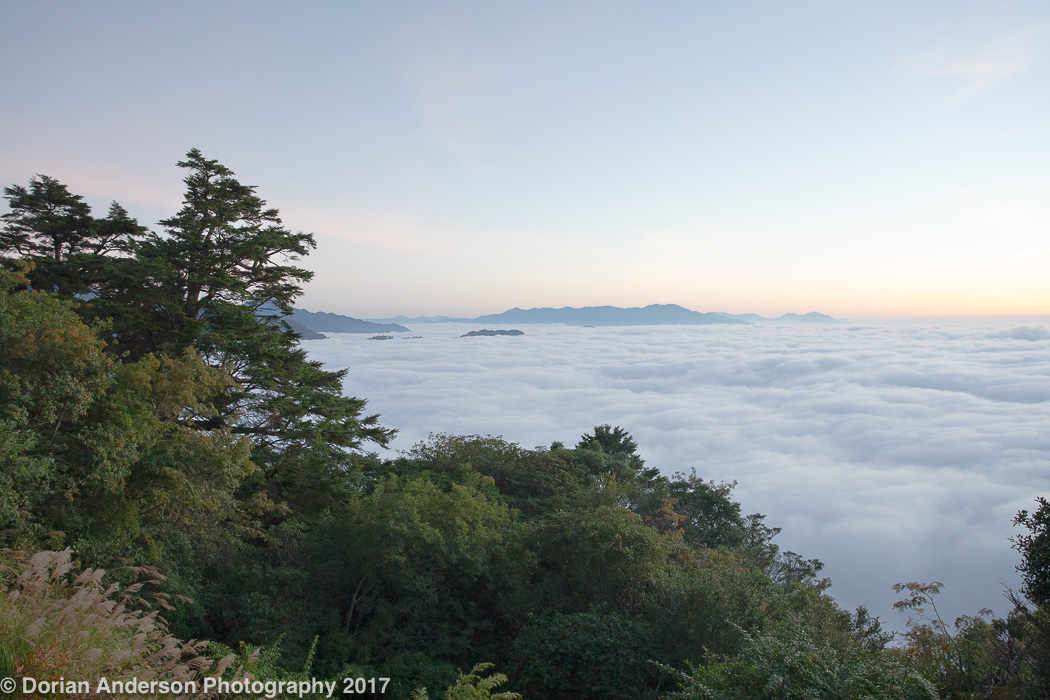
Any birding trip to Taiwan should prioritize the endemics as most of the other interesting species can be filled in around them. Places like Dasyueshan Nation Forest, Hehuanshan National Forest, and the elevated areas above Chiayi City, in Alishan Township, are particularly productive for endemics. With visits to those places and few others in between, my group was able to find 26 of Taiwan's 27 endemics (Taiwan Bush-Warbler the lone hold-out). And that was in just 8 days. The only endemic that requires extra travel is Styan's Bulbul, a bird that resides exclusively at the southern end of the country. We made that long trek but those visitors not hellbent on collecting every possible endemic might consider spending more time in other areas closer to the arrival/departure point of Taipei. If one wants to visit Lanyu/Orchid Island off the southern end of the country (see map below), then a visit to Kenting at the southern end will be required. Lanyu is most worth visiting in the spring when migrants abound but should generally be skipped at other seasons.


An interesting cultural note is that birdwatching in Taiwan is much more synonymous with bird photography than it is in the Unites States. In fact, many serious Taiwanese birders pack 500mm or 600m camera lenses instead of binoculars or spotting scopes. That there isn't much seawatching to be done in Taiwan explains some of this but a general Asian cultural affinity for photography and the gear associated therewith undoubtedly makes at least an equal contribution to the skew. This video from the first day of my trip nicely illustrates this difference. This particular hubbub was caused by the appearance of a group of Yellow-bellied Tits, a usually mainland species that has only been found in Taiwan a handful of times. At no rare bird would cameras so heavily outpace traditional birding optics in the United States or Europe. Irrespective, the video does nicely show that birders in Taiwan are as fanatical as are those in the US.

Twitching the rare Yellow-bellied Tit in Taiwan!
Complete and total bird madness!

OK, getting back to more serious birding business, it's worth noting that Taiwan's endemics are completely non-migratory (they wouldn't be endemic if the migrated off the island nation, right?). As such, they can be reliably found at any time of the year. In speaking with locals, it seems as though spring (late April into early May) is the most popular time to visit as it is then possible to see lingering Asian/Siberian winter migrants and returning, migratory breeders in addition to those endemics. Spring has the most birds but also the most rain, so do keep that in mind. Summer is the slowest season, but the action picks up again in the fall as migrants return from more northerly latitudes. Many species winter in Taiwan, so those cooler months are good birding as well. However, I have been strongly advised to AVOID THE TIME AROUND CHINESE NEW YEAR as it is a complete chaos during that time (late January into early February, depending on the lunar cycle). For reference, my very quick, driving-heavy, 8-day trip accumulated 160 species with only minimal time on the coast. Birdlists from spring trips of 10-12 days will be significantly closer to 200 species, the most successful exceeding that threshold. 

Otherwise, I'll say that Taiwan is a very safe and friendly place. Even with the language barrier, people are generally patient enough that I could communicate with them with hand gestures and sufficient time. Roads can be a bit hair-raising but are in great physical shape; I don't recall hitting a pothole the entire trip. Taiwan is a fully industrialized, first-world economy, and such prices for food and services are understandably more expensive than in other, less developed parts of Asia. However, prices seemed to me still significantly cheaper than what I would expect to pay for comps in the US or Europe. Most lodge-type accommodations seem to run $80-$130/nights. A four- or five-star hotel in the cities will run between $200-$300, very generally. 

EVA Airlines in North America - Highly recommended!

I flew the Taiwanese EVA Airlines direct from San Francisco (13 hours). It was very easy and had great in-flight service. I think that United is the only US airline that services Taiwan, but any number of Asian airlines will get you there as well (though often with long connections in Japan, the Philippines, China, or Korea). It's also worth noting that a full day is lost going to Taiwan as the International Dateline is crossed mid-Pacific; I left at midnight on Sunday and landed t 5:30am Monday morning. Returning 8 days later, I left on Monday at 7:50pm and landed in San Francisco at 3:50pm, 4 hours before I took off! So, keep that in mind when planning your travel. I have no idea about car rental as my group was shepherded around with a van/driver provided by the tourism ministry. 

OK, I know that's a lot of information, but hopefully it gives you a good idea of the history, geography, and logistics of Taiwan. In my next post I'll be focusing exclusively on birds, so do please check back next week for all of that information. I have lots of nice photos as well, so I think you'll enjoy those. Here's a fun one to whet your interest. It's a Collared Scops-Owl roosting in the rafters of an ancient temple. He perfectly represents the birding-cultural intersection that one can expect in Taiwan!

Collared Scops Owl - Otus lettia
Canon 400mm f/4 IS DO II + 1.4x III on EOS 5D Mark IV
1/40 at f/5.6, ISO 6400 (so not a lot of light was available!)

Wednesday, October 18, 2017

Post #120 - Pelagic Bird Photo Showcase and Pelagic Photography Tips/Tutorials

This weekend I had my final 3 of 12 fall pelagic birdwatching trips. All of these left from either Monterey or Half Moon Bay in California and split their time between inshore and offshore (i.e. off the continental shelf) waters. This was by far the most time I have ever spent on the water in such a small time; Needless to say both my birding and photography skills improved immensely. I am going to use this post to showcase some of the pelagic birds that I saw. Beyond that, I will discuss the photography logic and technique that I used to collect these images.

***Click on images for higher resolution views***
Sooty Shearwater - Ardenna grisea
Canon 500mm f/4 IS + 1.4x III on EOS 5D Mark IV
1/3200 at f/5.6, ISO 1600

Pink-footed Shearwater - Puffinus creatopus
Canon 400mm f/4 IS DO II on EOS 7D Mark II
1/5000 at f/4, ISO 640

Let me start by stating something that is obvious to anyone who has ever given pelagic bird photography a try - it is really, really hard. Several factors combine to make pelagic bird photography about as hard as it gets.

1) Pelagic birds are almost always in flight and most of them fly really fast, so shooting them is really challenging. Sure, it's sometimes possible to collect shots of birds sitting on the water, but those frames will not do these amazing birds justice. Flight shots are required to show their elegant forms and aerial abilities! Pelagic photography is therefore synonymous with flight photography, and anything that you learn here should benefit more your terrestrial-based flight-work as well.

2) Pelagic birds don't generally want to come close to the boat, and, unlike on land, you have no individual ability to more closely approach the subject - unless you feel like going for a swim.

3) Unlike terrestrial photography, the photographer is moving in a pelagic setting, often on a heavily pitching boat. Keeping the subject centered, under the desired Auto-Focus (AF) point is very difficult; As a result, clipped wing-tips and totally empty frames are commonplace.

4) Pelagic photography gives the photographer zero control over lighting conditions. If the sun rises at 5:30am and the boat leaves at 8:30am, then you've already missed the best light. If you reach the shelf edge at noon, you'll be photographing deepwater birds in harsh, midday light. If it's cloudy, then most lenses aren't fast enough to properly stop the action and obtain sharp flight shots. Lastly, if the bird flies down the sunny side of the boat, forget about shooting into the sun; That's a complete waste of time. That's for record shots only.

5) You can only get out on the ocean on organized trips, so you have limited chances to get the shots you want.

Black-footed Albatross - Phoebastria nigripes
Canon 400mm f/4 IS DO II + 1.4x III on EOS 5D Mark IV
1/4000 at f/5.6, ISO 400

So, given all these difficulties how the heck does one get decent shots of such seemingly impossible targets? I am going to give two sets of tips, General and More Advanced. Everyone should employ the general tips, and those that want to learn a bit more can move onto the more advanced strategies that I present later. I am a Canon user, but this all doubles for other systems as well.


Scripps's Murrelet - Synthliboramphus scrippsi
Canon 400mm f/4 IS DO II + 1.4x III on EOS 5D Mark IV
1/3200 at f/5.6, ISO 800

6 VERY GENERAL TIPS TO GET YOU STARTED

1) Put your camera in AI Servo mode. That is the mode for moving subjects. If you're in One Shot, you're going to have loads of pictures of blurry, flying turds. Canon has this silly hybrid AI Focus mode, but I avoid that as well. AI Servo is the only place to be for flight work (and 95% of other work as well). If you're camera is beeping as it focuses, you're in the wrong mode as the camera doesn't beep in AI Servo.

2) I use single point focus with 4 points of expansion for flight work. Single point works fine if you can keep the point on the bird, but that's easier said than done. Use as much expansion as you need. 

3) Shoot at the highest frame rate you can. This is done by putting your camera into Continous Shooting, the sort where you can hold the shutter down and take like a zillion pictures in a row. Also known as 'Spray and Pray' this is going to give you the most chances of getting the exact frame you want.

4) As a Canon user, I don't like all the autofocus case setting stuff that they've programmed into the 7D2 and the 5D4. I just use Case 1 and modify the settings to be Sensitivity -2, Accel/Decel 0, Switching 0. Sensitivity should always be at -2 and you can play around with the other 2 for yourself depending on what works best for you. I personally think people spend too much time playing with the settings and not enough time just getting better at quickly acquiring the subject and learning to track it efficiently. Practice trumps all.

5) If you don't want to shoot in Manual Mode, use Aperture Priority (AV) and always leave the lens wide open (smallest numerical f/ stop). For 95% of you, that will be f/5.6 using the Canon 100-400 IS 1 or 2 lens. Shutter Priority mode (TV) does not allow you to take full advantage of your lens as it sets the aperture based on what shutter speed you want. If you say you want 1/2000, it might select f/8. That's a waste if your lens can shoot at f/5.6 (which would cut you shutter by half, to 1/4000). Think instead about getting the fastest possible shutter speed by using the widest aperture. Pelagic birds will never be close enough that depth of field is a problem.

6) If it's sunny, you can try using a 1.4x teleconverter (TC) though your results will vary depending on which camera body you use; It will work best on 1Danything, 7D2 and 5D3/4. Adding a 1.4x TC to an f/5.6 lens doubles the number of pixels on the subject (which is good), but it also makes the lens f/8 and halves the amount of light hitting the sensor (which is not). If it's sunny, you've got plenty of light anyway, so go ahead and try the TC - assuming you have a good camera. But skip the TC on cloudy days unless your naked lens is f/2.8 or f/4. You simply won't be getting enough light to the sensor to make a sharp image. You'll just have a bigger, blurrier flying turd.

Cassin's Auklet - Ptychoramphus aleuticus
Canon 400mm f/4 IS DO II on EOS 7D Mark II
1/4000 at f/4, ISO 800


DISCUSSION OF MORE ADVANCED THEORY/STRATEGIES

Since pelagic birds fly so fast, it is critically important that you have a fast shutter speed so as to stop the action as perfectly (i.e. as sharply) as possible. If you look at all the photos in this post, all of them (save 1) were taken with a shutter speed of 1/2500 or faster. I wouldn't personally try to take a photo of a fast flying bird with anything slower than 1/1600. You may get lucky once in a while at 1/1600, but you should really be shooting much faster. My sharp frame with 1/1600 was the exception, not the rule. 

On sunny days, getting a fast shutter speed is not a problem. That is because there is plenty of ambient light, even moreso than on an equivalently sunny day on land as much more of the light is reflected by the water than it is by the land. So, the general strategy on sunny days is to open the lens all the way up and then dial in a shutter around 1/3200. Something around 1/3200, f/5.6, ISO 400 will work well as a starting point in mid-morning light, but individual exposures for each bird will vary greatly depending on whether it's white, gray, brown or black.

Problems really start to rear their head when there isn't as much ambient light. The best example of this is cloudy days, so let's start there. Very generally, there can be anywhere from 1-3 f/ stops LESS light available on cloudy days than on perfectly clear days. What does that mean? Look at these two photos of Pink-footed Shearwaters. That the were shot with different cameras and lenses doesn't matter, it's the settings that we're going to discuss.

Pink-footed Shearwater - Puffinus creatopus
Canon 400mm f/4 IS DO II +1.4x III on EOS 5D Mark IV
1/4000 at f/5.6, ISO 400

Pink-footed Shearwater - Puffinus creatopus
Canon 100-400mm f/5.6 IS II on EOS 7D Mark II
1/1600 at f/5.6, ISO 1600

These images are very similar except the first one was taken when it was sunny and the second when it was cloudy. Notably, the individual birds look almost identical. The first, sunny image was shot at 1/4000 at f/5.6, ISO 400. The second, cloudy image was shot at 1/1600 at f/5.6, ISO 1600. I don't like to shoot the 7D2 higher than ISO 1600, so 1/1600 was the fastest shutter I could achieve given the f/5.6 limitation of the 100-400 f/5.6 lens on that day. You can see that 1/1600 is 1.333 stops more light that the 1/4000 I used in the sunny image. I also needed 2 stops more ISO (1600 vs. 400) in the bottom image versus the top. So, there was about a 3-stop difference (3.33) in the amount of ambient light available in each instance, and I had to get the exposure correct on each day so as to accurately depict the bird in each condition. A similar comparison can be seen between the Northern Fulmar and Buller's Shearwater shown below. They are similar shades of gray and thus the exposures between the two species can be roughly compared. Look at the settings in the sunny versus cloudy conditions. Sunny skies generally let the shooter use ISO 400 or 800. Cloudy skies are going to necessitate ISO 1600 or higher, sometimes even with an f/4 lens. Remember, you can fix noise with editing software, but you can't do anything with an image that is blurry!

Northern Fulmar - Fulmarus glacialis
Canon 400mm f/4 IS DO II + 1.4x III on EOS 5D Mark IV
1/3200 at f/5.6, ISO 800

Buller's Shearwater - Puffinus bulleri
Canon 400mm f/4 IS DO II on EOS 7D Mark II
1/4000 at f/4, ISO 1600

I know all of this sounds very complicated, but these are the sorts of things you are going to need to think about as conditions change. Sure, you can just leave your camera in AV mode and let it select the correct exposure, but you won't learn anything in so doing. The camera is really smart, but not as smart as you - once you learn everything you need to know. If you shoot in AV all the time, you will eventually be limited by the camera. It's better to learn the exposure theory for yourself!

Buller's Shearwater - Puffinus bulleri
Canon 500mm f/4 IS on EOS 7D Mark II
1/4000 at f/4, ISO 1600

OK, something quick about exposure. Even under identical conditions, the correct exposure is going to vary bird to bird depending on its color; More light is needed to correctly expose dark birds than light birds, often several stops. What that means is that you kind of need to decide whether you're going to shoot light birds or dark birds unless you can very quickly change the settings as different species come into range. If you're set to shoot the dark back of a Sooty Shearwater and a Buller's Shearwater flashes you its brilliant white underside, you are going to saturate the whites in that shot as your shutter will be too comparatively slow/long. When you saturate the whites (or greatly underexpose the darks) you get nondescript blobs rather than nicely detailed images. You ideally want to be able to see individual feathers. The below shot is correctly exposed as you can see detail in both the light and dark feathers.

Pink-footed Shearwater - Puffinus creatopus
Canon 400mm f/4 IS DO II on EOS 7D2
1/2500 at f/4, ISO 1600

To aid on the overexposure end of things, you should activate the Highlight Alert feature on your DSLR. That will display overexposed areas of you image as blinking bits on your image review screen on the back of the camera. The idea is to take a few test shots so that you find an exposure that gives you a small amount of blinking bits but not more. At that point you need only worry about the lower, underexposed end of the image. Here is a short video that should help explain this.

Lastly, shooting in Manual Mode will help you learn all of this faster. Even in AV mode the camera is making its best guess at to the correct shutter speed, and very often it picks the wrong one. As far as pelagic photography is concerned, this most rears its head as a bird flies alternately against the sky and water; Though the exposure for a given subject is the same regardless of the background against which it is shot, the camera will generally tend to underexpose the subject against the lighter sky and overexpose it against the darker water. If you empirically determine the correct exposure for the subject that you want to shoot and dial it in manually, then the camera won't get fooled by the background. Yes, Spot Metering can help combat that problem, but it doesn't work well when keeping the AF point on the bird is difficult, like on a pitching boat.

Pink-footed Shearwater - Puffinus creatopus
Canon 400mm f/4 IS DO II + 1.4x III on EOS 5D Mark IV
1/4000 at f/5.6, ISO 800

Oh wait, one last thing! I find shearwaters and albatrosses the most obliging pelagic subjects. The are fairly willing to come somewhat close to the boat and they rarely directly overfly it (thankfully). Skuas are jaegers are the exact opposite. They are normally too far off, and when they do approach they usually fly too high overhead to make for interesting photos. I did get one decent chance on this skua though. This was an example of where I had to very quickly dial in some extra light to get detail on the very strongly shaded underside of the already dark wing. Note the light is 'terrible' as it is coming straight down. Shots against perfectly clear skies aren't nearly as interesting as those against water or those that included the horizon in the background, right?

South Polar Skua - Stercorarius maccormicki
Canon 400mm f/4 IS DO II + 1.4x III on EOS 5D Mark IV
1/4000 at f/5.6, ISO 800

OK, enough. That's a lot to digest. Please feel free to email me or leave a comment on the blog if things need clarification. I'll also be leading pelagic trips for both Alvaro's Adventures and Monterey Seabirds as this year rolls into next, so please come join me on those for birding and photography. I'd be happy to help you with whatever pelagic or more general photography questions you have.

Oh yeah, ABA seen #722, Guadalupe Murrelet!
I wanted one lifer this fall and this is the one that I got.
Record shot only. Super heavy crop and terrible light.
1 of 4 that we saw this past weekend.

The End 
(Sooty Shearwater)

Monday, October 9, 2017

Post #119 - Fall Bay Area bike-birding, including DUSKY WARBLER! And Bike-Bird Photography too!

I moved from Los Angeles to San Mateo in May of this year. At that time, I had a partially torn calf muscle and did not do any biking for the first month that I was here. Once June rolled around my leg was well enough to do some local bike-birding, mostly along the flat shores of the San Francisco Bay right out the back of my apartment. My leg has since fully healed, and I have been getting correspondingly more adventurous as the summer has transitioned into fall and the birding has picked-up. Right now, I shoot for one 40- to 50-mile ride each week and whatever shorter jaunts along the bayshore time permits. I've got my last three pelagic trips of the fall this weekend, so once those shut down I'll have a bit more time to dedicate to terrestrial bike-birding.

Seawatching from Moss Beach!

I had a particularly good ride last week, one that took me first over the mountains to Moss Beach. From that vantage I was able to add pelagic species such as Sooty, Pink-footed, and Buller's Shearwaters, 3 birds not traditionally associated with bike-birding. I also had Golden-crowned Kinglet, Fox Sparrow, Lincoln's Sparrow, and White-throated Sparrow, all of which were county bike-birds for me. Later, I rode back through Half Moon Bay where I added Laughing Gull, a nice bird this far north, and another pelagic bird, Parasitic Jaeger. From there is was a bit further south to grab Common Gallinule before again climbing the mountains to return home.
A stop at the beach in Half Moon Bay

Map of my ride.
54 miles, 2500 feet of climbing.

This past weekend was particularly exciting as a Dusky Warbler was found just a mile up the bayshore from my apartment. I jumped on my bike as soon as I received word of the bird and easily bagged it for my San Mateo County Bike List. Dusky Warbler was actually a bike lifer as it was not one of the 618 that I found during my bicycle Big Year in 2014. So that was really cool. It was my first bike-lifer since that effort. if this sounds familiar, that's because Roger Schoedl and I found a Dusky Warbler in Huntington Beach last year. Amazingly, we found that bird on October 8, 2016 and this bird appeared on October 8, 2017!


Dusky Warbler record shots


So, with the addition of that Old World warbler and Merlin on that same morning, I've now pushed my San Mateo County bike list to 180 species (most recent additions at end of post). All of those were collected on out-and-back efforts starting and ending at my home, so zero use of fuel at any point. Minus occasional car-chases for would-be ABA lifers and driving to pelagic trips, I've basically abandoned the car for purely birding purposes. I still use it for photography as that pastime often requires me to lug a lot of gear to wherever I'm going, often before the sun rises. I have, however, found a couple of photographically productive spots on the bayshore to which I can easily ride my bike. So, in that respect I guess I'm trying to make bike bird photography 'a thing' now as well. I'm pretty happy with the results so far, but you can judge for yourself. Those of you paying attention to the shooting info might notice that I've recently added the 5D Mark IV to my arsenal. I'll write more about it at some point, but I'll say now that I'm totally in love with it.

AGAIN, ALL OF THESE WERE TAKEN 
USING MY BIKE - NO CAR!

CLICK ON PHOTOS FOR LARGER, 
HIGHER RESOLUTION VIEWS!

Black-bellied Plover - Pluvialis squatarola
Canon 400mm f/4 IS DO II + 1.4x III on EOS 5D Mark IV
1/4000 at f/5.6, ISO 1250

Willet - Tringa semipalmata
Canon 400mm f/4 IS DO II + 1.4x III on EOS 5D Mark IV
1/5000 at f/5.6, ISO 800

Marbled Godwit - Limosa fedoa
Canon 400mm f/4 IS DO II + 2x III on EOS 5D Mark IV
1/3200 at f/8, ISO 1600

Marbled Godwit - Limosa fedoa
Canon 400mm f/4 IS DO II + 1.4x III on EOS 5D Mark IV
1/5000 at f/5.6, ISO 800


Most recent additions to San Mateo County Bike List

OK, that's it for now. There's a lot of stuff in this post, and I hope at least some of it inspires at least a few of you to ditch the car for a day and try out the bike instead. It's way more fun and rewarding than driving everywhere!

Thursday, September 28, 2017

Post #118 - Every bird has a story; Leg bands help tell it!

Hi again! A quick request before we get into the pelicans. I'd ask that if you like my content, please do consider 'Following' the blog. You can do that by clicking the blue 'Follow' Box in the right hand column of the web version as you'd see on your computer. If you are reading this on your phone, you can view the web version by going to the bottom of the post and clicking 'web version'. From there it's the same as above. For your efforts, you'll get an email each time I put up a post (only about once every 7-10 days), and I'll know that you are enjoying my content. It would really mean a lot me, so thanks. OK, now on with the good stuff...

Brown Pelican to set the stage!
I photographed this bird in La Jolla, CA a few years back

In transiting in and out of Pillar Point Harbor on my many recent pelagic trips, I've trying to find and photograph as many banded Brown Pelicans as possible. It's a fun little game, and I usually find between 4 and 6 birds on our slow exit from the harbor as we head out to sea. Alvaro Jaramillo put me in contact with some folks at International Bird Rescue, and I've since been submitting my sightings through the appropriate channels. It turns out that I've photographed pelicans that have been banded by a number of different agencies under a bunch of different circumstances. I am going to share this banding information with you so that you two can report a banded pelicans if you are lucky enough to find one.

Examples of banded Brown Pelicans that I
photographed in Pillar Point Harbor on Sept 14, 2017.
Case histories of some of these are below.

BLUE BANDS: International Bird Rescue places blue bands with with white letters on Brown Pelicans that have been rehabilitated and released from either their San Francisco or Los Angeles centers. The H and M series are several years old; The N series is more current. To report a blue banded pelican, click here. For some more general information on the project, please look here.

GREEN Z BANDS: These bands (also with white lettering) are used by Oiled Wildlife Care Network, and 46 of them were placed individual Brown Pelicans that were oiled (as a result of a crude oil pipeline leak) near Refugio State Beach in Santa Barbara in the spring of 2015. To report a green banded pelican, click here.

WHITE BANDS: White bands with black lettering are used by The Wildlife Center of the North Coast (WCNC) rehabilitation facility in Astoria, Oregon. In collaboration with the Pacific Eco Log (PEL) and the United States Geological Survey (USGS). In 2009, those agencies jointly initiated a banding project to band pelicans on the Oregon Coast. To report a white banded pelican, click here.

RED BANDS: These bands were placed on chicks that hatched in Mexico in the last few years. I am still gathering all relevant information to report these to the appropriate agency, so please check back if you find one of these!

Looking at the photo above, I've submitted reports for 5 of the 6 birds, the red-banded bird being the only exception. So far, I've heard back about the three blue-banded birds and the single white-banded individual. Reports for the blue-banded birds are as follows:


H24: Juvenile, male Brown Pelican. Rescued on 06/04/2011 from Half Moon Bay, CA. Stabilized at Peninsula Humane Society (San Mateo, CA) until transfer to International Bird Rescue's SF Bay Center in Fairfield, CA on 06/05/2011 to continue care. Treated for anemia, emaciation, scabs on the bill and cactus thorns embedded in the feet. Released on 06/24/2011 at Alameda, CA. Sightings: 09/28/2013 at Half Moon Bay, CA; 10/02/2013 at Elkhorn Slough, CA; 07/24/2017, 9/14/2017 (photo indicates missing metal band) at Pillar Point, CA.

M43: Adult, male Brown Pelican. Rescued on 02/18/2012 from Santa Cruz, CA. Stabilized at Native Animal Rescue of Santa Cruz until transfer to International Bird Rescue's SF Bay Center in Fairfield, CA on 02/21/2012 to continue care. Treated for a chest wound consistent with a bite from a California Sea Lion and a toe injury. Released on 03/03/2012 at Santa Cruz, CA. Sightings: 04/20/2012 (Unspecified location); 06/13/2013, 01/01/2015, 01/01/2015 at Santa Cruz, CA; 09/10/2015 at Pillar Point, CA; 12/20/2015, 01/15/2016 at Santa Cruz, CA; 05/08/2016, 07/05/2016, 07/27/2016, 07/28/2016, 08/01/2016 at Pillar Point, CA; 08/06/201 at Half Moon Bay, CA; 08/20/2016 at Pillar Point, CA; 11/13/2016 at Elkhorn Slough; 9/14/2017 at Pillar Point, CA.

N66: Adult, female Brown Pelican. Rescued on 5/20/2017 from Redondo Beach, CA by animal control and immediately transported to International Bird Rescue's LA Wildlife Center on 5/20/2017 to continue care. Treated for emaciation, leg abrasions, anemia and hypothermia. Released on 7/7/2017 at White Point Beach in San Pedro, CA. Sightings: 8/22/2017, 9/14/2017 at Pillar Point, CA.

As for the white-banded bird, I was super stoked and felt like a total badass when I received this certificate for my report. I know you have no life when this is the most exciting thing that happened to me this week.


So, there it is. We now know a least a bird more about a few of the banded pelicans. Beyond knowing, it's a good feeling to contribute to these ongoing research projects. Data in such studies can be very difficult to obtain, so I am sure that any and all reports are greatly appreciated by the respective researchers and agencies. Also, as leg bands will in the future almost certainly be replaced by more advanced electronic tagging methods, it's fun to try to find bands before they become an obsolete tracking method. That's it for now. Now get out there a find a few banded birds of your own!

Wednesday, September 20, 2017

Post #117 - Quick follow-up to last week's Grebe post

Before we dive into the grebe stuff, I'd like to take a second to ask you to take a look at "A Symphony of Feathers" a writing, birding, conservation, and community project from a friend of mine, Devin Griffiths. Devin and I first met when I lived in Massachusetts. He was a strong supporter of my 2014 "Biking for Birds" project and even interviewed me about it for this, his current project. He's a great writer and great guy, so please take a second to check it out! OK, grebe time.....

For those that didn't read last week's post, I described what seemed to me a colony-wide nesting failure of a large population of Clark's and Western Grebe on a freshwater lake/marsh here in California. Hundreds of birds collectively laid thousands of eggs, but only a few chicks seemed to have hatched. I used this blog to source some hypotheses as to what might have caused such a large scale nesting failure, and I received a few interesting responses.


Western Grebe - Aechmophorus occidentalis
Canon 100-400mm f/4.5-5.6 IS II on EOS 7D2 Mark II
1/3200 at f/7.1, ISO 400

The first suggestion, as provided by both a blog reader and someone with weekly if not daily access to the colony in question, was that otters were in large part to blame. I didn't know this, but apparently otters are voracious predators, eating all sorts of stuff beyond what I assumed do be a fish-only diet. This idea seems plausible but I do not think is the entire story. I say that for two reasons. First, I spent several days kayaking through the colony and did not see a single otter. There would have to be dozens of them to devour all the hypothetical chicks. Second, many of the eggs hadn't hatched, even well-beyond the 24-day incubation period of Clark's and Western Grebes. Predation of any sort would explain a disappearance of chicks but not the apparent corruption of otherwise intact eggs upstream of that point. So, otters are a best a partial explanation.


Western Grebe - Aechmophorus occidentalis
Canon 400mm f/4 IS DO II + 1.4x III on EOS 1D Mark IV
1/3200 at f/5.6, ISO 400

Other ideas that postulated were water levels or pollution/toxicity though nothing terribly specific beyond that was suggested. Either of these could have widespread effects and affect the nesting success of the entire population. That seems consistent with the colony-wide problems that I observed. Intrusion by boaters was also suggested though my inflatable kayak was the only boat that I saw near the colony on my 3 independent visits. So, unless I was single-handedly responsible for the death of thousands of eggs and chicks, I don't think boating disturbance was the primary (or even a significant) cause. But others might know better on that front.

So, it seems as it the mystery will continue. Interestingly, a colony of Grebes in Clearlake, California experienced similar problems in 2014; From 3,500 nests, only ~20 chicks fledged that year. So, whatever is happening, it seems to be a big deal. We as a community need to keep our eyes on disturbing trends such as these.

More pelagic trips coming up for me, so maybe I'll run into you aboard either Alvaro's Adventures or Monterey Seabirds!

Tuesday, September 12, 2017

Post #116 - Info sought on grebe nesting failure!

This is a different sort of post as I am really looking for reader input on a bird health/conservation issue that I have recently found curious and disturbing. I am going to speak very generally about large a nesting population of Clark's and Western Grebes somewhere in Northern California. I am doing it this way since I don't want to outright publicize the location, but I am certain that many of you will know the spot to which I am referring. If you do, please just keep it under your hat, thanks. So, with that caveat out of the way, I want to field opinions as to what seems to be a complete nesting failure of a population of several hundred if not several thousand grebes. 

Grebes EVERYWHERE, but no chicks to be found anywhere?!?!?

I first visited this particular location on July 5th of this year, and I was completely blown away by the number of birds I observed. I saw only 1 chick on that visit, but countless other birds were sitting on eggs at that time. I figured I had arrived just on the front end of what was surely going to be an huge hatch-out of grebe chicks in coming weeks. Consulting the Cornell Lab page on Western Grebe, it stated that the incubation period for the species is 24 days. I figured that if I returned in a few weeks, more of the eggs would have hatched by then. You can understand my surprise when I returned on July 24th - 19 days later - and found zero recently hatched chicks. If all of the eggs that I observed on the July 5th were just-then laid, sure, it would make sense that none of them had reached the required 24 days of incubation to hatch. But that seems really unlikely, particular once you read on.

Western Grebe on nest - Aechmophorus occidentalis
Canon 400mm f/4 IS DO II + 1.4x III on EOS 1D Mark IV
1/2000 at f/5.6, ISO 400, handheld

Fast forward to my third visit, on August 13. I thought for sure there would be all sorts of chicks by then, but, again, I found loads of birds sitting on eggs and no chicks (well, one, photo below). At that point I realized that something had to be very seriously wrong as the entire population hatched effectively zero young from what were certainly thousands of individual eggs from hundreds of individual pairs. To complete the timeline, a friend of mine visited the area this past weekend, on September 9, and said that all the nests had been totally abandoned. What the heck is going on?!?!!??

Western Grebe with chick - Aechmophorus occidentalis
Canon 400mm f/4 IS DO II + 1.4x III on EOS 1D Mark IV
1/1600 at f/8, ISO 400, handheld

What was really strange is that the adults looked generally healthy to my eye. Notably, I did not see a single adult bird catch or consume a fish in any of my three visits. That lead me to wonder if a food shortage could have affected the nesting success of the entire population (though that would more likely affect chicks than unhatched eggs)? I also wondered if the unusually heavy rains that Northern California experienced this winter might have contributed. Perhaps increased runoff deposited more of a certain toxin in the water? Altered the sediment composition? Changed the osmolarity, etc? I really have no idea what cold explain the apparent nesting failure, so I'm really grasping for any possible explanation.

So, I am looking to generate some discussion about this topic. I'd love to have what comments people make as official blog comments below. That way they are part of the post and others can read follow whatever discussion we can together generate. So with that, I want to hear what people think is going on with these birds......

Tuesday, September 5, 2017

Post #115 - Arizona birding! Plus Desert Photography at Elephant Head Pond!

What the heck happened to summer?!?!? It seems as though we've jumped right into fall! With that in mind, I want to quickly rewind to the first week of August, a week that I spent birding and photographing in Southeastern Arizona. Beyond what is fast becoming an annual pilgrimage to that birding Mecca (see Post #72 and Post #73 from last year), this year's trip was additionally motivated by 3 long-staying rarities that I wanted to add to my ABA list: Common Crane in Mormon Lake, Rose-throated Becard on the Santa Cruz in Tumacacori, and Tufted Flycatcher in the Huachucas. I found all three of those birds plus Five-striped Sparrow in California Gulch, so it was a great trip on the birding front, one that pushed my ABA list to 721! Both the crane and sparrow were so far away so as to not be worth photographing, but I did get record shots of the other two.

Rose-throated Becard                           Tufted Flycatcher

As for photography, I spent a wonderful morning at Elephant Head Pond in Amado adjacent to the the Santa Ritas Mountains (Madera Canyon). For those not familiar with this spot, it is desert photography at its finest. Seed and suet are put out every day, and many species  (Gambel's Quail, White-winged Dove, Curve-billed Thrasher, Hooded Oriole, Northern Cardinal, Gilded Flicker, Lucy's Warbler, Pyrrhuloxia, etc) cycle through the property to graze on the handouts each day. There are several blinds, and photographers are free to configure a wide array of perches however they like. The place has recently changed ownership and is now run by world-renowned wildlife photographer Dano Grayson. Dano is a really great guy and has some of the most amazing photography stories I've ever heard, so be sure to engage him if you make it to his place. If you're interested in shooting at the Pond at Elephant Head, you can get in touch with Dano at dano@danograyson.com. Tell him I sent you! I should also mention that Dano has a second set of blinds higher up in Madera Canyon that gets a completely different set of birds (Hepatic Tanager, Black-headed Grosbeak, Acorn Woodpecker, Mexican Jay, etc) than the pond. It's totally possible to spend one day down low and another up high.

With that I'll throw up a few of the shots I collected during my single morning at the pond. The flicker is the bird I most wanted this year. He was lured - only briefly - to this perch by a bit of suet packed into the back of the cholla skeleton. The idea in all of these shots is to get the bird to land on perch that has been positioned to be both fully lit and sufficiently far from the backing foliage that the background is rendered smooth and creamy. For best results, the perch should be at least twice as far from anything in the background than it is from the photographer.

***click on images for higher resolution views, 
particularly those landscape/horizontal oriented***

Gilded Flicker - Colaptes chrysoides
Canon 400mm f/4 IS DO II + 1.4x III on EOS 1D Mark IV
1/3200 at f/5.6, ISO 800

White-winged Dove - Zenaida asiatica
Canon 100-400mm f/4.5-5.6 on EOS 7D2
1/3200 at f/5.6, ISO 800

Pyrrhuloxia - Cardinalis sinuatus
Canon 400mm f/4 IS DO II + 1.4x III on EOS 1D Mark IV
1/3200 at f/5.6, ISO 800

Do notice that the above two shots both utilize the same perch, albeit at different proportions in the final image. That's always a dead give-a-way for set-up shots. The idea is to make set-ups shots look as natural as possible, and that's really hard to do if the same perch is used repeatedly. Varying perches will alway give the most interesting results. It's also a lot of fun to try to get exactly the bird you want on exactly the perch you want (see also these examples from last year).

These 2 cardinal shots were actually my favorites of those that I collected this year. Believe it or not, they were my first nice shots of this species. They were very common where I lived in Boston (2011-2013), but I was always focused on photographing shorebirds or generally rarer species. I kept assuming that I'd catch up with cardinal at some point but never did - until now!


Northern Cardinal - Cardinalis cardinalis
Canon 400mm f/4 IS DO II on EOS 7D2
1/3200 at f/5.6, ISO 800

Northern Cardinal - Cardinalis cardinalis
Canon 400mm f/4 IS DO II on EOS 7D2
1/3200 at f/5.6, ISO 800

I'll leave you with one technical tip. It is really important when shooting in bright desert sun to be mindful that you don't blow away the whites or completely saturate the colors of bright birds like the cardinal. If you overexpose, you'll lose all that lovely feather detail and be left with birds that look like nondescript blobs.

So, that's it for this installment. I'm sure migration and my upcoming pelagic trips will yield some interesting content in the next few weeks. Beyond that, I head to Taiwan in October and Ecuador in December, so please stayed tuned for recaps of those trips as the year winds down. Cheers!