Monday, July 27, 2015

Post #30 - Sorry for the loooooonnnnnnnng absence - Updated photo collection posted!

Hello! I am so sorry that I haven't written anything in the last 16 days; I certainly feel like a bit of a slacker. Without going into too much detail, several factors have converged to make the last month virtually silent on the birding front. Family commitments, slow summer birding, and often overwhelming summer crowds have led the list of obstacles, though difficulty associated with my ongoing and painful adjustment to Southern California's car culture has also contributed. As a result of these obstacles, I have been pushing most of my free time into the book I am writing about my bicycling-birding adventure last year. I have now written ~82,000 words towards what I think will be a first draft of ~90,000. I am hoping to have the first draft ready to start shopping to publishers by the time fall migration is in full swing. Once I have the first draft done, I'll have a bit more time and energy.

In place of actual birding and photographing, I have spent an inordinate amount of time the last few months updating my Flickr photo collection. It now displays what I consider to be my favorite images - most of which have been reprocessed using tricks & techniques I have learned since I originally captured and processed them. The taxonomically-organized www.dorianandersonphotography.com is still up and running, though I think many might find the running-feed format of Flickr easier to navigate. Here are a few samples to entice you to visit! 


Atlantic Puffin - Newfoundland

Least terns - Massachusetts

Chestnut-sided warbler - Massachusetts


Saturday, July 11, 2015

Post #29 - Sick/injured birds - to chase/count or not?

While watching the Women's World Cup final last Sunday at a bar, I checked the bird posts to see if any particularly interesting birds had surfaced. It is the middle of the summer, and things have generally been quiet of late in Southern California. You can imagine my surprise and excitement when I read a report of a Red-footed booby (RFBO) from Point Loma Harbor in San Diego. After almost 30 years of birding, there aren't that many new/life birds for me here in the lower 48 states. As it turns out, RFBO would have been an ABA-area life bird for me (I've see it in Hawaii though). As soon as I read the report, I concocted a plan for my first bird chase in months. I figured I could leave very early Monday, tick this bird, and return home with enough time to get at least some work done. This was the loose plan that I formulated at that time.

Returning home after the game, I saw several posts that described the RFBO in better detail. Basically, it looked as though the bird was sick, injured, or both. The bird was in such questionable shape that people were able to walk within 3 feet of it for photos with it (photos here). As soon as I read/saw this, I decided that chasing this bird was not for me. I told Sonia (my girlfriend, for those that don't read regularly) that I did not want my ABA-lifer RFBO to be a battered, sick individual. Sure, it's a very hard bird to see in the ABA area, but chasing a sick/injured bird sort of takes the fun out of it, doesn't it? The whole excitement of the chase is founded on the principle that the bird can disappear at any moment. If this decision means that I never add this bird to my ABA list, so be it. Also, since the bird was sitting on a boat, it did not make for terribly interesting photos (at least for someone who wants to avoid anything man made in his photos).

Anyway, the bird was captured and taken in rehab midday on Monday. I am sure more than a few people twitched this individual bird for county, state, year, or life lists before it was scooped up. I realize that most rarities are lost and that many of them probably do not survive these deviations from their normal ranges. However, I just decided that chasing a bird that clearly had something very wrong with it was not for me. I'm not passing judgement, I just wanted to share my thoughts on this topic since I am sure it will generate at least some discussion. 

Thursday, June 25, 2015

Post #28 - Is there a disconnect between birding and conservation?

I was asked in an interview last week if I thought that birding and conservation went hand-in-hand. My "No" response raised eyebrows, so I think it is worth a bit of time to here to elaborate a bit further than I was able during the interview.

While I have not met every other birder besides myself on planet earth, I can say that the effectively all  of us (>99%) are concerned with the well-being of the landscapes, ecosystems, and species around us. We understand, unlike a terrifying majority of our human cohort, that we are a constituent part the natural world, and as such, we have an obligation to minimize our impact on it. In recognition of this, we often drive fuel-efficient cars, pick up litter on trails, and recycle everything we touch. We organize community programs and volunteer our time to educate others. Most importantly, our infectious enthusiasm for all-things-birds inspires others to both notice the feathered creatures around them and respect the settings those birds call home. In short, birders are fabulous environmentalists. If mother nature were hiring representatives, many of us would be perfectly qualified. However, and for all the amazing things that our community has accomplished, I feel that we have yet to grow this individual environmentalism into a collective conservationism. Why is this and what might we do about it?

I should say here that I have zero formal experience with conservation; What I offer here is my perception of the process. Conservation seems to require many necessarily labor intensive steps to accomplish its goals. We cannot, unfortunately, just decide we want to conserve a piece of land or species and have it magically happen overnight. From what I have gleaned, conservation takes an incredible amount of coordinated effort to be successful. Research must be performed, funding secured, land acquired, strategic management plans implemented, and reports submitted. Each of these phases seems as though it could turn into a multi-year project of its own. This is probably why conservation is coordinated more through organizations than through individuals; The tasks at hand, and the obstacles deliberately put into place, are so large that no single person can attack any aspect of the challenge alone. Conservation is not a hobby, it is a profession - a generally under-appreciated and underpaid one at that.

Environmentalism works well on the individual scale, but conservation works well when effort is coordinated. So, while birders have made individual decisions to live more sustainably that many others, we have not yet managed to nucleate a grassroots, birder-motivated conservation effort on the national scale. I think this is the function of groups like the National Audubon Society and the American Bird Conservatory (to name just two). These are groups with which I am familiar, but at present, do not feel, as hobbyist birder and photographer, a terribly personal connection. Certainly birders do a tremendous amount to aid conservation, but here we perform more of a supporting role. What I think we fail to realize is the collective weight we possess, and while I am not advocating for the direct creation of a "bird lobby", something akin to that might be an interesting counterbalance to those of the developers, industrialists, and consumers that are already in place.

We bird because we enjoy it and it is fun. In its simplest form, birding is an incredibly entertaining distraction from the routine of daily life. In its most extreme form, it's an incurable disease around which the rest of one's life is planned. As I said in the interview, "Birding is fun. Conservation is work". The challenge that we as a community face is how to get each other as excited about conservation as we are about adding a new bird to our life list's or snapping that perfect photograph. I just think at least some discussion about how to best deploy our collective weight in conservation ventures moving forward is warranted. 

And, just for fun, here are two older shots with which I was messing around this past week. 

American oystercatcher - Haematopus palliatus
Winthrop, Massachusetts, 6/10/12
Canon 500mm f/4 IS v1 + 1.4x III on EOS 1D Mark IV
1/1250 at f/5.6, ISO 400


Bobolink
Parker River NWR, Plum Island, Massachusetts, 5/21/12
Canon 500mm f/4 IS v1 + 1.4x III on EOS 1D Mark IV
1/640 at f/8, ISO 400

Thursday, June 11, 2015

Post #27 - A quiz about woodpeckers!

As I have had little time for birding recently, and as birding in its summer nadir here in Los Angeles, I am going to use this post to write a bit about woodpeckers. This idea was precipitated by nothing more than this held-over photograph that I took in Costa Rica. I thought, "I know something about woodpeckers, but I certainly don't know it all". With that as the backdrop, I present the first Speckled Hatchback woodpecker quiz. I certainly learned at least something from putting this together. I hope you learn at least a little something too!


Acorn woodpecker - Melanerpes formicivorus
Canon 500mm f/4 IS v1 on EOS 1D Mark IV
1/400 at f/7.1, ISO 1600, Manual

Answers with explanations at the end!

1) There are about how many species of woodpeckers in the world?
A) about 50
B) about 150
C) about 190
D) about 230
E) over 300

2) Besides Antarctica, woodpeckers are absent from which continent?
A) South America
B) Australia
C) Asia 
D) Africa 
E) Europe

3) The largest woodpecker in the world is the:
A) Pileated woodpecker
B) Imperial woodpecker
C) Woody woodpcker
D) Great spotted woodpecker
E) Ivory-billed woodpecker


Northern flicker - Colaptes auratus
Canon 500mm f/4 is v1 on EOS 7D
1/125 at f/8, ISO 400, Aperture priority
This was from the first month I had this lens!

4) All of the following are types of types of woodpecker except:
A) Hammerbill
B) Wryneck
C) Piculet
D) Yellowneck
E) Flameback

5) Woodpeckers generally have how many toes on each foot?
A) Two
B) Three
C) Four
D) Five
E) They have webbed feet, who cares?


Woody woodpecker

6) Woodpeckers have evolved which of the following to help them climb trees?
A) Scaly feet for better grip
B) Suction-cup underbellies
C) Prehensile beaks to grip bark
D) They put sap on their feet
E) Stiff tail feathers to help them brace themselves

7) True or False
Woodpeckers can walk down trees head first.

8) Why don't woodpeckers get headaches from banging on trees all day?!?!?
A) They eat grubs that contain a natural painkiller
B) They have tiny brains
C) They have special feathers on their heads to dampen the impact
D) Their brains have built in shock absorbers
E) They take turns so as not to wear themselves out


Yellow-bellied sapsucker - Sphyrapicus varius
Canon 500mm f/4 IS v1 on EOS 1D Mark IV
1/2000 at f/5.6, ISO 1600, Manual

1) Answer D. While I could not find an exact number anywhere online (shocking!), I manually counted from The Clements Checklist of the Birds of the World downloadable version (2014). I came up with 229 - give or take! There are 23 woodpecker species in North America (22 regularly occuring + Ivory-billed - however unlikely)

2) Answer B. Woodpeckers are absent from Australasia which includes Australia, New Zealand, New Guinea, and assorted other South Pacific Islands. While they are found throughout Africa, they are notably absent from Madagascar.

3) Answer B, sort of. At 22-24 inches in length, Imperial woodpeckers are technically the largest woodpeckers in the world. Originally endemic to Mexico, they are generally thought to be extinct. If this were officially the case, that would bestow the largest woodpecker crown on the Ivory-billed woodpecker of North America (and Cuba). However, this species is also, and equally sadly, likely extinct. So, as far as I can discern, at 16-19 inches in length, the Pileated woodpecker is currently the world's largest.

4) Answer A. Hammerbill is a figment of my imagination.

5) Answer C. Woodpeckers generally have four toes, two pointing forward and two pointing backwards. As its name suggests, American three-toed woodpecker has only three, as does the closely related Black-backed woodpecker. Incidently, the Eurasian three-toed woodpecker breeds further north than Any other species. 

6) Answer E. Stiff, load-bearing tails help woodpeckers by providing a fulcrum that the birds can use for leverage as they climb. 

7) Answer False. Nuthatches are the only birds that can walk down the trunk headfirst!

8) Answer D. Woodpeckers have evolved several anatomical features to help protect their brains. They have abnormally thick skull bones and they have a spongy meshwork of soft bone, called Trabeculae, inside their skulls to help cushion the brain from impact. There is a very nice article that gives even more information here.

Well, that's it. I hope you learned at least something from this silly exercise!


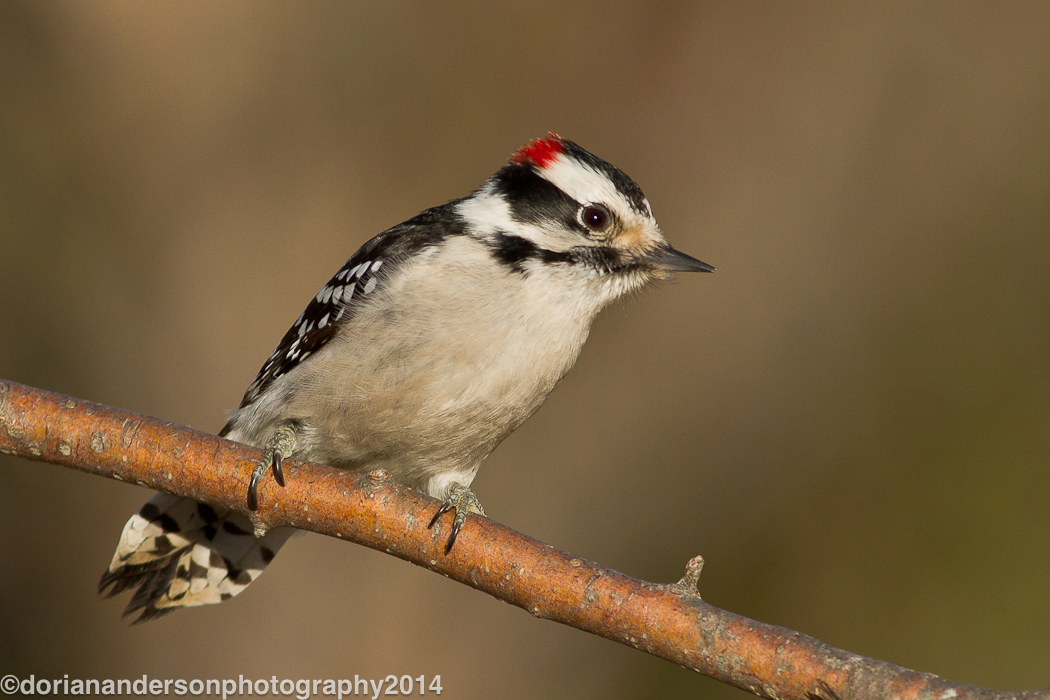
Downy woodpecker - Picoides pubescens
Canon 400mm f/5.6 on EOS 7D
1/2000 at f/6.3, ISO 320

Wednesday, June 3, 2015

Post #26 - Costa Rica, Part 3 of 3!

After 3.5 days in the cloud forest around San Gerardo de Dota, we piled in the car and headed towards Arenal National Park. To reach that destination, we would have to retrace out tire tracks back through San Jose and then northwest towards Arenal. The journey was relatively painless, and I added two familiar kites, Swallow-tailed and White-tailed, along the road.


Our second lodge, Finca Luna Nueva, was a very interesting and unique place. Nestled in the rainforest about 15 miles southeast of Arenal proper, the entire property functioned a sustainable, biodynamic farm. Most of the food we ate was grown onsite, and we learned quite a bit about the farm's inner workings in a series of tours that we took. It is work noting that this particular lodge does not put out hummingbird feeders or fruit of any sort. The property is incredibly birdy, moreso even than our first lodge, but it does not set up nearly as well for those interested in photography. We saw tons of birds, but few of them were ripe for photos.

Birding around out little cabana on the first afternoon, I found a completely different complement of birds than at the higher elevations. Unbelievably bright Passerini's tanagers bounced around in the underbrush while Squirrel cuckoos and Keel-billed toucans foraged overhead. Honeycreepers were well represented as Red-legged honeycreeper, Banaquit, and Scarlet-thighed dacnis all made appearances. Species such as Yellow-bellied elaenia, Common tidy-flycatcher, Buff-throated saltator, Yellow-crowned euphony, Masked tityra, and Red-throated Ant-tanager competed for 'best named bird' on the property. The capper if the first day was a Gray-necked wood-rail that sauntered across the unpaved road that ran right behind our cabana. With my lack of pre-trip studying, I hardly knew such a bird existed.

Rufous-tailed hummingbird


The morning of the second day was spent birding during the farm tour, and the afternoon was spent exploring the farther reaches of the property. Gray-headed chachalacas were conspicuous, as were gaggles of Montezuma oropendolas. Hummingbirds were represented by 4 species, and Social and Pyratic flycatchers joined the more numerous Great kiskadees and Tropical kingbirds in the more open spaces to hunt for insects. Other birds observed included Rufous-winged woodpecker, Barred antshrike, Laughing falcon, Olivaceous piculet, Streak-headed woodcreeper, Crimson-collared tanager, and the absolutely brilliant Green honeycreeper. I could scarcely turn around with finding some new and gorgeous bird. However, the highlight of the day was certainly the Three-toed sloth we found munching on Cecropia leaves. As a bonus , she was carrying a young one around!

Three-toed sloth


The following day was centered on our big zip-lining adventure, but I managed to squeeze in some early morning bird before we hit the road. Highlights from this rather short session included Black-mandibled toucan, White-fronted nunbird, Red-lored parrot, Blue-black grosbeak, and very brief look at a stunning Purple-capped fairy. 3 Crested guans appeared while we were eating breakfast. I had no idea they were so huge. Later that morning, I was even more impressed by the 2 Great curassows that crossed in front our truck as we were being hauled up the side of Arenal to start our Ecoglide zip-lining session. It rained very heavily during our zip-lining adventure, but it was fun nonetheless. A Rufous-tailed jacmar actually flew out of the forest and landed on the actual zip-lining cable before I scared it off as I quickly slid towards it.

Big grasshopper of some sort

Even bigger beetle of some sort (4" long body)

We were rained out that afternoon but returned to Arenal the following day. Since the EcoGlide property had been so birdy the day before, we actually made a quick birding stop there en route to Arenal proper. New birds on that visit included Smoky-brown woodpecker, Grayish saltator, Melodious blackbird, Black-crowned tityra, and Gray-capped flycatcher. I also found the more familiar Northern rough-winged swallow and a very late-migrating Red-eyed vireo. EcoGlide is not known as a birding destination, but they have very extensive grounds around which we were permitted to walk. This habitat is as good as the Arenal Observatory Lodge for those that take the time check it out.

Midday we hit the the aforementioned Observatory Lodge. Between the entrance road and the lodge, I added Spotted antbird, Southern rough-winged swallow, Hepatic tanager, Shining honeycreeper, and Buff-rumped warbler. Birding was admitted slow as it was getting very hot by the time we arrived. The two best birds I found were a gorgeous female Green Hermit in the parking area and 2 Sunbitterns on the road on the way out. As this foray marked the last real birding we were to do before we headed to San Jose that afternoon, closing out the trip with those two birds made for a fantastic end to our week in the country.

The trip was a rousing success. I saw tons of cool birds, and I had a really nice time hanging out with Sonia and her mom. It will be nice to visit the country again a some point, and I am sure this will happen in the not-too-distant future. I was just amazed at how fast the birdlife changed over just short distances. No where else have I observed such an incredible diversity of birds and animals in such a small area. I am sure some of this is just the tropics, but either way Costa Rica was really a special place!

May 14, 2015 - afternoon at Finca Luna Nueva
May 15, 2015 - entire day at Finca Luna Nueva
May 16, 2015 - early morning at Finca Luna Nueva
May 16, 2015 - mid- to late-morning at Ecoglide Zip-lining Adventure
May 17, 2015 - Ecoglide, round 2
May 17, 2015 - Arenal and environs

Tuesday, May 26, 2015

Post #25 - Costa Rica, Part 2! Part 3 still to come!


In the last entry, I wrote briefly – well, maybe not-so-briefly – about my general impressions of Costa Rica and my experiences as a first time visitor to the country. In this entry I will spend my words on the birds that I saw during the first 3.5 days of our trip. As this escape was planned only a week in advance, I was admittedly underprepared from an identification standpoint. This actually made for very relaxing birding. Unconcerned about finding every possible species, I was simply content to enjoy whatever birds crossed my path on my daily walks. I did mange to scrape out 144 species in the course of my stay, and more importantly, experience at least a sample of the country’s amazing diverse birdlife.

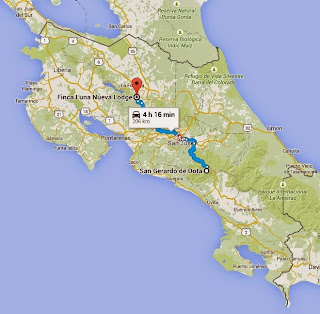
San Gerardo is southeast of San Jose - 
uphill all but the last few miles

Cloud forest above San Gerardo (close to 8000' here)

We spent the first 3.5 days southeast of San Jose. High in the cloud forests of San Gerardo Dota (7200’), I got my first taste of Costa Rican avifauna at The Savegre Hotel, Natural Reserve and Spa. Hummingbirds were prominently featured with Magnificent, Green Violetear, White-throated mountain-gem, and Striped-tailed hummingbirds dwarfing the endemic Volcano and the miniscule Scintillant. These 6 species, and only these 6, were perpetually buzzing around the lodge’s many feeders. Besides nectar, the lodge additionally put out fruit for the birds each morning. This buffet attracted several tanager species including Silver-throated, Flame-colored, and Blue-gray. Rufous-collared sparrows, Ruddy-capped nightingale-thrush and Clay-colored thrushes hopped everywhere. Slaty flowerpiercers were bounced from flower to flower, and the fruit tree just outside our room attracted numbers of Long-tailed liky-flycatchers and Mountain elaenias. I scarcely had to move that first afternoon to find all these great birds.

Scintillant hummingbird - just 3" long!

Rufous-capped nightingale-thrush

Female white-throated mountain-gem


Day 2 was devoted to finding the Resplendant quetzal, a specialty bird of the Costa Rican highlands and arguably one of the most beautiful birds in the world. With the help of a local guide, we visited a known quetzal nest. We missed the birds on our first pass through the area, but the male appeared directly overhead a few hours later. He perched and foraged just 40 feet from us, even affording us flight views as his meter long tail flapped breathtakingly behind him. That morning, we also found Spotted wood-quail, Rufous-browed peppershrike, Emerald Toucanet, Spot-crowned woodcreeper, Yellow-winged vireo, Collared redstart, Spangle-cheeked tanager, White-napped brushfinch, and Elegant (formerly Blue-hooded) euphonia. Even as relatively novice birders, Sonia and her mom could appreciate the mind-boggling beauty of these species.

Resplendant quetzal - almost 3 feet long!

Our last morning at San Gerardo was spent on a series of short hikes. On these we added Yellowish flycatcher, Barred becard, and Common Chlorospingus. We also found 2 more quetzals. One was clearly incubating eggs as all we could see for the hour that we were in the vicinity was his two longest tail feathers sticking out of then nest! That afternoon we ventured up to Mirian’s café on the entrance road to San Gerardo. Here I added higher elevation species such as Sooty thrush, Large-footed finch, and Firery-throated hummingbird. The last of these was particularly stunning, even though I managed only a 5 second look at it.

Yolanda (Sonia's mom) hikes!

I could go on forever about our time at San Gerardo. It was beautiful, quiet, and birdy. I think the timing of our trip was just perfect in these respects. The crowds of the dry season long departed, we saw scarcely anyone in the lodge or on the roads and trails in the area. May is a shoulder month between the dry and wet seasons, and we really lucked out with the weather. We did have afternoon thunderstorms each day, but these cost us at most and hour and half of birding each day. They actually provided us, particularly Sonia’s mom, a chance to rest before the next outing. 

Blue-gray tanager

Here are my eBird Checklist from our time at San Gerardo de Dota.
May 13 – Mirian’s cafe and environs
http://ebird.org/ebird/view/checklist?subID=S23432323

Until next post!


Monday, May 18, 2015

Post #24 - Costa Rica, Part 1 - Quite long!


Sorry for the long absence, but writing while in Costa Rica (or while preparing to leave) proved impossible! Between somewhat limited internet access and virtually limitless birding opportunities, I didn’t slow down enough to write a thing this past week! As I am now on the plane home, its time to crank out what I hope will be the first of two blog posts recapping this trip. The first of these will focus on my general impressions of Costa Rica and suggestions I have for future travellers. The second will specifically highlight the birds that we saw during the two major phases of our particular trip. I will also mention some of what worked and that which did not work from a photography standpoint in that second point.

Topographical map of Costa Rica

This last-minute, 8-day sprint was, almost unbelievably, my first foray into the tropics in nearly 30 years of birding.  I did admittedly spend 9 days birding in Northern Mexico on one of my Victor Emanuel Nature Tours youth camps, but even that episode was nearly 20 years ago (ugh, I feel like a dinosaur writing that). Both Sonia and I start new jobs this week, so it made perfect sense to escape while neither of us was working. As an added bonus, we brought Sonia’s mom with us. This meant this trip was as much about family as it was birding. We managed to see a ton of great birds, experience a really wonderful country, and spend some really nice family time together.

Sonia and mother Yolanda

We divided the trip into two parts – the cloud forest in San Gerardo de Dota and the lusher areas around Arenal National Park. As this was our first visit to the country, we figured we didn’t need to run ourselves ragged moving from place to place. This proved correct and made for a very relaxing introduction to Costa Rica. As we discovered, staying at all-inclusive eco-lodges ensured great birding without the need for much daily travelling. It also ensured access to non-birding activities for those that needed a break from bird-centric activities.

A map of the 2 areas we visited

There are many reasons besides its amazingly varied habitats and approximately 850-900 bird species that Costa Rica is a prime birding destination. First, the country is very politically stable and the people are very friendly. That the country formally abolished its military in 1948 speaks generally to both points. Second, Costa Rica is very small (about the size of West Virginia) and easy to navigate. We had zero issues finding anything using Waze or Google navigation tools on a phones (it cost $30 to activate an international data plan for the week). Third, Costa Rica is relatively inexpensive. Yes, it is the most expensive country in Central America, but the aforementioned stability and hospitality understandably come with a price. As an aside, we used dollars for just about everything. Fourth, the country displays a great respect for all things natural and has constructed its tourism industry around this sentiment. I will round out this blog entry with a more in depth discussion of some of these points.

Meeting The People
Absolutely everyone we contacted during our stay was incredibly friendly and, when required, willing to help. This included not only the staff at our eco-lodges, but also the people with whom we interacted beyond their admittedly protective confines. Both Sonia and her mom are fluent in Spanish. I took 4 years of high-school Spanish and possess a basic ability to understand what is being discussed in casual conversation. Spanish is certainly not a prerequisite for visiting Costa Rica, but it did allow us an interesting window into the country’s people that I think those who don’t speak any Spanish might miss. Nowhere was this on better display more than at a dinner we had at a local ‘soda’ in San Isidrio.
Serving typical rice-and-bean-based local fare (‘comida typica’), this small roadside restaurant and fruit stand, or ‘soda’, provided the perfect opportunity to interact with some local folks. Joined, without initial invitation, at our table by the husband-and-wife owners, we quickly welcomed the chance to speak with them about the local area, the local people, and the country in general. Without going into too much detail, what we general took away from this conversation is that most Costa Ricans are thankful for what they do have and not in want for that which they don’t. They are content with a pace and style of life that many from more developed countries might pejoratively label as basic. Material possessions seem to take a back seat to family and experiences, and there seems to be a general respect for the natural world on which many of them rely for their income – either directly as farmers or indirectly through eco-tourism. Take away point: This couple, like all the folks we met, was simply wonderful.

Bird guide Marino at a feeding station near the Savegre Hotel, Natural Reserve, and Spa


Navigating the landscape
Costa Rica is blessed with an amazing array of habitats. These range from cloud forests, to rainforests, to lowland foothills, and to marshes and beaches. The diversity of habitats explains the astounding array of birds that can be found within the country’s borders. As Costa Rica is so small, it is exceedingly easy to move between several of these areas in even just a short stay. We elected to do this by car. We rented an economy model, a Toyota Yaris. This proved to be a very wise and completely painless decision. You do not need to rent an SUV to get around in Costa Rica. We found Costa Rican drivers to be quite courteous. At no point did we feel that we were going to get pushed off the road – even in our tiny car.
While there are zero traditional freeways, there is a decent network of paved main roads that can be used to get to wherever you need. As most of them are a single-lane in each direction, traffic generally moves slower than it does on multi-lane highways. San Jose seems to be a perpetual snarl, but most visitors are likely to quickly exit the city in favor of other areas anyway. Many of the more rural side roads are dirt and can admittedly be a bit rugged, at least over stretches. Those who don’t mind being bounced around a bit (like us) should be able to navigate all but the worst of them in a standard sedan. Our Yaris handled even the ride up to Arenal Observatory Lodge without incident. Many folks had said we needed 4-wheel drive to reach that point – complete hogwash. Take away point: Getting around is quite easy provided you aren’t in a rush.

Eco-lodge hospitality and product
As this was our first visit and since we had Sonia’s 69-year old mother with us, eco-lodges provided the perfect introduction to Costa Rica’s birds, plants, and animals. We stayed at the Savagre Lodge in San Gerardo de Dota and the Finca Luna Nueva Lodge and Farm near Arenal. As our general experiences at both of these all-inclusive type lodgings were similar, what I say below applies to both and should extend to similar accommodations. Lodges have restaurants on-site; These 2 were no exception. We hardly needed to use our car once we reached the lodges.  The staff at both places had whatever answers we needed and generally went to great lengths to ensure that our stay was pleasant, stress-free, and educational.
            As for the physical side of things, the grounds at both of these lodges were exquisite. Hummingbirds, toucans, tanagers, and honeycreepers could be seen right from our front porches at both places. I scarcely had to move to find amazing birds. Gray-necked wood-rail walked out from our parking space at Finca Luna. Both of these lodges had their own private reserves, and we could fill up most of the day simply drifting between the various trails that snaked around the properties. This arrangement would let me bird for a few hours, then return for family time and meals. Sonia and her mom accompanied me on some shorter walks, but they also made time for spa treatments and make-your-own chocolate experiences as well. What activities not directly provided by the lodges can be easily organized with their help. Both lodges had onsite bird guides available for private tours or the more general “I saw this bird that looked like this……”-type consultations. Take away point: Lodges make birding easy while accommodating non-birders as well.

Me on the Finca Luna Nueva farm tour

Entrance to Savegre Lodge

Eco-tourism
            Costa Ricans certainly recognize both the present and future value of environmentally sustainable travel. This appears true from the industry level down to the individual. Both Sonia and I remarked that many Costa Ricans seem to have a general interest in birds, animals, and plants. This might not seem surprising given the riches of each in the country, but all too often nature’s wonders are somehow taken for granted. That Costa Ricans seem to have avoided this pitfall speaks to their appreciation for all things nature.
The attitude is echoed and supported by a government that has set aside an astounding 26% of the country’s lands for conservation. Besides San Jose, the country generally feels perfectly underdeveloped. With just 1.76 births per woman as of 2014, population growth and associated human development is unlikely to be a major problem in the foreseeable future. A commitment to recycling seems the national norm; Everywhere one turns, specifically in these eco-lodges, there are helpful reminders of how and where to dispose of what. Take away point: Costa Ricans understand that people will visit their country and enjoy the biodiversity provided that it is protected.

Sonia and Yolanda spy a very odd bird!

The bottom line is that Costa Rica is as great a travel destination for the Latin American newbies (such as ourselves) and more seasoned Central and South American birders. Both Sonia and I want to spend more time in Costa Rica in the future, and there is no doubt in my mind that we will. As it is a very easy 5.5-hour plane ride from LA, we might find ourselves back there sooner than we even realize!

In the next entry, I will focus on the actual birds that we saw during the two phases of out trip. Please stayed tuned! Until then, enjoy this grasshopper!