Sunday, February 11, 2018

Post #130 - Mindo, Ecuador!

Overview
OK, let's pick up the great Ecuador adventure in Mindo, a small town/city of about 3000 people located about 2 hours west of Quito. Mindo is known - beyond birding - as an outdoor-adventure destination, and with zip-lining, river tubing, hiking, and other activities there is no lack of things to do. Town is very lively, and we found a nice assortment of local food right along the main street.

While interesting birding can be found anywhere, Mindo isn't so much a specific birding destination as it is a great base of operations to access a variety of nearby birding and photography locations. We spent three days in Mindo, and I am going to use this post to highlight some of the day trips that we took from that base. What I present is hardly an exhaustive list, so please know that there is a ton to do beyond what's here. Really, though, all you need to do is pull over on any back road and you're going to find great birding.

Locations that I visited and that I'll cover

Refugio Paz de los Aves
Rio Silanche
Mashpi-Amagusa
The Birder's House

Getting there
The easiest way to get to Mindo - from the airport is - to drive north and west through Quito to join Highway 28, the main (paved) artery west. The turnoff to Mindo is well signed, and from there one follows another well paved road down the hill several miles to reach town.


Highway 28 route

Alternatively, the more adventurous can follow the unpaved Nono-Mindo Road from Nono through Tandayapa and farther west to reach Mindo. As I described in previous posts, there is fantastic birding all along that road, particularly in the cloud forest that surrounds the Bellavista Lodge between Tandayapa and Mindo. The Nono-Mindo Road is probably passable in a two-wheel vehicle, but we had a high-clearance SUV-type that made the ride significantly smoother than it would have otherwise been.


Nono-Mindo route

Places to stay
There are all sorts of places to stay in and around Mindo, from lodges to cheap hotels to Airbnbs. As we did lodges in Tandayapa, my wife wanted to do Airbnbs in Mindo to mix it up. It's also worth noting that Airbnbs are much cheaper than lodges and are a great option for the budget-minded traveler. We did stopped into Septimo Paraiso to check it out and found it really nice. It's very well located and would make an ideal base of operations. They feed hummingbirds, so there's that going on right on the property. But really, everything is so close together that it doesn't really matter where you stay.


Airbnb tree house in Mindo

Excursions from Mindo

Refugio Paz de Los Aves
This place is world famous and is right off of Highway 28 between Nanegalito and Mindo. It is a private reserve run by Angel Paz and his son Vinicio and is a must-do for anyone in Mindo. I suggest the 4-hour, early morning tour (6-10am) that includes antpittas, lekking Andean Cock-of-the-rock, some general birding, and a full breakfast. Be warned that the tour rarely ends at 10; Ours ran until almost noon! So, two important points. First, eat something substantial before you go since you won't get fed until much later than advertised. Second, don't make any other plans between 10am and noon as your tour will likely run into that time. Also be aware that Giant Antpitta has become significantly more difficult to locate in recent years. It is not like with the original "Maria" individual that appeared on the same log at the same time every morning. At present, it is estimated that only 1 in 4 tours scores the Giant, and much work is now required to find it in-habitat. We missed Giant and Yellow-bellied Antpittas but observed the widespread Chestnut-crowned, the rare Moustached, and the tiny Ochre-breasted (only 4 inches long!). We had great views of cock-of-the-rock, albeit too early and too misty for decent photographs. Beyond the advertised species, we saw Powerful Woodpecker, Golden-headed Quetzal, Scaled Fruiteater, and a host of other birds. https://ebird.org/view/checklist/S41306149)


***click bird images for larger, high-resolution views***

Ochre-breasted Antpitta - Grallaricula flavirostris
Refugio Paz de Las Aves, Mindo, Ecuador
Canon 500mm f/4 IS on EOS 5D Mark IV
1/100 at f/4, ISO 2000

Rio Silanche
Administered by the Mindo Cloudforest Foundation, Rio Silanche is located about 50km/30mi west of Mindo on Highway 28. The turnoff to Silanche is at km 127. Ad additional 7km on a dirt reqoad is required after that. At just 1000 feet of elevation, Silanche is several thousand feet lower than Mindo and as such the birdlife is completely different. There's no faster way to fluff up your trip list than to spend a day birding at Silanche. We spent a rainy morning at Silanche and found a wide array of birds including Hook-billed Kite, Double-toothed Kite, Blue-tailed Trogon, Cinnamon Woodpecker, Pacific Antwren, Bronze-winged Parrot, Purple-throated Fruitcrow, Black-faced Dacnis, and Green Honeycreeper. Silanche is MUCH better for birding than it is for photography. So, I would leave the big lens back at your place of lodging and just roll with a 100-400 for documentation purposes. Also, there's not much civilization near the reserve, so be sure to bring plenty of food and water if you're going to spend the entire day.  Again, the eBird checklist represents only the things we could identify visually as we didn't know any of the calls!
https://ebird.org/view/checklist/S41299904

Mashpi-Amagusa
This place is probably 1.25 hours northwest from Mindo (via Pacto) and is a must for birders and photographers. It is a small, family run operation with very nice grounds and awesome feeder set-ups (directions here). In particular, Mashpi-Amagusa is an incredible spot for Chocó endemics such as Indigo Flowerpiercer, Moss-Backed Tanager, Glistening-green Tanager, and Black-chinned Mountain Tanager. Many of these birds come right to the feeders for close views. Hummingbirds are also very-well represented and present very nice photo opportunities. One thing to note: Mashpi-Amagusa is often very foggy, and that fog can make shooting very challenging if not completely pointless. Such was the case on my visit (see example below). I could shoot through about 5 feet of it, but anything more and the fog took over the shot. Regardless, Masphi-Amagusa is worth a visit just for the birding. https://ebird.org/view/checklist/S41213161

Fog ruined most of my Amagusa shoot - bit's that's life.
This Flame-faced Tanager woulda been sweet w/o fog.

Juvenile Empress Brilliant that really
wanted to be identified. He also spent 
a fair amount of time sitting on my head.

Close-up of juvenile Empress Brilliant - Heliodoxa imperatrix
Mashpi-Amagusa Reserve
Canon 100-400mm f/4.5-5.6 IS II on EOS 7D Mark II
1/250 at f/7.1, ISO 1600

Velvet-purple Coronet - Boissonneaua jardini
Mashpi-Amagusa Reserve
Canon 100-400mm f/4.5-5.6 IS II on EOS 7D Mark II
1/160 at f/7.1, ISO 1600

All that being said, I need to make a VERY IMPORTANT clarification. There are two places that people refer to as 'Mashpi'. The first is the Mashpi-Amagusa Reserve, the birding spot that I have discussed above. There is also the Mashpi Lodge, an obnoxious and elitist accommodation right next to Mashpi-Amagusa. All local birders hate the Mashpi Lodge as the building was build against their explicitly solicited advise. The building is large, all glass, and functions as the perfect bird killer right in the middle of the jungle. Locals who toured the place while it was being built noted dozens of dead birds around it. Worse, they builders/owners somehow managed to get the place endorsed by the National Geographic Society (with what I can only assume was a direct cash payment to NGS). So, I strongly urge everyone to visit the Mashpi-Amagusa Reserve and to avoid the Mashpi Lodge. With rates of $700/night and up, I imagine that won't be a problem for most people. Ecolodge my ass. No real birder would ever be caught dead there. Here's a photo of it. I'm not even going to link to the website.


The bird killer

The Birder's House
This place is a diamond in the rough. We had never heard of it before saw a sign for it as we drove the Nono-Mindo Road from Tandayapa/Bellavista to Mindo. We decided to stick our heads in, and were we ever impressed. This property is the SINGLE BEST PHOTOGRAPHY SPOT that I visited in the highlands. It was so good that we scrapped our plans for the following morning so that I could have an additional session on the property. The guy who runs the place, Vinicio Perez, is very friendly and speaks English quite well. He is a photographer and has set the place up perfectly. He has an extensive hummingbird array that is covered my a high, plastic canopy. He also has 2 two permanent blinds that attract a wide very array of birds. Importantly, he has set the blinds up with plenty of space between the subjects and the backgrounds so that you can get smooth, uncluttered backgrounds for your shots. I literally could have spent 3 full days shooting at his place. He has several small cabanas and serves hot meals, and had I known that we could have stayed on site we certainly would have done so. Really though, the results speak for themselves!
https://ebird.org/view/checklist/S41269178

Inside on of Vinicio's blinds - it's pretty sweet!

Blue-capped Tanager - Thraupis cyanocephala
Canon 100-400 f/4.5-5.6 IS II on EOS 7D Mark II
1/500 at f/5.6, ISO 1600

Buff-tailed Coronet - Boissonneaua flavescens
Canon 100-400 f/4.5-5.6 IS II on EOS 7D Mark II
1/250 at f/5.6, ISO 1600

Dusky Chlorospingus - Chlorospingus semifuscus
Canon 500mm f/4 IS on Canon 5D Mark IV
1/250 at f/4 ISO 2000

Violet-tailed Sylph - Aglaiocercus coelestis
Canon 100-400 f/4.5-5.6 IS II on EOS 7D Mark II
1/500 at f/5.6, ISO 1600

Like I said, there is way more to do in Mindo than these 4 places, but those should give you at least some ideas as to what sorts of things are available. That's where I will leave things for the moment. Next time we'll pick up much farther east, in the Ecuadorian Amazonian Basin. That will be the fifth and final post in this Ecuador collection.

Friday, February 2, 2018

Post #129 - Ecuador's Tandayapa Valley

OK, last time we left off at 11,500 feet of elevation, high above Quito at Reserva Yanacocha. In this post, we are going to move north and west, dropping elevation until we reach the birding hotspot that is Ecuador's Tandayapa Valley. What makes the valley cool is that the birdlife changes as one drops elevation from its higher, southern end towards its lower, northern end. Even better, there are nice lodges at the top, middle, and bottom of the valley, so it is possible to bounce around within the valley and stay at a couple of different elevations. So, with that, let's get going.

Getting there
There are basically two ways to reach the Tandayapa Valley. The first is the faster, more straightforward, and shown below. This route utilizes the paved but twisty Highway 28 to get you to the valley. Once you turn off of that road you'll be at the north end of well-maintained dirt road that runs the south length of the valley and connects to the Nono-Mindo Road at its southern end.

Route 1: Paved Highway 28

The second way is the route that I outlined in the last post, the one that ultilizes the unpaved Nono-Mindo Road to reach Tandayapa. That route connects well with a visit to Yanacocha as described in that last post. This is the same map I showed in that post.

Route 2: Unpaved Nono-Mindo Road

A Closer look at the Tandayapa Valley
Now that we've reached the Tandayapa Valley, let's talk a closer look at it. The valley rises from 5,000' at its northern end at Reserva Alambi to 7,350' at Bellavista Lodge at its higher, southern end. Tandayapa Bird Lodge sits midway between those two endpoints, at rough 5,900'. Tandayapa Bird Lodge sits right above the town of Tandayapa, right where the Nono-Mindo Road intersects the road that runs up the valley and connects the various lodges. The town of Tandayapa is so small that you shouldn't expect anything from it. If you want a restaurant, proper store, or cell service you should head to Nanegalito, ~5 miles beyond Alambi on Highway 28.


Reserva Alambi - Alambi is AWESOME, as much because of the wonderful family that owns the place as the birding on and around the property. Alambi is less a lodge and more a guesthouse, the sort that you might find on Airbnb; It only holds 6 guests at a time, and hosts Jairo, Favian, and Maria come and go over the course of the day, completing vacating the premises at night. Sonia and I had the place to ourselves the 2 nights that we were there, so it was a really intimate and personal experience. Since it is so small, Alambi is NOT suited for big tour groups; It is much better for a couple or small group of friends. Breakfast and lunch are served on the back porch so the birding never stops! Dinner is indoors. It is also the easiest lodge to reach from Highway 28, being just 100 yards down the dirt from that paved main thoroughfare.

Alambi backyard feeder array

Lunch with a view

Alambi dinner area and attached kitchen

Hummingbirds starred at Alambi. All of the action was on the back porch where a dozen hummingbird feeders were hung. In the course of our 2 days and nights, I think we had 15-16 hummer species right from the porch. It was constant action, and the birds were so stunning that it makes Alambi the perfect place to stay with a casually-birding spouse. The hummers allowed very close approach for photography. My only critique is that the feeders are hung so close to the backing foliage that it is very tough to get shots will clean, smooth backgrounds. I took the time to set up some of my own perches and wait for birds to land on them. That's how I got the first two shots below. Headshots were easy as I could usually find a smooth background patch against which to shoot such a small area of the bird.

***Click images for larger, sharper views***

Andean Emerald - Amazilia franciae
Reserva Alambi
Canon 100-400mm f/4.5-5.6 IS IIon EOS 7D Mark II
1/250 at f/6.3, ISO 1600

Rufous-tailed Hummingbird - Amazilia tzacatl
Reserva Alambi
Canon 500mm f/4 IS on EOS 7D Mark II
1/125 at f/5.6, ISO 1600

Crowned Woodnymph - Thalurania colombica
Reserva Alambi
Canon 100-400mm f/4.5-5.6 IS II on EOS 7D Mark II
1/320 at f/5.6, ISO 1600

The grounds beyond that feeding area were also very birdy, and we took several walks up the main dirt road in front of the place to find additional species. It is also possible to visit Alambi as a guest, and many tour groups do just that. If you come on your own, please do leave $5-10 per person as a tip to help defray the cost of sugar water and the incredible amount of labor that such a wonderful hummingbird array requires. There is a tip jar at the far end of the porch. Bottom line is that Alambi and those who run it are wonderful. You simply cannot go wrong! Jairo really knows his birds and is available for private guiding upon arrangement.

Beyond all the hummers, bird highlights included Barred Hawk, Red-faced and Slaty Spinetails, Fawn-breasted Tanager, Blue-necked Tanager, Black-winged Saltator, Tricolored Brushfinch, White-winged Tanager, and Golden Grosbeak.
http://ebird.org/ebird/view/checklist/S41191897
http://ebird.org/ebird/view/checklist/S41213177

Tandayapa Bird Lodge
With a central location in the valley, Tandayapa Bird Lodge (TBL) is a popular choice, particularly for larger tour groups as the lodge can accommodate 20-30 people at a time. Like at Alambi, we spent 2 nights at TBL. Access to TBL is admittedly a bit tricky as your vehicle must climb an unbelievably steep and rocky driveway to reach the lodge. I would not want to try it in a sedan though it can apparently be done. Built right into the steep valley hillside, TBL feels very secluded and private. That feeling is made greater by the fact that the forest runs right up to edge of the lodge. The hummingbird feeders are very well-positioned on the porch, and it is really easy to get clean shots of birds as they come and go from the staging perches.

Dining/Communal area at Tandayapa Bird Lodge

Porch at Tandayapa Bird Lodge

Fawn-Breasted Briliant - Heliodoxa rubinoides
Tandayapa Bird Lodge
Canon 100-400 f/4.5-5.6 IS II on EOS 7D Mark II
1/80 at f/5.6, ISO 1600

Green-crowned Briliant - Heliodoxa jacula
Tandayapa Bird Lodge
Canon 100-400 f/4.5-5.6 IS II on EOS 7D Mark II
1/80 at f/5.6, ISO 1600

Very interesting was the illuminated insect sheet that attracted moths of every size, shape, and description, particularly at night. It was to this sheet that many species of birds, most notably several Toucan Barbets, would come each morning to feed. Photographing around that insect sheet was very challenging as there was very little light and the backgrounds were perpetually cluttered without a decent distance between the sheet, the nearby perches, and the surrounding forest. But is was really cool to see the birds (and the moths!) so close.


There is a nice trail that runs around the property, but do beware as it is quite steep and rocky. It's more suitable for adventurous individuals or couples than it is tour groups. Also very cool was the antpitta blind where we had very nice views of Scaled Antpitta, albeit basically in the dark as they put the worms out super early. We also had fantastic views of Crimson-rumped Toucanet and Rufous Motmot when they came into the feeders. This toucanet was perched on a hummingbird feeder and was using his huge beak to snap at hummingbirds if they approached too closely!

Crimson-rumped Toucanet - Aulacorhynchus haematopygus
Tandayapa Bird Lodge
Canon 100-400 f/4.5-5.6 IS II on EOS 7D Mark II
1/200 at f/5.6, ISO 1600

Tandayapa is a really nice place, but unlike Alambi, isn't the intimate sort where you can just sit around on the property all day and feel like you own the place. Tandayapa is a lodge, Alambi is a house. What makes Tandayapa great is its location and size, two things that are really, really good for tours. Alambi possessed a warmth that Tandayapa did not, and Tandayapa possessed a big group functionality that Alambi lacked. So, both places are great, but for different things. With respect to bird diversity, I found Tandayapa to be the lowest of the three lodges I discuss in this post. Much of that is due to the fact there isn't much open, birding space around the lodge. Walking down the rocky driveway to reach the road will also be difficult for some folks. As such, it's tough to just walk out to the main road as you can at Alambi and Bellavista. Tandayapa is a very fine place to stay and sleep, but you're going to have to get off the property (i.e drive somewhere else) to bird.

http://ebird.org/ebird/view/checklist/S41221652
http://ebird.org/ebird/view/checklist/S41254076

Bellavista 

At the top of the Tandayapa Valley, in proper cloud forest, is Bellavista. We did not stay at Bellavista but used one of our mornings at Tandayapa to drive up there to visit the lodge and bird the area. That was one of the best decisions we made as we saw all sorts of amazing birds up there including Crimson-Mantled Woodpecker, Pearled Treerunner, Strong-billed Woodcreeper, Green-and-Black Fruiteater, Scaled Fruiteater, Turquoise Jay, Grass-green Tanager, Beryl-spangled Tanager, and the highly prized and absolutely stunning Plate-billed Mountain-Toucan, bar far the coolest bird we saw anywhere in the valley. Again, we heard a ton of other stuff but didn't know what any of it was!

Plate-billed Mountain-Toucan (Record shot only)

http://ebird.org/ebird/view/checklist/S41239938

Bellavista shares some attributes of Alambi and TBL. As it is a series of cottages (unlike one big building like at TBL), Bellavista has a charm reminiscent of Alambi, albeit on a scale large enough to accommodate tour groups. They have some feeders on the property, but the best birding is out on the Nono-Mindo Road road as it runs a bit father up the hill. It is very easy to walk out the front gate and start birding. Anyone can handle it.

Location-wise Bellavista has pluses and minuses. It's at the top of the valley and so the cloud forest and associated exiting birding are juts out the front door. But it's also the farthest lodge from any paved road by at least 20 mins. On the other hand, Bellavista is farther along the Nono-Mindo Road, so it's much easier to get to Mindo than from say Tandayapa. From Alambi you'd get right onto Highway 28 and take that paved road around to Mindo instead. I also saw zero photographic set-ups at Bellavista, and I strongly suspect it ranks at the bottom of the three lodges for shooting. I also suspect it is the best birding of the three lodges so what you think of it will depend on your interest. Bellavista is a great place to see the recently described olingito (a cute, furry mammal). They put food out for them each night.

So that should get you started. There is another Lodge, San Jorge Tandayapa, but we neither stayed or birded there. I have generally heard good things about it, but my emails, however, went completely ignored. 

OK, that should get you started. The Tandayapa Valley is a short drive from Mindo, and it is towards that birding destination that well will head in the next installment.

Sunday, January 21, 2018

Post #128 - Birding Quito's Reserva Yanacocha

I initially wrote at the end of my last post that this post would focus on the Tandayapa Valley. The problem with that plan was that I didn't realize how much I had to say about Reserva Yanacocha. So, I am going to fill this post with Yanacocha information and save the Tandayapa stuff for the next installment. A visit to Yanacocha couples very well with a drive along the famous Nono-Mindo Road (also called Ecoruta Paseo del Quinde) to reach Tandayapa, and I'll show at the end of the post exactly how you can do that. But for now, let's focus on Yanacocha.


Morning view from Yanacocha

Getting to Reserva Yanacocha
Reserva Yanacocha is administered by the non-profit NGP Jocotoco Foundation and is located at over 11,000 feet of elevation in the mountains on the western side of Quito (a city itself at ~9,300 feet). The map below shows that the reserve is 75-90 minutes from the Quito Airport. As it is so close to Quito, Yanacocha makes an ideal stop as you transit into or out of the city. There is no lodge at the reserve, nor is there anywhere notable to stay terrible nearby. There is one "lodge" on the west side of Quito, but my communication with it/them was so atrocious I don't want to point anyone in that direction. Your best lodging bet is probably to spend the night before your visit in Quito and head up to Yanacocha in the morning (more on this in a bit).


Reaching the reserve can be a bit challenging, particularly as the directions that the almost-always-reliable Google kicked out for us were quite wrong. It is therefore important that you have dictated or written directions ahead of time. The directions - taken verbatim from the reserve website linked above - are:

"The reserve is accessed via the old Nono-Mindo road, also known as the 'Ecoruta Paseo del Quinde', which begins by exiting the Avenida Occidental in the Mena del Hierro area of Quito. After 10km on this road, there is a sign for the Reserva Yanacocha Jocotoco where you will turn to the left. After 8km along this dirt and cobble road, you pass through a fenced facility of the Quito water company (Empresa de Aqua Potable del Quito EPMAPS). After passing through this facility, continue on 2 kilometers to reach the reserve entrance."

Those instructions are correct but do need a bit of clarification. The referenced, signed left hand turn (just across the street from a community soccer field) is a bit deceptive as you turn onto a cobblestone road so narrow and steep that it looks more a personal driveway that any sort of through-road. Never fear, just keep going up the very steep, bottom cobble section and the road will within a kilometer turn to dirt and level off a bit. You'll be going through grazing pastures at that stage. When you reach the water facility there is often a guard/official in the little hut. He might pop his head out and ask where you're going. Just tell him 'Reserva Yanacocha" and he'll let you through. At least that's what we did; It was painless. The road is passable in a regular car but was very rutted and bouncy even in an SUV.


***Click on images for full-size, sharper views!***
Masked Flowerpiercer - Diglossopis cyanea
Reserva Yanacocha above Quito (11,500')
Canon 100-400mm f/4.5-5.6 IS II on EOS 7D Mark II
1/320 at f/5.6, ISO 1600

The reserve is open from 7:00am to 3:30pm. Admission is $15/person (bring cash, exact change appreciated). There are restrooms and a small shop that sells coffee and snacks. I would strongly suggest arriving right as the reserve opens. This will accomplish 3 goals. First, if there is going to be sun, it's going to be in the morning as Yanacocha tends to cloud up over the course of the day. Once it clouds up, there's not much of view. Second, arriving early will give you more time for your $15. Lastly, a morning visit to Yanacocha couples very well with an afternoon drive down the Nono-Mindo Road to reach the Tandayapa Valley later in the day (see below).

Big leaf - or small man?

Birding the reserve
Yanacocha is high altitude birding at its finest. Over 220 species have been eBirded from the site, and it is really the hummingbirds that make it special. There is one feeding station right at the main entrance, and there is a second maybe a mile to a mile-and-a-half along the very well-maintained dirt road/trail that leads clearly away from the parking area. Among the sought species are the stunning Golden-breasted and Sapphire-vented Pufflegs, the bright orange Shining Sunbeam, the unbelievable Sword-billed Hummingbird, the gigantic Great Sapphirewing, and the critically endangered and very range-restricted Black-breasted Puffleg (only rarely seen). Other notable birds include Andean Condor, Giant Conebill, Imperial Snipe, and several species of antpittas. We liked Yanacocha so much that we visited on 2 consecutive days, an afternoon and the following morning.


Sword-billed Hummingbird - Ensifera ensifera
Reserva Yanacocha above Quito (11,500')
Canon 500mm f/4 IS + 1.4x III on EOS 5D Mark IV
1/320 at f/5.6, ISO 2000

Shining Sunbeam - Aglaeactis cupripennis
Reserva Yanacocha above Quito (11,500')
Canon 100-400mm f/4.5-5.6 IS II on EOS 7D Mark II
1/640 at f/5.6, ISO 1600


Other high-elevation birds we saw included Andean Guan, Buff-winged Starfrontlet, Scarlet-bellied Mountain-Tanager, and Hooded Mountain-Tanager. But we hardly dented what the reserve offers in our two visits. I can't imagine what you could find if you spent a whole day walking the various trails, particularly if you hired a local guide (we did not). I didn't know a single call, so everything on these eBird checklists represents a seen species. I always get sucked into photographing so my personal birdlist is never as high as someone who focuses exclusively on birding.

eBird checklist from my afternoon visit (almost exclusively photography): http://ebird.org/ebird/view/checklist/S41165642
eBird checklist from the following morning visit (mostly birding): http://ebird.org/ebird/view/checklist/S41191896

There were very few people at the reserve on either of our visits, and I doubt if the place ever gets truly crowded. We did run into another birding group on our second visit, the Benningfield family from my home Bay Area. I've actually run into kids Jonah and Max birding around the bay, so it was really funny to bump into them so far from home!


Coupling Yanacocha to Tandayapa
If you visit Yanacocha, it is then very easy to drop back down and rejoin the paved, main road west towards Nono. From there, you'll turn onto the unpaved Nono-Mindo Road for 25km to reach Tandayapa at the center of the Tandayapa Valley. What's really interesting is that if you drive that route, you'll drop from 11,500' at Yanacocha to 9,300' in Nono to 5,500' in Tandayapa. If you make birding stops the length of that drive, the species will change markedly as you drop. 

What I would suggest is using your first full day in the country either entirely at Yanacocha or split between a morning at Yanacocha and then an afternoon descent along the Nono-Mindo Road to reach Tandayapa (or Mindo, if you feel like continuing) by late afternoon. There's absolutely nothing between Nono and Tandayapa: It won't take much gas to make that run since it's all downhill, but the other, uphill way (Tandayapa > Nono > Yanacocha) will require much more gas so do be aware of that. Also, take snacks if you're going take your time on that route.


OK, I think that's it for now! Next up - Tandayapa Valley, for real this time!

Sunday, January 14, 2018

Post #127 - Ecuador introduction: Preparation for your trip

I recently returned from two exciting weeks in Ecuador, and I am going to use the next few posts to share my experiences with you. This was my third trip to South America, the pervious two being to Colombia in 2016, so I had at least some experience with the continent and its birds before this trip. Those Colombia trips were organized by the Audubon Society, so I didn't have to worry about any of the logistics. In contrast, I organized every aspect of this most recent Ecuador adventure, a personal trip for my wife and me. I handled the flights, rental cars, route planning, lodging, and all birding and photography logistics. What initially seemed an overwhelming task wasn't actually that bad, and I am going in the next few post to lay out exactly what we did with the goal that readers could replicated some or all it should they desire.


Me and Sonia

Our trip was split into two discrete parts, 8 days around Quito/Tandayapa/Mindo in the northwestern highlands and 5 days in the Amazon Basin and Yasuni National Park in the lower, eastern reaches of the country. I'll discuss those areas in greater detail in subsequent posts, but for now I'll give you some general information that might help in planning an Ecuador trip. These will be, in no particular order:

Travel logistics and Health preparations/considerations
Rental Cars and Navigation
Geography
Lodging
Money/Finances
Safety
Communications
Field Guides
A note about eBird checklists

A few caveast: First, I'm sure that I've forgotten something important, so I'm sorry ahead of time for that. Second, this post is specific to my experience, and I cannot elaborate on that which I did not do (use the buses, e.g.) So, feel free to ask me any questions, but please realize there is a lot that I don't know. If you do have a question, please use the comment sections to ask it. That way everyone will benefit from my response - assuming I have anything useful to say.


Ecuador. Central Andean region in gray.
The general areas I visited are indicated.

Travel logistics and Health preparations/considerations
American travelers do not need a formal visa to travel to Ecuador though you will clearly need a passport. No vaccinations are required, but Hepatitis A and B, Yellow Fever, Rabies, Typhoid, and Influenza are recommended. If you're entering from a country that has Yellow Fever (not the US), you'll need proof of YF vaccination. Malaria is present but rare. Zika is probably present as well though hard data is lacking. Your best bet to avoid the already slim chances of Malaria/Zika is to wear long sleeves/pants and use insect repellent with at least 25% DEET. I didn't get any shots beyond what I already had (tetanus, MMR, etc). I hardly even used inset repellent; Mosquitos just don't seem to like me. 

I drank bottled or filtered water the entire time I was in the country. Most lodges, hotels, and the like provided filtered water. Those with particularly sensitive digestive systems might also want to avoid eating salad or uncooked veggies as those will have been washed in local water. Having intestinal issues on the first day of a 10-day trip would be no fun.

Also be aware that Quito sits at 9,300 feet of elevation, so the air is much thinner. Yanacocha sits at 11,500, and the true 'paramo' even higher. Please be advised of that if you have had issues at high elevation in the past, asthma included.

Geography and elevation
Looking at the topographic map above, it's easy to see that the Andes occupy the middle third of the country with lower elevations sloping away on each side. I highlight this as the distribution of the country's birds varies as much along elevational clines as it does across geographic regions. No only that, but there are also huge differences between the Eastern and Western Andean Slopes. For example, Golden Tanager is found between 900-2000 meters on both slopes while the superficially similar Silver-throated Tanager is found between 500-1400 meters on the western slope only. Golden Tanager's range is strictly elevation dependent, but Silver-throated's range is dependent on elevation AND slope. So, pay attention to location and elevation: It will make identifying birds much easier!

Golden Tanager - Tangara arthus
Canon 500mm f/4 IS + 1.4x III on EOS 7D Mark II
1/100 at f/7.1, ISO 1600.
Note: taken in Colombia

Rental Cars, roads, and navigation
We rented an SUV for the 8 days that we were in the highlands. It was expensive, ~$650 for that time, but worth every penny as it let us comfortably explore the more interesting, unpaved, back roads (Nono-Mindo, e.g.). Most of those back roads can be passed in a smaller, sedan-type car, albeit much more slowly and with much more bouncing around. With the SVU, we didn't think twice about road conditions; We just plowed ahead. I have unlimited foreign data on my phone, so we just used that for navigation. The well-known birding spots were all straightforward to find as almost all of them were off of just 1 or 2 main roads. Everything is so close together that getting around isn't that challenging (I'll show exact maps with locations in the next post specific to the highlands). Local drivers were fine, no more or less courteous/aggressive than anywhere else. 

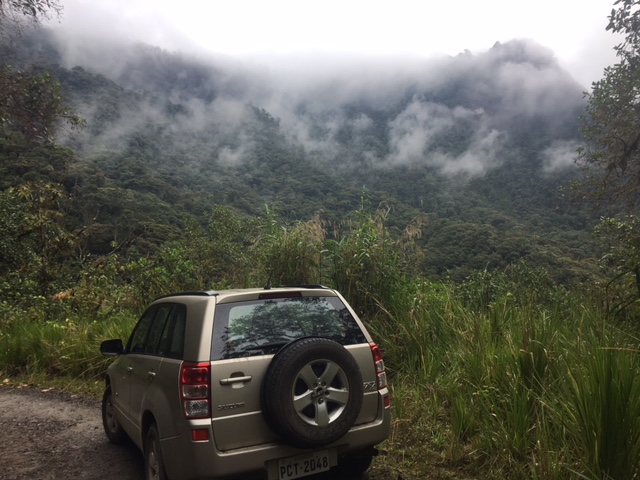
Our Suzuki on the famous Nono-Mindo Road

Uber operates in Ecuador. We didn't use it, but it looked like a very cheap way to get around, particularly Quito. 

As for the Amazon Basin, if you go there your lodge will organize everything for you, including the necessary internal flight from Quito to Coca. From there you'll get into a powered boat, again at the direction and organization of your host lodge. There aren't any roads so you haven't any other choice!

Lodging
All the expected sorts of lodging are available in Ecuador. We stayed in hotels our 2 nights in Quito and lodges and Airbnbs for our 7 nights in the highlands. We were also in a lodge for our 5 days in the Amazon Basin. I will cover specific lodges in subsequent posts. As expected, lodging and food are inexpensive compared to the US. There looked to be many cheap, roadside hotel/motel-type places, but I can't speak to those since we didn't use them.

Money/Finances
Ecuador uses the US Dollar as currency. It is also worth noting that not everywhere - lodges included - is set up to take credit cards, so be aware of that. I actually had to wire money internationally ahead of time to confirm/hold my reservation at two of my lodges (Alambi, Tandayapa). I carried quite a bit of cash as I wasn't sure how easy it would be to withdraw it once I was there (my stash covered me so I never found out). 

Safety
Safety was a non-issue as far as I could tell. Everyone we encountered was incredibly friendly and willing to help us when we needed it (i.e. directions). I tried not to leave my camera gear in the car unattended for extended periods of time, but that's the same everywhere I go, domestic travel included. I had no reservations about walking around in remote areas with my expensive gear on display. That's not to say robberies don't happen, but I didn't feel threatened, targeted, or uneasy at any point.

Be careful - cows
often wander into the road!

Communication
Cell phone service was spotty outside of towns. Most lodges have WiFi though it is much slower than anything that we have here in the states. It is also here worth noting that communication generally happens slower in Ecuador than it does in the US. What I mean is that it often took 2 or 3 emails to lodges and other relevant entities before I was able to get firm answers and secure exact dates/times/services. Customer service simply does not happen in real time the way it does in the US. Please be aware of this and have the appropriate patience. Start planning your trip well in advance to allow for the slower pace of communication.

Field Guides
There are two books or field guides that you should consider buying before any Ecuador trip. The first of these is the industry standard and downright incredible "The Birds of Ecuador: Field Guide" by Robert Ridgely and Paul Greenfield. In full disclosure, that book is big and heavy; It is more than 2 inches thick and weighs more than 3 pounds. The plates are absolutely stunning, and the text and maps, located in their own sections, are very streamlined and easy to navigate. Some people buy this book, break it apart, and have it rebound into two separate entities, a field-friendly collection of plates and a larger, less portable bit that stays in the hotel room as a more detailed reference. NOTE: THIS BOOK DOES NOT INCLUDE THE GALAPAGOS!


The second book is a smaller option, the "Fieldbook of the Bird of Ecuador" by Miles McMullin and Lelis Navarette. This book is small enough to fit in one's pocket and serves as a nice field reference. Be aware, this book is very hard to find in the states but does make for a nice, local purchase in Ecuador. It is a bit information dense with so many species on each page, but that's the only way they were ever going to get all the birds into a single, portable volume. THIS BOOK DOES INCLUDE THE GALAPAGOS.


A note about eBird checklists
From a birding perspective, the most important thing that any visiting birder needs to know is that there are A LOT of species in Ecuador, about 1600 to be precise. More impressive still is that those species are packed into just 109,000 square miles, an area comparable to either Oregon (98K) or Colorado (104K). Though that species total might seem totally overwhelming, the trick is to get an unidentified species into a family and go from there. I found eBird's site-specific checklists to be invaluable as an identification aid as they greatly narrowed down the species that I could expect to find at each specific birding site; When those checklists were cross-referenced with field guides, I was able to identify 95% of the birds I saw. JUST REMEMBER TO DOWNLOAD THOSE CHECKLISTS WHEN YOU HAVE WIFI! Getting into the field without them is a pain in the ass. I will have a bit more to say about this in follow-up posts.

OK, that's it for now. Hopefully this helps you at least start planning your Ecuador adventure!

Next time - Birding Quito's Reserva Yanacocha - Please stay tuned!

Tuesday, January 2, 2018

Post #126 - A day of birding around San Salvador, El Salvador with super guide Julio Acosta

Well, here it is, the first Speckled Hatchback post of 2018! This will be the fourth full year for the blog, and I am going to kick it off with a very quick post about birding in El Salvador. Wait a second? Wasn't I just in Ecuador for 2 weeks? I was, but I was also in El Salvador in-transit. As the Ecuador posts and the photos that will accompany them are going to take a lot of time to prepare, I am going to hop right into El Salvador in the interim. 


Located between Guatemala and Honduras, El Salvador is the smallest country in Central America. At just over 8000 square miles, El Salvador is comparable in size to the state of Massachusetts or the country of Slovenia. Roughly 550 species have been eBirded from the country, none of which are true endemics. However, El Salvador does share a number of regional endemics with the countries it borders, so there's no lack of neotropical birding excitement. Many North American migrants winter in El Salvador and surrounds, so those interested in neotropical migration might find the country a particularly interesting destination for that reason. For example, I saw 25 Tennessee Warblers in a morning of birding, a total that exceeded the number of Tennessee Warblers I've seen in the states in the last 10 years combined!

My visit to El Salvador actually occurred in the larger context of my Ecuador trip. As there are no direct flights from San Francisco to Quito, we (my wife and I) flew through San Salvador where we had 8-hour layovers on both the outgoing and returning legs. The outgoing layover (1pm to 9pm) didn't have enough daylight to make leaving the airport worthwhile, but, with the returning layover running from 7am to 3pm, we had a perfect window to get out and do some birding. Interestingly, and in preparation for the layover, I went into eBird to see what birding might be available near the airport. In looking through the recent sightings at nearby sights, many came from 'Julio Acosta ES Tour Guide'. As Julio provided his email on his eBird profile page (julio_explorer@yahoo.com), I contacted him and arranged to have him guide us around during our extended layover.


Me and Julio

Before I get into birding specifics, I first want to say that Julio is an ABSOLUTELY FANTASTIC guide. He knew all the local birds by sight and sound, and his more general knowledge of the natural world and the country was equally impressive. A former English teacher, Julio is perfectly fluent in the language, and his fun and laid-back personality ensures that he can get along with just about anyone. If you're thinking about hiring a bird guide in El Salvador, you absolutely must get in touch with Julio. He is your man!

Julio and a driver collected us from the airport at 7:00am, and we headed for Ecoparque El Espino on the west side of downtown San Salvador. Located at nearly 3000 feet (900 meters) of elevation and overlooking the city, the park was incredibly birdy. We arrived at 8am and had effectively non-stop action for the next 3.5 hours. Highlights included White-bellied Chachalaca, Lesser Ground-Cuckoo (heard only), Gartered and Elegant Trogons, Lesson's Motmot, Orange-chinned Parakeet, Rufous-browed Peppershrike, White-Throated Magpie-Jay, Bushy-crested Jay, Rufous-naped Wren, and Streak-back, Spot-breasted, and Altamira Orioles. I ended up with 53 species at that first stop (eBird checklist). A quick, second stop at the nearby Parque del Bicentanario, yielded a stunning view of the national bird, the Turquoise-browed Motmot (eBird checklist). When all was said and done, I tallied 61 species between the two locations. After that, it was back to the airport to make our connecting flight.


View of San Salvador from Ecoparque El Espino.
The hotspot is just 10-15 minutes from downtown.

El Salvador's birding is often - and understandably - overshadowed by that found in other, larger Central American countries. However, that doesn't mean there isn't great birding to be found in the country. While it would be possible to bird the entire country in a week, a birding visit to El Salvador is probably best coupled to a visit to another destination. Interestingly, Avianca allows layovers of up to 72 hours, so it would be very easy to drop into El Salvador for 3 days before continuing to somewhere else more distant. Alternatively, and because the country is so small, it is possible to fly in and out of San Salvador and spent 7-8 days birding El Salvador and the neighboring Guatemala and Honduras. It is worth noting that the dry season in El Salvador runs from November to May, so do think about that as you plan any potential visit.

For those with long layovers like we had, leaving the small San Salvador airport for a day's worth of birding is very straightforward but does cost a few bucks (El Salvador, like Ecuador, uses the $US). Importantly, a departure tax of $15 per person applies once one leaves the airport, and it is necessary to pay that tax BEFORE you leave the building. We went to the Avianca information desk as soon as we arrived and quickly dealt with the tax right then and there. The receipt from that tax allowed us to obtain our day visas at an additional cost of $10 per person. So, it cost us $50 (2 x $15 departure + 2 x $10 visas) to leave the airport for the day, but it was well worth it to spend a morning birding with Julio. Re-entering the airport was very easy. We showed up 1.5 hours before our flight and breezed our way to out gate with plenty of time to spare.

So, there it is; A quick morning of San Salvador birding turned into an entire blog post. I hope some of you will have the opportunity to visit El Salvador in the future. If you do, please find this post archived in the International Birding tab under the banner heading. It'll be waiting there for whenever you do finally make it to El Salvador!