Wednesday, February 24, 2016

Post #56 - Could birds and birding be in my professional future?

Many of you know at least a bit about my personal history. For those that don't, let's just suffice it to say that I built a reasonably successful career as an academic scientist before, in 2014, leaving that increasingly frustrating trajectory to ride my bike around the country and look for birds. Before I left, I had no idea how the adventure would unfold, nor what the heck I would do to pay my bills when I returned. Since that adventure ended, I have actually returned to academic science as postdoctoral fellow at USC. Part of this was due to economic necessity, part to a lack of other (i.e. biotech) options, and part to the fact that I still do enjoy some aspects of academic research, particularly mentoring undergraduates and graduate students. The problem is that there really isn't anywhere I can go from my current position. Not only did I give up any chance of real advancement when I stepped out of the pipeline the first time, but I still don't want the life that I think that pipeline would prescribe even if it was still open to me. So, at present, I find myself, a hyper-motivated individual, working a stop-gap job with no solid plan for the long-term. It is incredibly frustrating and at times equally unsatisfying.

Now for the good news. What I did not expect is that the bike trip has opened quite a few doors in the birding world, and I am starting to wonder if at some point birds and birding might be my vocation as opposed to something that I do when my vocation and my LA commute to it affords me time. Speaking at birding festivals and similarly bird-centric gatherings has proven to be incredibly enjoyable, on par with birding itself. Guiding, albeit just in the capacity of day outings at festivals, has been very rewarding, giving me the opportunity to share my love of birds with others while coincidently socializing with tour participants. I really enjoy writing about birds and birding. That's the primary reason I try to keep up this blog, simply because I enjoy it. I was recently asked to contribute an essay to the sequel to "Real Birders Don't Wear White", so at least a few people think I can write a level above that of a salamander. Hell, you too have read this far!  Who knows, maybe I can cobble together some sort of eclectic but coherent, bird-centric vocation moving forward. I am so far from being able to transition out of my current situation that I feel a bit funny even discussing this, but hey, this is what's on my mind right now and I think putting my feelings out there every once in a while might interest someone, somewhere.

As for birds, I spent an entire day out on Sunday of this past weekend. I squeezed out 128 species around Orange County. The highlight of the day was the 2 hours I spent chasing this Eurasian Wigeon around a local park pond. I have seen quite a few of these, but I have never been even remotely close enough to photograph decently. One thing I can say is that when I am working with a bird, trying to get that perfect frame, nothing else matters but the subject and my interaction with it. It could have been raining $100 bills behind me and I would never have noticed as long as this guy was in my viewfinder!


Eurasian Wigeon - Anus penelope
Canon 400mm f/5.6 on EOS 7D2
1/2500 at f/5.6, ISO 400

Tuesday, February 16, 2016

Post #55 - Super Bird Sunday - seeking ABA #700!

I obtained my first field guide, The Golden Guide to North American Birds, when I was 7 years old. Mesmerized by the diversity and beauty of the birds there depicted, I dreamed that one day I might see every bird in it. As I established my birding roots around Philadelphia and South Jersey during my youth, I came to appreciate that the 700-species plateau was for many North American birders a lifelong goal. I thus at age 10 decided that I too would do my birding best, through whatever means possible, to join that 700 club. By age 12 I had racked up roughly 200 species in my local area. My inaugural trip to Arizona in 1991 took me to near 300 species, and visits to Texas and Washington State in subsequent years helped push me north of 400. Though academics and heavy drinking distracted me form birding during my college years, I reached 500 species while an undergraduate at Stanford, and 600 on a trip to South Texas in 2008 while I was in graduate school at NYU. Since I quit drinking and obtained my Ph.D. in 2010, the past 5 years have seen a steady increase in my birding activity, most notably my 2014 bicycle Big Year, Biking for Birds, that took me nearly 18,000 miles around the lower 48 states on what was certainly the adventure of a lifetime. Bird photography (view at Smugmug and  Flickr) has become my latest addiction, and I now spend as much time seeking that elusive 'perfect shot' as I do engaged in more traditional birding. 

My best shot from this past weekend......
Northern Pintail X Mallard hybrid! 
Canon 500mm f/4 IS + 1.4x III on EOS 7D2
1/3200 at f/5.6, ISO 800, Manual, Handheld

Anyway, now that you are up to speed on my birding history, we'll join the present. In the last post, I chronicled my experience at the fantastic Laredo Birding Festival from February 3-6. I arrived at that event sitting at 698 species for North America. I did not expect to add any lifers in the Laredo area, but, as I had made it that far, I decided to use the extra Sunday, Super Bowl Sunday, to run south to the Lower Rio Grande Valley (LRGV) to chase a number of rarities that had been reported in the days leading up to and during the festival. As the festival concluded at 9pm Saturday and my flight back to LA left Laredo at 6:30am on Monday, this left me just 12 intervening daylight hours to conduct my birding business. I would in the darkness that surrounded that window, need to drive from Laredo to the LRGV and back. The whole thing turned out to be a whirlwind!

I picked up my rental car at the Laredo Airport at 9:30pm on Saturday night. I sprinted to Mission, arriving just after midnight. I caught a few ZZZs, and by 7am was at Frontera Audubon to search for my first two target birds, the Code 4 female Crimson-collared Grosbeak that head been present for weeks and the just-that-week-arrived Code 4 male Blue Bunting. Accompanied by LRGV birding belle Tiffany Kersten, I managed, after a 3-hour search, a brief but serviceable look at the grosbeak for ABA #699! This species in notoriously reclusive, so that I got any look at it was a cause for celebration. Had it not given its distinctive whistle, there was no way in hell I would have found the stealthy bird. As it was, I did not manage any sort of photograph. The bunting proved painfully elusive, and was left on the table when we left Frontera to head to Estero Llano Grande to pursue the White-throated Thrush, another Code 4 rarity, that had been reported from that location for the past 2 days.

The grosbeak was back in that tangle somewhere!

The search for the thrush was anything but protracted. We parked, walked to the fruiting tree around which the thrush had been hanging, waited 2 minutes, and a BOOM - there it appeared 20 feet in front of our faces! Species number 700 was just too easy! Thirty years in the waiting, I finally joined the 700-club! A quiet celebration ensued but was short-lived as we quickly turned our attention to yet another Code 4 rarity, the Northern Jacana that has been hanging around Santa Ana NWR for the past 6 weeks. 

White-throated Thrush for ABA #700 - Woo Hoo!

Tiffany and I spent the next 1.5 hours searching in vain for the jacana. Our frustrations were compounded by the fact that several other people had seen the bird that morning; Even using their advice, we were unable to locate the stealthy wader in any of the Willow Lakes at the refuge. 

Rather than continuing the jacana battle, we decided to double back to Frontera for a second shot at the bunting. We arrived to miss the bird at its favorite watering spot by 2 minutes, but I relocated it not too far from that spot 10 minutes after that. It gave me a brief but breath-taking view in full sunlight before disappearing into the same impenetrable understory that obscured the grosbeak earlier in the day. Tiffany came over and we managed several brief but serviceable views beyond my initial encounter. I did my best to get a photo, but all I could muster was an OOF (out-of-focus) blue blob amidst the tangle. A better photo would have been nice, but the heart-stopping view the bird initially gave me was memory enough. Bird #701 was secured, buffering me from falling below the 700-line when Hoary and Common Redpolls are most certainly lumped in the near future. The bunting was even more stunning than I had imagined, besting the more familiar Indigo Bunting in the iridescent blue department.
 
Blue Bunting for #701

With the first 3 of my target birds safely secured, it was time to race back to Santa Ana for one last shot at the jacana. Tirelessly walking the trails around the ponds, Tiffany and I scoured the reedy and marshy surrounds for what would be the fourth Code 4 rarity of the day. We had been birding non-stop for nearly 11 hours at that stage, and, as the sun sank lower into the western sky, it took with it our hopes of finding the jacana. We folded our hand at 6:00pm, in time for me to drop Tiffany at home and race back to Laredo by 9:30pm so as not to incur an additional charge on my 1-day car rental.

All smiles, even minus the jacana.
It's tough to argue with 3 Code 4 rarities in a single day!

The entire day was a huge success. It was a great way to record species number 700; That I recorded two other, equally rare species on the same day made it all the more memorable. Tiffany was great company and very patient in helping me chase down the birds I needed, sometimes even ahead of the Blue Bunting that she needed for her own ABA list. Reaching 700 species felt incredibly good, but has only whet my appetite to continue birding and photographing. I have not yet birded Alaska, so that's a destination with loads of new birds and photographic opportunities that is certainly in my future. Sonia, my fiance, has become an increasingly capable birder, and I cannot wait to see what amazing things we will find together in out future travels! Right now my "Seen with Sonia" list might be my most fun!

I want to thank everyone who has helped me in any aspect of my birding over the years, as well as you readers who tune in to hear where my birding has recently taken me. At the end of the day, its the fellow birders that imbue our birding experiences with their most indelible colors. Without the people, birding is, well, for the birds.......

The next life bird bird I'll seek will be Scripps's Murrelet on a February 28th pelagic out of Ventura. Stay tuned, much more birding, photography, and associated nonsense coming your way!

(As a quick aside, I count only well-seen birds on my ABA list. I have heard both Black Rail and Buff-collared Nightjar in the ABA area but neither is included in my total. The Red-legged Honeycreeper from Texas in 2014 is still pending, as is the Gray Thrasher that I observed in San Diego in August of 2015. So, who knows? Maybe I'll be at 703 without having to lift my binoculars!)

Tuesday, February 9, 2016

Post #54 - Laredo Birding Festival! Thoughts on a birding lobby.....

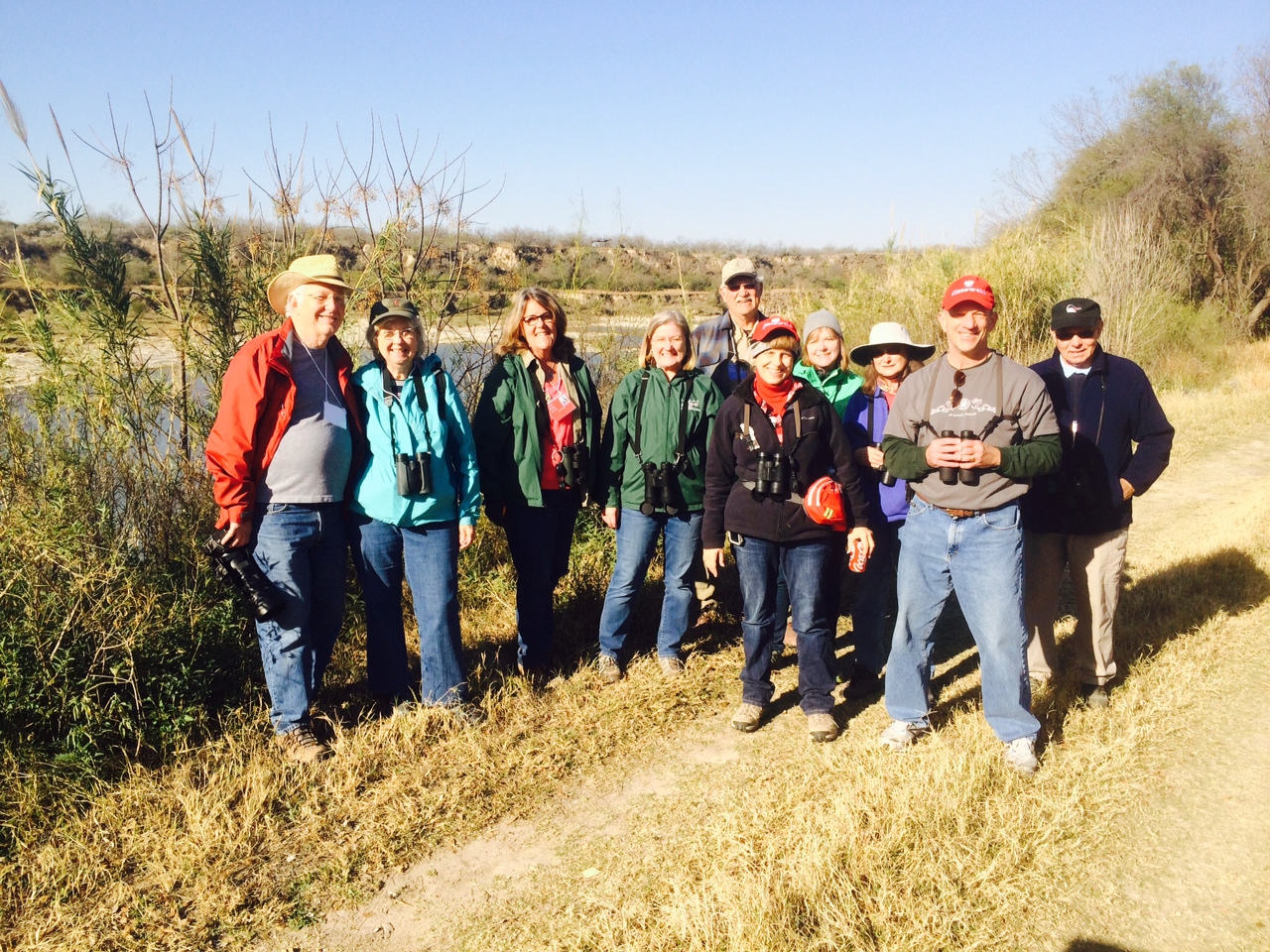
Yee haw!!! Greetings from Texas! Well sort of. I am actually back in LA after spending Wednesday through Saturday of last week in Southern Texas at the Laredo Birding Festival (LBF). This was only my second true birding festival, but boy was it a good one! The little brother of the much larger and well-known Lower Rio Grande Valley Birding Festival (LRGVBF), the LBF provides an equally good opportunity for participants to view many of the South Texas specialty birds including kingfishers, orioles, flycatchers, and jays. This year, the LBF was limited to 110 participants, almost all of which stayed at the fantastic La Posada Hotel. This made for a very intimate experience as field trips included a maximum of just 10 participants. I presented a lecture on the second night of the event, and I functioned as a birding guide for each of the three days. In short, I had a blast. The weather was perfect, the birds plentiful, White-collared Seedeaters generally cooperative, and the attendees enthusiastic. For those folks thinking about a trip to Texas, the LBF might be the perfect opportunity when it rolls around again next February!

La Posada courtyard

Birders at Salineno

Birders at private ranch north of Laredo

Here is the log book from Salineno. I last visited Nov. 24, 2014
during my bicycle Big Year in 2014!  It is organized by state, hence
everyone on this page was from MA. This time I signed the CA page.

One interesting fact about Texas is that only 2-4% of the total land area (depending on who you ask) is held by the state or federal government. Stated another way, roughly 97% of the land in Texas is privately owned. This means that it is critical for conservation entities to liaise with local landowners if anything is to be accomplished. The LBF itself works closely with local ranchers to secure access  to private land that is otherwise restricted, and it is this access that really makes the festival special. Much of the land I birded is open only during the festival, and I felt quite privileged to have been able to bird many of the amazing ranches surrounding Laredo. Several of the cooperating ranchers even attended the closing dinner on Satuday night. Beyond the incredible company and birding, I think the LBF serves as a model for how birding entities should interact with the communities in which they operate. 

Closing dinner. I was the "churro assassin", consuming
at least 8 of the sugary treats on top of an equally absurd
number of tostadas.

The closing dinner was held in a local arts center. Local school children contributed all of the artwork you can see in the photo, and festival organizers, local artists, and members of the city council were on hand to award prizes to particularly outstanding pieces. One point that was repeatedly hammered home was the economic impact of the festival on the community. I think that this is a consideration often ignored by birders, that is that our collective financial worth actually matters to the communities that we visit. While I am not advocating the creation of a "birding lobby" it would be very interesting if birders found a way to throw their collective weight around more than we currently do. Birding is one of the most popular hobbies in the country, and our contribution to local economies is many instances is significant. National organizations like the Audubon Society certainly carry come amount of clout, but even I as a seasoned birder feel disconnected from most of them. Maybe at some future point I will ponder how might we birders might better nucleate to effect changes that benefit both birds and the communities connected to them. 

I'll leave you with the best photo that I grabbed during the festival. Most of my time was focused on making sure attendees got their target birds, but I did grab a few seconds to myself to grab this frame!

Altamira Oriole - Icterus gularis
Canon 400mm f/5.6 on EOS 7D2
1/2500 at f/5.6, ISO 800

Wednesday, February 3, 2016

Post #53 - Birding? Cancelled! The interply of aesthetics and apertures in bird photography....

First, the Ignite Channel put together a nice piece about my 2014 adventure. Please give it a click and take a look, before or after your usual Speckled Hatchback fix. Now, on with the usual nonsense, errrr show, umm, whatever!

You know that feeling when the universe feels as though it is actively conspiring to stop you from doing whatever it that you want to do? Yeah, that was this past weekend. Originally forecast as crystal clear, Saturday morning was cloudy. This crushed any hope of quality photography. Light rain in the afternoon forced additional route and strategy alterations, but the worst was still to come. Transiting along the Pacific Coast Highway between Newport and Huntington Beach, our admittedly already testy car decided right then would be the perfect place to die completely! We coasted into a roadside parking lot from where Triple-A was called, a tow truck summoned, and birding, like our car, declared dead-on arrival. We had "Petra" towed to out usual shop where she would stay for the rest for Sunday and Monday. Heavy rain Sunday would have effectively crushed birding even if Petra had been functional, so yeah, like I said, birding seemed doomed from the start. I guess its tough to get too upset about rain anywhere in California, these days, right?


Birding fail! (note rain)
 

This is how Saturday felt....

So, in lieu of fanciful birding tales from the weekend, I'll flip into photo mode for a short while. Photographers often use the term "bokeh" to describe how a lens or particular lens settings render out of focus points of light and, by proxy, structures. What do I mean by this? Here is a photo of a Ring-necked Duck that I took a few weeks ago and have held off sharing until a slow birding cycle!

Ring-necked Duck - Aythya collaris
Orange County, California
Canon 500mm f/4 IS on EOS 7D2
1/3200 at f/4, ISO 400

The bokeh here is the blurred water both in front of and behind the subject duck. It helps to frame the subject and to smooth out what could be potentially distracting elements in both the foreground and background. In this particular shot, I have strengthened the effect by taking a very low perspective on the subject. This leaves only a thin focal plane through which the subject in swimming; The rest of the image is a blur, or bokeh.

Photographers generally manipulate two parameters to obtain to correct exposure and artistic rendering in a photograph: aperture and shutter speed. Aperture is the size of the hole through which the light is focused onto the sensor, and shutter speed is the time that the hole is open. Bird photography is generally done at very wide apertures so as to freeze, without motion blur, whatever action in being captured. Luckily for me and my particular shooting style, wide apertures are generally the best at producing bokeh as they render out-of-plane light and structures more strongly out of focus or blurred. One thing to note is that large apertures are designated by smaller f-stop (f/) numbers; Hence f/2.8 lets in more light and creates more out-of-focus blur than f/8. 

Aperture range of a standard lens. Moving 1-stop either
halves or doubles the amount of light the hole lets in.

 Larger apertures (small f/) produce better background blur

Every photographer has a different style. I personally really like strong bokeh as it helps, in my opinion, to focus the viewer's directly attention on the subject. For those that prefer including more habitat, they generally close the lens down a bit so as to get more depth of field on the surroundings. While I sometimes like that style, it is tough to argue with beautifully blurred backgrounds! Here is one of my old photos that I particular like!

Pectoral Sandpiper
Canon 500mm f/4 IS on Canon 1D Mark IV
1/3200 at f/4 ISO 400

Tuesday, January 26, 2016

Post #52 - Play that funky music, white bird!

So....this bird has been hanging around Orange County for the past few weeks. I first observed it at Mile Square Park two weeks ago, and I more recently ran into it again at Carl Thornton Park. It was fairly approachable the second time, letting me get close enough to snap this photo with just a 50mm lens!

Mystery goose!

What on earth is this bird? It lacks the black wing primaries of a Snow Goose, as it does the characteristic black grin patch on the bill of that species. This birds legs and bill are also orange, not the pinkish we would expect on a Snow Goose. So, we can probably rule that species out, as we can the smaller but fairly similar Ross's Goose. Maybe this bird is some sort of domestic fowl, a genetic amalgamation many generations removed from anything either pure bred or completely wild. Actually, it is a genetic anomaly, but not of the domestic sort. Based on this shot, I (and many others who have seen the bird) surmised it is a leucistic Canada Goose! Guilt by association aside, the structure of the bird fits this diagnosis perfectly (see group shot below).


Hold on, wait a minute. What does leucistic mean? And how is it different from an albino? Well, albanism is a genetic condition that results from a defect in the production of melanin. Melanin is a pigment that is expressed in pigment cells in the hair and skin (from which feathers originate) as well in the retinal cells of the eyes. It is the lack of melanin in retinal cells that causes the characteristic pink-eyed phenotype. Importantly, the normal pigment cells are present, but they are defective in melanin production. The pigment cells in the hair and skin are still fully capable of producing other pigment types, so albinos can sometimes appear yellowish due to the normal production of these other pigments.

Leucism, on the similar but other hand, results from a lack of the pigment cells themselves. This means that little to no pigment is produced in the hair or skin of leucistic individuals. The eyes aren't affected in leucism as the retinal cells are present and still capable of producing melanin. Make sense? Maybe? Even as a seasoned geneticist, I have difficultly with this! I am willing to bet that loyal blog reader Greg B will have something to say about this. Hopefully he can clarify anything that is confusing. Be sure to check in on the comments section at a later date to see if he chimes in!


Over the years I have seen many partially leucistic birds. Though the above goose is a great example of the condition, this Piping Plover that I photographed on Plum Island, Massachusetts a few years back is the single best example of leucism I have seen! 


I first observed this bird as it flew in off the ocean. As it wheeled towards the beach, I almost soiled myself. I though I had found something of the 1st-North-American-record sort. I was going to be a MassBird legend! Once it landed,  I realized that I was looking at genetic rather than geograpahic rarity. In some respects, this individual is as rare as it gets, inside or outside the bird's normal range. I was stoked to grab a few nice shots of the little guy before he resumed his oceanic trajectory. One for the archives for sure!

Tuesday, January 19, 2016

Post #51 - Impromptu pelagic, will the ABA Big Year record fall this year?

As fate would have it, a last minute cancelation afforded me the last spot on the Sea and Sage Audubon Society winter pelagic trip out of Dana Point this past Saturday. As I hadn't been offshore in the last few months, and ever from Orange County, I figured the trip would be a nice day on the usually calm waters of Southern California. The day went precisely as I expected. We hit pockets of birds here and there, and we managed to run up a list of pelagic species that included Pomarine Jaeger, Northern Fulmar, Pink-footed Shearwater, Black-vented Shearwater, Cassin's Auklet, Common Murre, and Brown Booby (once rare, now expected on SoCal pelagics). All of these were Orange County birds for me, as were near shore species Brandt's Cormorant, Black Oystercatcher, Pacific Loon, and Black Turnstone. Most of the birds were distant or poorly lit, but I did, after many West Coast pelagics, finally get a few really good shots of Black-vented Shearwater!


Black-vented Shearwater - Puffinus opisthomelas
Canon 500mm f/4 IS on EOS 7D2
1/4000 at f/5.6, ISO 800


Black-vented Shearwater is a generally warm water shearwater that has recently become more common in California. As recurring El Nino events have moved warm water up the California Coast in the last few years, this species has correspondingly spread northward. Named for their black undertail, or vent, they are the smallest of the expected Pacific shearwaters. They are relatively compact and fly with stiff, fast wingbeats. They can be seen from shore and are generally a good bird for beginners to learn before they graduate to separating/identifying rarer Pacific species like Manx Shearwater. Anyway, it was nice to grab a few nice frames of these speedy little guys.

I will admit that I really love this county listing thing, particularly as Orange is so convenient to and small compared to other California counties. What Orange lacks in photographic opportunities, it certainly makes up for with bird diversity. Now-friend Jeff Bray found 329 ABA countable species in Orange County last year to equal the record OC Big Year effort made by also now-friend Tom Ford-Hutchinson in 2013. That's some serious, close to home birding for both of those OC residents!


Some ugly dude, Jeff Bray, OC resident Sharon Harrow 

Anyway, one of the things I love about pelagic trips is the social component. On any pelagic trip there are going to be birdless stretches during which the focus shifts to socializing. This really helps to break up what can otherwise be a long day on the water. Bird stories are predictably swapped, and usually there are at least a few laughs had. On really slow trips each person can take solace in knowing he or she wasn't the only one who ventured forth on that particularly unproductive day. So go pelagics; For every amazing trip there are going to be a few duds from which there is no escape other than a long swim home. Luckily, this wasn't one of them.


On any pelagic, I can be found at the stern....

Also on board the boat was Minnesota resident Olaf Danielson, 2016 Big Year birder extraordinaire! In just the first 3 weeks of the year, Olaf has amassed roughly 350 bird species. To put that into perspective, Neil Hayward, who set the ABA Big Year Record with 749 species in 2013, did not find 350 species until late March! Neil dubbed his year The Accidental Big Year to reflect the fact that he kind of fell into it by chance. Once he got going though there was not stopping him! It will be very interesting to see how Olaf's year unfolds. I simply cannot imagine given the birds he has found already, he won't make a serious run at Neil's record. Olaf is a very interesting character, and I encourage you to visit his blog to see exactly what I mean! 

Olaf D and Tom Ford-Hutchinson

OK, that's it for this installment. Hopefully I'll run into at least a few of you on a pelagic in the near future!

Monday, January 11, 2016

Post #50 - Unscrambling scrambled eggs....

Woo Hoo! First post of 2016, yet another Big Year for me! Just joking, I'm still recovering from the last one! Let's get year 2 kicked off in style. Please do share this blog with anyone and everyone you think might find all this bird-craziness at all interesting or entertaining. The more the merrier, right? I am going to try to update it each Tuesday, but some of that will be dependent on my ability to get out birding/photographing to generate content. Easier said than done working a a 60/hr a week job and writing a book on the side! 

A few weeks ago, in South Texas, I photographed this presumed Gadwall-Pintail hybrid. Last week I stumbled across a Pintail-Mallard hybrid here in Southern California. Sadly, I did not have my camera with me so you'll have to use your imagination for that one...

Presumed Northern Pintail x Gadwall hybrid

Anyway, the Mallard-Pintail from last week really got me thinking. I realized that I have photographed a few other hybrids in the last few years. I'll share these photos with you and we can together try to sort out who came from who. Sound good? Let's start with this odd oriole. This bird was photographed in Arizona (Portal) in May of 2014 during my bicycle Big Year. 

Hybrid oriole

The first thing that jumps out about this bird is the facial pattern. Bullock's Oriole would have a generally orange face with a black eyeline. This bird has more black than would be expected on the face of that western species, but not a full black hood like that of the more eastern Baltimore Oriole. The facial pattern thus seems intermediate between the two species. So does the wing pattern, with the coverts showing more white than a Baltimore but not the extent of the Bullock's. So far as I can discern, this is a Bullock's x Baltimore hybrid. I am sure that there are some other, subtler nuances that better birders might be able to glean from the photo, but I feel that between these two, generally easy-to-see-and-discuss field marks, there won't be too many fights about this identification. 

Next up is an interesting shorebird that I photographed on Plum Island in September of 2013. The images are heavily cropped and the lighting was beyond terrible, but we can start to deconstruct the genetics that possibly produced this rarest of rare birds.

Hybrid sandpiper

I nearly wet myself when I first laid eyes on this bird. It was initially spotted by Massachusetts birder Suzanne Sullivan as it flew in to join a group of several hundred similarly sized shorebirds. She immediately pointed it out to me, and we both realized that we were looking at something incredibly rare. Mentally running through the possibilities, we quickly realized it was a hybrid of some sort. I was able, with much maneuvering in the mud, to obtain at least one other decent shot of it. The bird on the left is a White-rumped Sandpiper (WRSA) and will provide a starting point for our dissection.

White-rumped Sandpiper (L) and presumed hybrid sandpiper (R)

Our mystery bird is about the size of the WRSA. It has remarkably generally similar shape and wings that reach the tip of the tail. Though it is not easy to see in this photo, the first photo shows the bill to be both longer and more decurved than a pure-bred WRSA. Its bill shape is actually more suggestive of a Dunlin than anything else. The streaked flanks and breast are also suggestive of WRSA, but rufous color on the back and head are all wrong for that species. Here again, the bird resembles, a Dunlin. Dunlin do not normally have rufous heads, but the head pattern at least resembles WRSA. So, without being able to obtain a feather for DNA analysis to confirm my speculation, the phenotype suggests that our mystery bird might in fact be a White-rumped Sandpiper - Dunlin, a "Rumplin" as some have dubbed the intergrade. Whatever it was it was certainly very exciting when in appeared!

Last is this presumed hybrid warbler several of us found and photographed in Ventura, California in October of 2013. It was in a huge feeding flock comprised mainly of Yellow-rumped Warblers and Townsend's Warblers. 

Hybrid warbler

Without a good look at the face, this bird could easily be passed off as yet another Yellow-rumped Warbler among the hoards with which it was associating; It has a generally gray-brown back, faint streaks on a dusky breast, and a yellow rump, all general features of winter plumage Yellow-rumps. However, with a good face view, pure-bred Yellow-rumped Warbler seems highly unlikely. The main thing that jumps out is the broad supercillium above the eye. This feature, to me, is strongly suggestive of 2 eastern species, Blackburnian Warbler and Cerulean Warbler. This bird does have 2 white wing bars which is consistent with both of those species, but the generally gray color isn't right for either. The back is unstreaked, a feature of Cerulean. The problem is that that feature could have come from the other parent, so it doesn't allow us to firmly conclude much. So, while I am far from certain about anything on this bird, it seems that it could be a Yellow-rump x Cerulean or a Yellow-rump x Blackburnian hybrid warbler. I guess it is also possible that one parent of this bird was a hybrid that mated with a pure bred species. Who knows?!?!? I welcome any input anyone has on any of these birds. 

I personally find hybrids to be loads of fun. There are obviously incredibly rare, and they usually stimulate at least some identification debates in the birdosphere. I like to keep the discussions fairly general; I'm not into dissecting every single individual feather. I mean, were never going to know for sure, right? If I find any more in the future, you can bet they will appear here!