Tuesday, October 13, 2015

Post #40 - Some thoughts on our connections to the natural world

I am a biologist, not in the casual sense, but professionally. In the past 20 years, I have spent time designing and performing experiments to further our understanding of neuronal differentiation, molecular embryology, cell polarity, tissue morphogenesis, synaptic plasticity, small RNA biogenesis, and a host of other fancy-sounding fields that neither of my parents understand. The goal of my collective work, in the end, is to understand how our bodies and those of the other living things around us function at the cellular level. This basic biological knowledge, when applied by others to disease states, has the power to alleviate human suffering in many capacities. When reductionist work such as mine is coupled with the top-down approach employed by organismal and evolutionary biologists, a still more complete biological picture emerges. Beyond an understanding of our own intrinsic biology, we realize that we are actually just a single, though incredibly important and often destructive, player in a carefully coordinated biological dance that has been occurring at the planetary level for hundreds of millions of years.


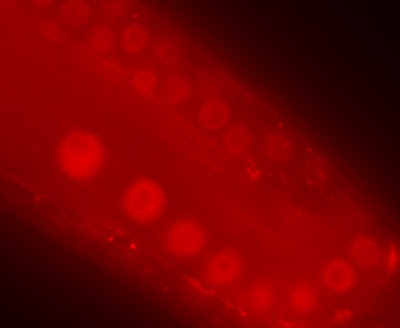
A particular protein I study fused with a red
fluorescent protein in the C. elegans germline.
The protein localizes to the nucleus of the cell. 

I use this as a backdrop to explain and to explore an experience and series of thoughts I had today. Today is Tuesday, and like most, I find myself in my lab at USC. This morning I was analyzing some DNA sequence data. As per usual, I put some music on my headphones so as to block out any other distraction while I focused on the task at hand. Staring at the biological code as depicted in my sequence data, the seemingly endless quaternary code of nucleic acid bases that defines and dictates much of our biological existence, I caught my own reflection in the screen. Hands extended towards the computer keyboard, headphones upon my head, digital music formed by little more than 1's and 0's playing in my ears, I suddenly felt incredibly detached from biology, the same biology that I have dedicated my life to understanding. For a split second, I felt more a part of the machines to which I was connected than to my own biology, to my own being.


Lesser Goldfinch on Primrose
Apropos of more organismal approaches to biology
Canon 500mm f/4 IS on EOS 7D2
1/4000 AT F/5.6, ISO 800

Beyond a terrifying but altogether temporary experience, I think this sort of moment reinforces precisely why it is important that we maintain some form of connection to the natural world around us. Time with nature and the natural world's constituent organisms - both macro- and microscopic - reinforces the connection that we have to them, a connection that is sadly being lost as the sphere of human influence expands to previously undisturbed regions of the globe. In the digital age, not much of what we touch, see, hear, or generally experience has escaped the heavy hand of human design or manipulation. I am reminded that the time when I am the absolute happiest is when I am in some natural place simply looking at birds. Beyond photographic subjects and ticks on life lists, birds provide one of the most common reminders of the natural world that exists beyond the confines of our usually human-centric horizons. I know that when things in my own life seem their most tumultuous, I recenter myself by retreating into decidedly more natural spaces to sort myself out. Maybe today's brief episode is a reminder that I owe it to myself to do just this every once in a while. Biology is everywhere - inside AND outside the lab.

Monday, October 5, 2015

Post #39 - Interesting snowy egret behavior w/ PHOTOS! Plus herons doing cool stuff!

Two weeks ago I visited one of my "local" spots, Malibu Lagoon. I say "local" since there is zero true local birding where I live (see below). Anyway, on that particular visit, I spent quite a bit of time photographing Snowy Egrets. Beautiful, but sometime overlooked by birders seeking for rarer species, they are incredibly skilled fisherman. They generally hunt by stalking prey in shallow water, relying mainly on patience and lightning fast reflexes to catch prey that swims past them. All birders are familiar with a motionless Snowy Egret, a seemingly spring loaded-neck ready to extend the moment a fish approaches. It's basically industry standard for most waders.


I live at the red dot, smack in the middle of endless sprawl. 
Malibu is the small peninsula at upper left, 41 miles from home
The sprawl goes upwards of 50 miles in some directions.

On my last visit to the lagoon (Sept 20), I witnessed a foraging behavior that I had not before seen. On that day there seemed to be an ever-shifting throng of small fishes at water's surface. However, these fish consistently stayed well-clear of the shore and the half dozen hungry Snowies that lined it. Growing impatient, the birds took to the air to pursue the prey. Flying as slowly as possible, the egrets hovered above the water while they did their best to snatch fish from water's surface. The weren't truly hovering, more like awkwardly flapping as they tried to find a balance between directed forward flight and stalling completely. After a while I realized there was a periodicity to the behavior, and I set up shop to try to photograph it. Though not up to my normal technical standards, here is a series of shots of one bird that shows the behavior really well!


Target acquired


The plunge


Whiplash


Recovery


Meal time

The shots above were taken once the sun was higher than ideal. I also managed a number of nice single shots from earlier the morning when the light was a bit better.


Snowy Egret fishing "on the wing"
Canon 500mm f/4 IS on EOS 7D2
1/6400 at f/7.1, ISO 400

Snowy Egret slowly cruising over water's surface in search of fish
Canon 500mm f/4 IS on EOS 7D2
1/6400 at f/7.1, ISO 400

Sprinting after prey in the shallows
Canon 500mm f/4 IS on EOS 7D2
1/6400 at f/7.1, ISO 400

Lastly, here is probably the most unique shot I got all morning. How this bird didn't end up in the drink I have no idea. Light was rough as it was late, but its still a keeper.


Here are two particular videos that showcase other clever foraging behaviors. Both are pretty amazing, so take the few minuets to check them out. You won't be disappointed!

Here a Green Heron used bread as bait to attract fish......

and a Black Egret creates shade to attract fish.

Hopefully you have a new appreciated for how clever waders can be. See if you can find a common bird doing something different next time you are in the field!

Monday, September 28, 2015

Post #38 - Monterey seabirding, lifers! Honeycreeper news too!

First a quick note, I have fallen into a nice rhythm of updating this blog on Monday or Tuesday, so please make a mental note to check in early each week! Also, it would really mean a lot to me if you would consider "liking" The Speckled Hatchback on Facebook (click "like" button on the bird's shoulder after linking to page). Not only do I use it to disseminate relevant information, but (believe it or not) it will really help me when I finally try to publish my book about last year. Having folks who read the content I generate tells publishers there is at least some market for whatever I produce! OK, with that out of the way.......

This weekend I made my annual fall pilgrimage to Monterey, California for several days of sea birding with pelagic guru and close personal friend Debi Shearwater of Shearwater Journeys. Last year, during my petroleum-free bicycle Big Year, I wasn't able to do any pelagic birding beyond that which I could do from shore. I was certainly excited to get back onto the water this year!


Out on the wate-r-r-r-r-r-r-r-r!

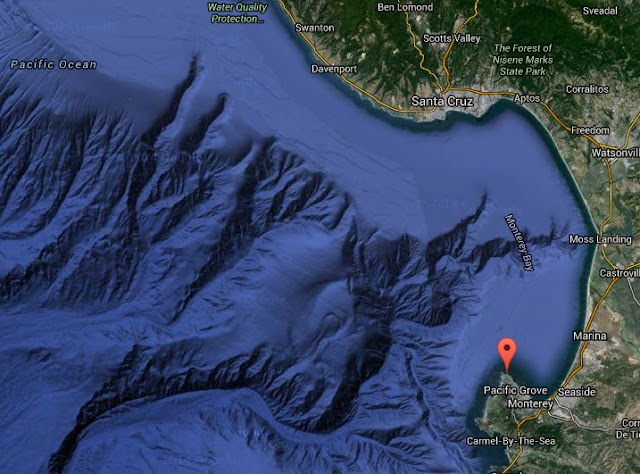
Monterey Bay is the premier sea birding destination in North America, and, with 3 trips scheduled on 3 consecutive days, I hoped to tap into both the resident and potentially rare seabirds the bay has to offer. For those that have not visited the region before, I offer the following map. What you see here is the huge submarine canyon that lies beneath the surface of Monterey Bay. In a matter of a few miles, the sea floor drops from 100 to 1000 fathoms. Recall a fathom is 6 feet. That means the ocean is well over a mile deep at some points. That's deeper than the Grand Canyon! Nutrient upwellings along these step, underwater canyon walls attract little fish, bigger fish, and, in turn, marine mammals and pelagic birds. It was here that we headed on each of my trips this past weekend.


Monterey Seavalley

One thing that I think people generally fail to realize it exactly how dynamic the ocean is. My three trips, again on 3 consecutive days, were completely different though we generally visited the same general areas on each day, the section of the canyon directly northwest of the pin I have placed at Point Pinos. As is often the case with pelagic birding, we were at the mercy of the wind on each day. The first day was very blustery, blowing at 15-20 knots (A knot is a nautical mile per hour. A nautical mile is 1.15 standard miles). As a result we did not spend as much time as we had hoped in the deeper water. We did manage Sooty, Black-vented, and Pink-footed Shearwaters, all 3 Jaegers, Northern Fulmar, Black-footed Albatross, Black and Ashy Storm-petrels, and Red and Red-necked Phalaropes. The highlight of the day was the Humpback whale show in the inner bay (near Moss Landing). Upwards of 40 whales were feeding on huge schools of anchovies! It was very impressive! We also observed a Loggerhead Turtle, an apparently rare sight this far north the Pacific Coast. We also found a school of well over 1,000 Commn Dolphins. Photography on this day was virtually impossible, but I did manage a few shots before it got too bumpy.

Heermann's Gull - winter plumage adult

Black-vented Shearwater

The wind on Saturday, my second trip, cooperated a bit more. As a result we were able to spend a bit more time in the deeper water. Species were fairly similar to the first day with the notable additions of Manx shearwater, Buller's shearwater, Flesh-footed Shearwater (seen only at a great distance), and Least Storm-petrel (missed by me, ugh!). The whale show was even more impressive than the previous day with 50+ giants feeding all around the boat. At one point a group of actively feeding whales surfaced 35 feet from the boat. I was too busy yakking with Debi and did not have my camera ready - @#$%^&!

Black-footed Albatross

Black-footed Albatross

Pacific Golden-plover, back on shore after trip 2
So easy this year and so difficult last!

Day 3 was the most interesting of the bunch. The wind and seas were calm, but we had fog on and off throughout the morning. We fought through some bird thin times early in the day to find some very large Storm-petrel rafts later in the afternoon. Formerly common in Monterey Bay, Storm-petrel flocks of any size have been virtually absent for the past 2-3 years, possibly due to the warmer than usual waters associated with the current El NiƱo. Amidst hundreds of Ashy Storm-petrels, we found dozens of Blacks and a few Wilson's. Most notably, we found a single, silvery Fork-tailed Storm-petrel and several Least Storm-Petrels in with the others. These last two represented life birds for me and were cause for great excitement! As I was focused on observing the fast moving little lifers, I did not even bother with photos; I wanted to make sure I got countable looks before they vanished! 

Northern Fulmar

Northern Fulmar showing primary molt

The Storm-petrels represented ABA birds 696 and 697 for me. In related news, the Red-legged Honeycreeper I observed on Thanksgiving of last year was accepted (9-0) by the Texas Bird Records Committee! You can read more info on that here. If the ABA follows suit, I'll be able to add that bird at some point. The jury is still out on the potential ABA 1st Gray Thrasher I observed in San Diego a few months back. I assume I'll lose Hoary Redpoll as a lump with Common Redpoll at some point, but I'm knocking at 700 ABA species any way you cut it! Right now of my 697, 695 come from the lower 48 and 2 are from Canada. I have not yet birded Alaska. Maybe some day.....

Anyway, enough of the listing stuff for now. The whole weekend was fantastic. Sonia joined me on the  3rd of the 3 trips. She and Debi really hit it off. They had a good time giving me crap in between birds. For those that haven't met Debi, she's worth the price of admission on her own. If you ever make it to Monterey Bay, particularly in the fall, you should seriously consider taking a trip with her. It won't be dull, I promise!

Leaving the dock on Day 3

Fun with Debi and Sonia


Sunday, September 20, 2015

Post #37 - Birding in Sweden, Part 2 of 2

As promised in the previous post, this edition will delve into the specific places I birded and the species I saw during the big Sweden trip - Let's get right to it! My trip started out in the southwest corner of the country at Falsterbo, a birding hot spot that I can most easily compare to Cape May, New Jersey (but take away all the people, houses, etc). Like Cape May, the peninsula funnels birds, most notably raptors, down a narrow strip of land before they are forced to cross a large body of water, the Delaware Bay in the case of Cape May and the south end of the Baltic Sea in the case of Falsterbo.

Falsterbo is the red pin

A more detailed view of Falsterbo

Despite generally crappy weather during my 2 day stay, I observed dozens of Honey Buzzards, Eurasian Sparrowhawks, and Eurasian Kestrels. Marsh Harriers and Hen Harriers were also present. Shorebirds included European Golden-plover, Common Snipe, Eurasian Curlew, Northern Lapwing, Common Ringed-plover, and Common Redshank; Garganey, Eurasian Wigeon, and Barnacle Goose rounded out the waterfowl. On the landbird front, swallows, swifts, tits, and wagtails were all in great abundance. For those thinking about visiting Falsterbo, you might want to coordinate your visit around the annual Falsterbo Bird Show in the fall. This 4-day event draws thousands of birders from all over Sweden (and beyond!), and a temporarily erected tent city houses information kiosks, optics and photography demonstrations, information on relevant conservation organizations, bird related art, and much more. I should here insert that almost everyone here speaks near perfect English; There is effectively zero language barrier. It was at this festival that I gave a talk (in English) about my bike trip to a large group of very attentive Swedish birders.

Bird show tents at Falsterbo

More bird show tents

Who, who, who, who let the dogs out?
More like, who, who, who, who let the owls out!  *cue rimshot*

Path at Skanƶr, a few miles north of Falsterbo.
Gathering rain clouds evident.....

Cows at Skanƶr

A few clear skies at Skanƶr

After departing Falsterbo/Skanor, I headed north towards Gothenburg for my next lecture. As I was driven on this leg by a local birder, we made a quick birding stop at Getterƶn Natural Reserve just south of Gothenburg. The stop was brief, but might have been my favorite of the entire trip. Though we only had half an hour, we observed hundreds of Graylag and Barnacle Geese, several dozen Common Cranes, and a lone White-tailed Eagle. However, shorebirds were the clear the stars of the visit. Eurasian Oystercatcher, Northern Lapwing, Common Ringed-plover, Common Sandpiper, Spotted Redshank, Common Greenshank, Wood Sandpiper, Ruff, Eurasian Curlew, Bar-tailed Godwit, Broad-billed Sandpiper, and Curlew Sandpiper were all present. It was a great opportunity to observe/study these species in their native lands as most of them they stray to North America at rare points (those italicized species are ones I personally have on my ABA list!). Birding around Gothenburg the following day I found Common Pochard, Tufted Duck, Little Grebe, Eurasian Skylark, Northern Wheatear, and Meadow Pipit, among others.

My third lecture was in Linkƶping (Lin-CHO-ping), east of Gothenburg. I managed a fair amount of birding between my various commitments that spanned 3 days. Birding in rural areas just outside of town I found Great spotted Woodpecker (very common but my favorite bird of the trip!), Lesser spotted Woodpecker, Eurasian Nuthatch, Eurasian Blackcap, and Fieldfare. The highlight of the inland leg of my trip was certainly my visit to TƄrkern, a large inland lake/marsh with thousands of waterbirds. In addition to more cranes, geese, and ducks, I added Bearded Reedling, a specialty bird of the preserve. More common species included Long-tailed Tit, Reed bunting, Eurasian Reed-Warbler, Yellowhammer, Eurasian Sisken, and Linnet.

Entrance!

Early morning view from observation platform

Me with the frog prince

Me, my hostess Terese, and Linkƶpink visit
coordinator Kjell

Linkƶping center

The next stop on my tour was the island of Ɩland in the southeast corner of the country. Ɩland is a bit similar to Falsterbo though even more rustic. Most of the action occurs at the south end of the island, at the lighthouse in Ottenby. I spent two full days on the southern half of the island. During this time I observed thousands of waterfowl and cormorants. New species on the first day included Horned Grebe, Red-breasted Merganser, and Common Merganser, European Pied Flycatcher, Lesser Whitethroat, Eurasian Wren, Parasitic Jaeger, Red-backed shrike, and Eurasian Hobby. The sure highlight was the appearance of 5 European Bee-eaters as were standing on the observation tower. A group of them actually nested in the area, but were presumed to have migrated as no one had seen them in a full two weeks. They were certainly striking; Unfortunately, they never came within 75 years of us, so photos were out of the question (basically the same story for all the birds I saw). The scenery around Ɩland was fantastic! There is a very active birding community on the island, and it appears to be the retirement destination of choice for Swedish birders. Anders, my host and high-up in Birdlife Sweden, moved to Ɩland with just that plan in mind.

View from observation tower

Rocky shoreline

BAAAAAHHH! Sheep everywhere

Ottenby lighhouse

Boat

Other birds observed around Ɩland during my stay included Arctic Loon, Common scoter, Eurasian Dotterel, Arctic Tern, Merlin, Stock Dove, Rock pipit, Coal tit, Marsh tit, Song Thrush, Mistle Thrush, and Greenfinch. Speaking of green, favorite bird of this part of the trip was the Green Woodpecker we saw feeding on a neighborhood lawn. I have looked for this bird many times in the UK but missed it on each occasion. Finally seeing this incredible bird was a nice cap on my time on the island. 

I returned to Falsterbo for one final day before departing. On that day, I managed 2 Black-tailed Godwits between yet further bouts of wind and rain. Apparently the weather this summer and fall has been terrible; My 3 rainy days split over 2 weekends at Falsterbo certainly confirmed this. The weather during the intervening week was great, so I did get a break from the gales and the gloom the weekends brought. 

On the whole the trip was fantastic. Though dodgy at times, the weather generally cooperated, and I spent many hours birding some truly beautiful areas. I will certainly return at some point, likely in the summer when I an photograph birds nesting on the tundra. If anyone is thinking about a Sweden birding trip, please feel free to contact me with any questions. I'll do my best to answer them or, if I can't, point you in the direction of someone who can!

Swedish Pancakes, just because......


Saturday, September 12, 2015

Post #36 - Birding in Sweden, Part 1 of 2

Sorry for the extended intermission, but I am just now returning from 10 full days of lecturing and birding in Sweden. The trip actually materialized as a direct result of my Biking for Birds project last year. My blog was apparently quite popular in environmentally-aware Sweden, and, as a result, I was this year invited to visit the country and give a series of lectures about my eco-adventure. I was very much looking forward to this international opportunity, and I can say unequivocally that the trip lived up to my expectations in every possible sense, except one. The birds, the scenery, and, most notably, the Swedes were amazing; As a side note, the photography was very disappointing (more on this soon). In this post I will try to provide an overview of the trip and my general impression of birding in Southern Sweden. In a subsequent post, I will describe more of the specific sites I birded and the species that I encountered. I hope that the two posts together will show that Sweden offers some truly fantastic birding!


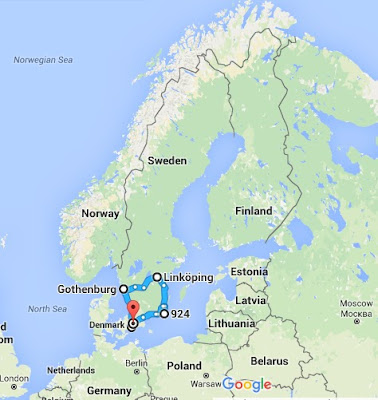
Wide view of my route

More detailed view of my route. 
I took trains and buses between these points.
I was hosted/escorted by local birders at each destination.

As you can see from the maps above, my visit was confined to the southern quarter of the country. My 9 full days gave me plenty of time to explore this geography. My route was planned around my lecture dates, and, as such, I am sure that a more bird-centric itinerary would easily better the 132 species I observed during my stay (I had another 10 'heard-only' or poorly seen that I did not formally count). I also had a few days of terrible, nearly unbirdable weather that cost me at least a few species. Here, I should be be very clear about 1 thing: trip lists from Sweden, like those from any high latitude, are never going to include comparatively huge numbers of species irrespective of how an itinerary is designed. Species density falls off as a function of distance from the equator, and Sweden is a LONG way from that reference point. With a modest 519 species on its cumulative list, Sweden hosts a mere moderate number of species. For comparison, Cameroon, an equatorial country of approximately the same size and at approximately the same longitude, hosts well over 900 species. Incidentally, equatorial Ecuador - granted a very different longitude - hosts nearly 1,700 species in an area just over half of that Sweden, but I digress. What made my time in Sweden so special was not the number of species but rather the circumstances under which I birded. 

My circumstances......

This is a view from one of the observations towers at Ottenby at the south end Ɩland, an island in the southeast corner of the country. Expansive coastal pastures separate the Baltic Sea to the east from ancient woodlands to my immediate west. Few, if any, signs of human interference (less the observation tower and the distant cows) are readily evident. The freeways, strip malls, loud picnics, military bases, traffic jams, helicopters, and skyscrapers that characterize my usual Southern California birding outings are notably absent from this idyllic scene. Birding under these decidedly more natural conditions was an incredibly welcome change and added an immeasurable amount of joy to the entire experience, an amount of joy that no species total - high or low - would ever influence. This, moreso than the accumulation of a lengthy species list, is what I call 'high quality birding'. 

More of my circumstances, this time at TƄrken east of Linkƶping

These circumstances as depicted certainly result from avoiding the most populous areas, notably the capital Stockholm (home to 2.2 million people). However, outside of Stockholm, the entire country is generally sparsely populated. The country has only 10 million inhabitants total, most of which are spread through small cities are rural areas. As a point of reference, Los Angeles County, where I live, is home to a similar 10 million people (as is New York City)! Gothenburg, the second largest city in Sweden, has just over half a million people; Only 8 cities have over 100,000 souls. The point is that Sweden is significantly less developed than either coast of the United States. In fact, much of the inland areas of the country where I spent my time country looks like the upper midwest with rolling hills, lakes, family farms, and mixed deciduous/coniferous forests. I guess its understandable that many Swedes and other Scandinavian folks settled in the Upper Midwest when they reached the New Word (hence the Minnesota Vikings!)


The comparatively small population means that it is completely possible to find wild, relatively undisturbed birding areas. However, this can be attributed to more than a small population as the Swedes are some of the most environmentally-aware people on the planet. Small homes and cars dominate, environmentally-sourced food is commonplace, and their recycling regiment puts that in United States to complete shame. All of this is impressive, but the fact that litter of any sort is effectively nonexistent might be the most impressive environmental feature of the country. The coastline here is free from the old tires, plastic bottles, fishing/crabbing paraphernalia, balloons, fast food waste, and other assorted and offensive crap that washes up along most of North America's coasts. It was a really refreshing change. 

Even the trash at McDonald's is sorted - wake up USA!

Lastly, I do want to comment on the photographic situation here in Southern Sweden. In short, it is virtually nonexistent. I did not take a single decent photo in my 10 days in the country - and I consider myself a very capable photographer. The big problem is that the birds are are UNBELIEVABLY skittish. Gulls in the states tolerate people strolling past them. Here they take off the moment you round a distant bend in the beach. Ducks and shorebirds fly off at distance at which North American birds wouldn't pay an observer any attention. I am not sure why the birds here behave this way, but at least some of it can be attributed to the bird hunting culture in Mediterranean Europe  (DO READ THIS!!!!) where anything with wings is fair game for hunting. Any species that migrates through that area has learned that humans equal death, and as such they keep their distance from people at all points in their global wanderings. Perhaps the photographic situation would change further north or during nesting season, but I wouldn't even bother brining a camera to Southern Sweden if you come for spring or fall migration. If all you want is record shots (and bad ones at that), fine, bring a camera. If you want actual photographs, then forget it. It then goes without saying that a decent scope here is absolutely indispensable

OK, that's it for this post. Next post I will give a more detailed itinerary with the actual birds that I saw in each place. I hope folks found this post informative!

Tuesday, September 1, 2015

Post #35 - Fall is here! What range maps don't show us, Whimbrel migration

I can't believe summer is winding down. It feel like just yesterday Sonia and I were moving into our new LA digs! Though it has taken a bit of time to adjust to car culture and the hoards of people EVERYWHERE, I think I have established some form of birding and photography pattern that will permit me to enjoy the influx of birds that fall migration will bring to Southern California. So, without too much more mucking around, let me tell you what I was thinking about this past week while birding out and about. 

Birders are well familiar with distribution or range maps. These graphics show generally where a particular species occurs at what time of year. Take for an example the range map for Whimbrel. 


From this, we can see that Whimbrels nest in the extreme northern latitudes and winter in more southerly locations, notably along the California Coast, Gulf Coast, and southern half of the Atlantic Seaboard. Clearly, the bird does not magically translocate from one end of the continent to the other; This is suggested by the yellow shading which roughly designates major migration routes and stopover points. This map effectively communicates what the population of Whimbrel is generally doing at various points in the year, but it does not do justice to the incredible feat that is Whimbrel migration. For this, we need to look at the migration traces of individual birds, and this is precisely what advances in bird tracking now permit us to do. Take for example this slice of tracking data from 4 particular Whimbrels.


From this we can see some representative migration routes. The routes shown here, particularly the nonstop, 4000-mile oceanic segments, do far more to inspire our awe than a traditional range map. Prior to obtaining these data, we might have mistakenly assumed that Whimbrel migrated to South America via Central America. This overland route might make sense to our land-based human sensibilities, but it appears as though at least some Whimbrel exercise an unexpected and lengthy oversea route to reach their South American winter destinations. Range maps certainly have utility in conveying where a particular species can be broadly found, but they less effectively communicate how the individual birds move between the regions as indicated on the range map. This is where tracking data will provide invaluable. Coupled with real time range maps as generated in eBird, we are likely to glean much new and interesting information about bird distribution, movement, and migrations. It should be very exciting!

Whimbrel - Numenius phaeopus
Malibu Lagoon, Los Angeles County, California, 8/9/15
Canon 500mm f/4 IS v1 + 1.4x III on EOS 7D2
1/2500 at f/5.6, ISO 800, Manual mode